Episode Transcript
[00:00:00] Speaker A: Foreign.
[00:00:10] Speaker B: Welcome back to the latest episode of Big City Catholics. I'm Deacon Kevin McCormick, and I have the privilege to be with Bishop Brennan. A real treat for me. We have a really busy time together here because there's a couple of big things that have just happened in the diocese last week, and we need to kind of work them through and to see where we're at. So, as we always do, let's begin with prayer, Remembering we're always in the presence of God as we begin. In the name of the Father and of the Son and of the Holy Spirit.
[00:00:34] Speaker C: Amen.
[00:00:35] Speaker B: Lord God, you have put us in this time, in this place to do your work. Help us to open our eyes to see the grace that abounds in everything we do. Help us to hold on to those things that are important, Lord, and give us the ability to let go of everything else. And we ask this in your name. Amen.
[00:00:51] Speaker C: Amen.
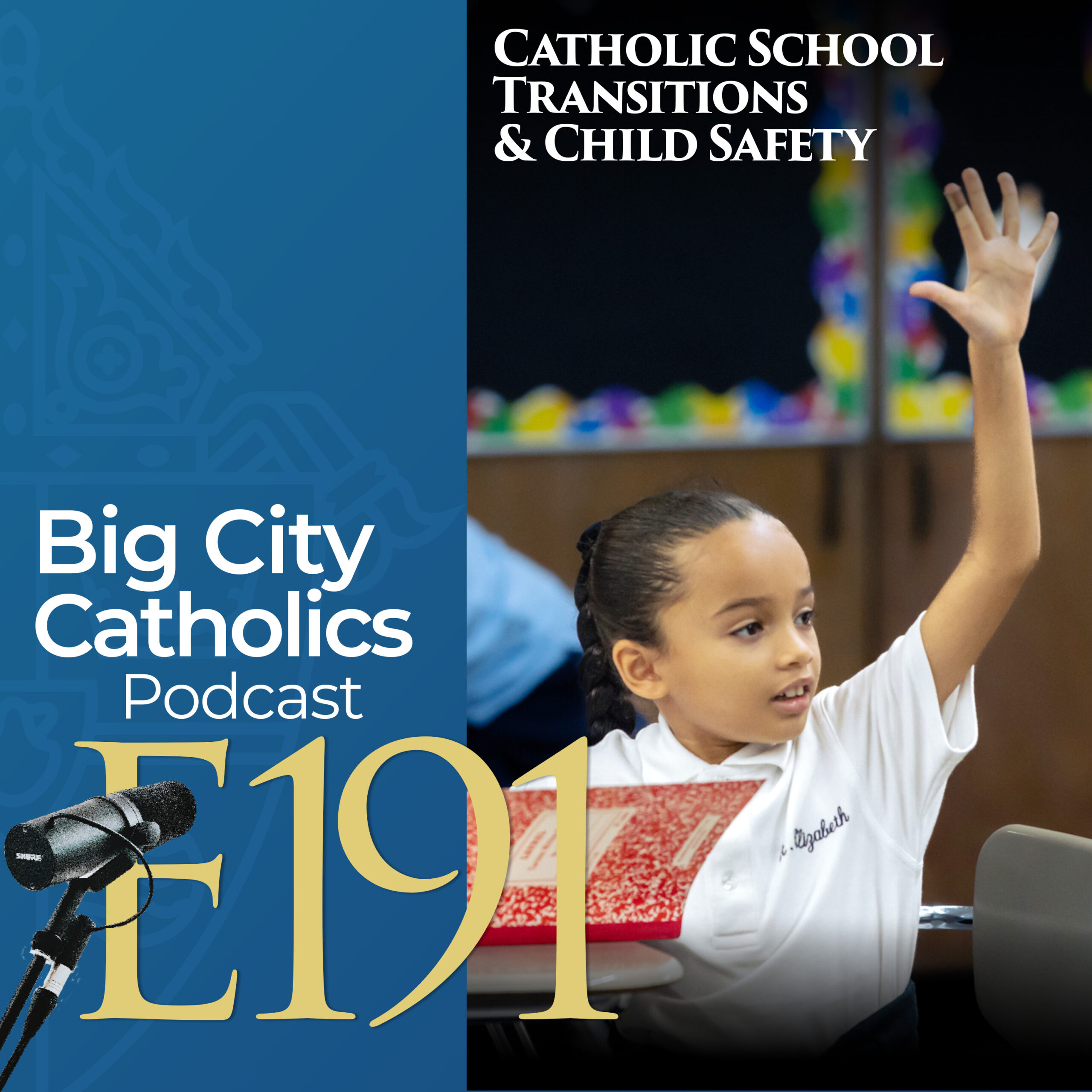
[00:00:52] Speaker B: So my world has been quite busy, and my world is your world. We had some rough news last week. We had to announce the closing of seven of our schools.
[00:00:59] Speaker C: Schools, yes. And, you know, when you hear that number, it really does shock us a little bit. You know, we hate to see the seven schools not being able to make it. But you've been working with the local boards for the better part of this year. It may come as a surprise to some people, but these are things that we had seen coming. Right.
[00:01:18] Speaker B: I started first grade in 1965, and since then, there's been a drop in the Catholic school population consistently over the last 60 years.
And that continues in our own day. When we begin to lose our population, then our bills go up because fixed costs don't change. And that becomes the tension that we're in. And we work very hard to make sure we can help schools to work through it. But when it becomes consistently in a deficit, it comes to a point where we can no longer help them. Bishop, I wish I could tell you that I had struggles in the classrooms. I had parents that didn't cooperate. I had principals that weren't very good. And all that's just not true.
We have outstanding parents who've sacrificed so their kids can be part of this. We have faculty members who have gone out of their way to take a cut and pay to do work in the mission of the Lord and our principals, every one of them outstanding women and men, and it just didn't work.
The good news is that everybody is going to be placed. We're working right now to prepare for meetings next week. Monday, Tuesday, Wednesday, and Thursday we'll be meeting with all of the schools that are closing, meeting with the parents, meeting with the faculty and helping them all be placed in September. So it's a busy time, it's a sorrowful time, but it also gives us an opportunity to kind of focus in on what's really important. Like we said in the prayer.
[00:02:36] Speaker C: That's right, like you said in the prayer too. We thank God and recognize that we're placed in this time, in this place, in this moment in history, and that the Lord is trusting all of us to do what we can with what we have and relying on his help.
So while there's always the sadness when a school closes, multiply that by seven this time there's also great hope because we do want to see those young people in Catholic education. And I know that other schools are very happy to receive the newcomers and integrate everybody into one family. So we're going to count on that.
[00:03:14] Speaker B: And you can. We have great principals and pastors and chair people who are working right now behind the scenes to prepare for open houses, to bring people over. There's a lot of choices that parents can make. I want to make it clear to our listeners that we don't choose where they go. That's all a parent decision. But we have opportunities for them to make the best choices. We have online resources, we'll have in person resources. I have to spend time and thank John Notaro and the folks at Futures. All scholarships will be respected and will be carried over, assuming qualifications remain the same, which they do year to year. And Bishop, if you don't mind, I hope it isn't inappropriate. But when we find a loss, when we find a cross that we have to carry, and it's not easy for you or me or the administration, but it's a lot harder. We all agree on the parents and the teachers and principals.
But even in the midst of that Good Friday, there are graces that as Catholics, we have to kind of remove any cataract that's in our eyes to allow us to see those graces, the terrible graces, if you will, the awe filled reality of God. I mean, we're six weeks away from Holy Week, so I don't want to push everything there, but that's our story. And we can't be people of despair. And even when we deal with things that are very difficult and in a few moments we're going to talk about things that were hideous, we still can find a way to heal and to grow.
[00:04:31] Speaker C: That's right. And if I could, on A practical level, we're also working hard to make that Catholic education affordable for folks because that becomes a big issue for a lot of families. That word affordability is being tossed about a lot in politics. There are ways that we can make Catholic education affordable. Thank you to, to, as you said before, to John Notaro and to the futures in education, to all those who contribute to that for making Catholic education possible for all of these students. But we are looking federal legislation and we're counting on the state to opt in so that there can be even more assistance available for families.
[00:05:12] Speaker B: I had the opportunity to be on a lot of New York news last week. Every one of the interviews I had, I implored our governor, Governor Hochul, to opt in to the federal educational tax credit. That's a game changer for us. It doesn't cost New York State anything. In fact, every student, not just private school or Catholic school, parochial schools, are going to benefit. Every student in New York state will benefit. It won't cost the New York state taxpayer a dime, and it'll change everything. It'll give us the ability to have choice. It's amazing what people want to have choice over and what they don't want to have choice over, we see in states like Florida and Ohio, just to name two, putting level playing field. They're changing the way kids are educated. And, you know who benefits? The kids. Not the union, the kids. So that's really what we have to press on. And I've been putting on my LinkedIn pages all about this and. And I had opportunity to be on another podcast, the reverend, the rabbi, and spent a lot of time with them on this. So we have to keep this ball moving and we have to get in the consciousness of our parishioners. We need this desperately.
[00:06:15] Speaker C: We do. Now. This decision that each board had to make is not something that they came to last week and said, oh, I think we have to do this. We've been working with this for years, years. And very much so in the last few months, you had the responsibility of coordinating it so that it was something that was done together and not, you know, bit by bit by bit. Last week happened to be when everything came together, that we could do this. On a similar note, last I issued my letter about our decision to work toward global settlements in many of our cases involving sexual abuse of minors. This is a scar that will never shed it. I use the term scar because it's always going to be there, but it's a horror. It's a terrible thing that happened. And Something we can never apologize enough for. But we made this move. A legal team had been working for months and months trying to put together the right kind of package so that, that we could actually have these negotiations. And so we released the letter last week. The timing was the same. I think this is a good moment for us to talk about what we're doing in this diocese, in the local church here, in terms of safe environment, victim assistance, child protection.
So today we have the privilege of having Mary Ellen Quinn, the director for the Office of the Protection of Children and Young People, and Elizabeth Harris, our Victims Assistants Coordinator, with us for this discussion so that we can talk about what we've been doing really since, I'd say about 2004, when we knew that we had to take a different look at this and how we're constantly building upon it. So welcome, Mary Ellen. Welcome, Liz.
[00:08:07] Speaker A: Thank you.
[00:08:08] Speaker D: Thank you.
[00:08:08] Speaker C: One of the things that we had been working on when I first came here, we were very close to working with the Attorney General because the Attorney General had some time ago subpoenaed all the Diocese of New York State and was going through, you know, past history and current practices. And we wanted to cooperate and we entered into an agreement with the Attorney General. A lot of it had to do with timelines, reporting, not reporting crime. We committed to doing that a long time ago, but kind of just reporting what's going on. It's sort of an accountability piece. With that in mind, we've been working with Stone Turn, an outside agency, and we continue to work with Stone Bridge the USCCB Terms of audits. But Mary Ellen, tell us, give us a thumbnail of some of our safe environment practices and protocols and things that we are doing to try to give that sense of transparency or so that we can share with people what's being done and take accountable measures.
[00:09:08] Speaker A: Thank you. So we are training everyone, our volunteers, our employees and our clergy. We are background searching them. We're asking them to sign codes of conduct. We've strengthened those codes of conduct through the monitorship. They've taken a deep dive into our practice practices, and we've added more training, especially for the clergy and employees. But we also, years ago we only had one training for volunteers, and it that lasted forever. We're now strengthening that and giving them yearly training. You know, some people are a little miffed about it, to say the least. But the training just gives everybody another set of eyes. It gives them a different perspective of how to look at things so that maybe they see something that, you know, could lead to A problem down the line.
[00:09:57] Speaker C: Exactly. You know, it's true. It's not that we do the training because everybody's a suspect. We do the training because we need lots of eyes and ears on the ground.
[00:10:06] Speaker A: Exactly.
[00:10:07] Speaker C: You know, we live in a. I hate to say it, we live in a sick world. And no one, not even the church is immune from that. But I have to say a great big thanks because. Yeah, well, some people may be missed about it. So many people are just going about doing it and really taking it very seriously, aren't they?
[00:10:25] Speaker A: Yes. And you know who's the biggest cheerleaders are the grandparents, because they didn't have this when their kids were growing up and they wish they did.
[00:10:32] Speaker C: Yeah.
[00:10:33] Speaker A: So that's really cool that they are recognizing that this is. This all has a value. And you know, as we go into this world of AI and all the computer stuff, you know, are some of our Virtus bulletins reflect on that. So it's giving everybody great information. I mean, some people don't even realize what AI is at this point. They're not that computer savvy. They don't know. So this is giving them a good perspective.
[00:10:56] Speaker C: It really is. You know, there too, training for people who are working within church settings. We're asking people to do. But the initial training and the subsequent retraining, plus the articles, each month we get an article to read. And there's never a time when I look at that and say, boy, I didn't think of this or that. I mean, AI. And even before AI, just what's available to everyone, including children, on the regular web. And also to be aware of some of the things that are happening, people who are taking advantage of our young people. It's valuable information, not just for the volunteer or the professional work that you do, but really in your own families and in your own communities.
[00:11:40] Speaker A: Yes, it strengthens everything. People who, who don't even realize that their kids are on games online with could be strangers are now taking a deeper look at that because of something they read in one of our articles. So it really is good information, good education for parents, grandparents, educators, and our clergy.
[00:11:59] Speaker B: Bishop, if I could just thank you for having such great people. My office and their offices at icc and we spent a lot of time together and a lot of our principals immediately know to give Mary Ellen and Lizzie a call. Lizzie, if you don't mind. You go into our schools and you're dealing with our kids. Our kids think they're the most sophisticated things in the world. Like what I did when I was 12 and you did when you were 12. What is it like when you're talking to our children in our schools and all the other places that you work with? What's it like when you kind of deal reality with them?
[00:12:30] Speaker D: It's a wonderful experience for me. I hope that it is for the children as well.
I like to bring the education and awareness to kids that, you know, the stranger danger they learned when they're little about not to speak to people they don't know out in the street or in a store. You have to bring that to the online world. There are strangers on the online world that you don't know. And just because they seem friendly or they give you the likes that you're looking for on your pictures and your stories, they're not your friends.
Adults should not be friending children, even if you know those adults, even if they're adults from your. From your school and your community. It's not appropriate. And it's never the children's fault. And I want to drive that home to the kids. It's never their fault. But if they get into a situation that they're. They realize now that they're speaking to someone that they shouldn't be. There are so many people around them that will support them and love them. I always say, you can go to mom, dad, or the person you love and live with and tell them about something that has happened to them online. But you have a family and a community at your school, too. Our parents work very hard to send the children to Catholic schools because we care so much, our teachers and our principals and our staff. So those children should also feel comfortable to say, I'm in a situation. Something happened to me online. I sent a picture I'm not supposed to send, and now that person is contacting me and want more. So we want them to know they can speak up and come to us as well to help them.
[00:14:01] Speaker B: You guys do tremendous work with our religious ed programs as well. I think it's important to highlight that. That all the students, all the children and young people of our diocese very much are kept safe. Because, to use the metaphor, you're on that wall and you see things we don't want to see, but we have to. And it's a real gift that we get to work with you and actually
[00:14:19] Speaker D: help kids become adults and to keep them safe. That is the bottom line that we say all the time. When I come to the schools and when I hear from the principals. We just spoke to a principal today, and they said, that, you know, our paramount concern is to keep our children safe and we'll do what we can to do that.
[00:14:38] Speaker A: And Kevin, we appreciate you being so open to working with us. It's really been a very collaborative effort. We've been able to establish such better relationships with the teachers, with the principals. And they know now when they have a problem, they can call us and we'll help them. It's not, you know, a fear or any stigma that they don't want to call, they call right away. So it's very helpful and we welcome
[00:15:02] Speaker D: those calls and the, the teamwork between us and your office, fantastic. It helps to get the job done.
[00:15:10] Speaker B: If someone was in our parish, a school, a religious ed or sports program, what do they do? Like how I'm a coach, I'm a teacher, I'm a catechist, I'm a secretary, I'm whatever. And I'm not really sure. I get a suspicion, should I be calling you or do I need the hard facts before I can say anything?
[00:15:29] Speaker D: I say it's like the subway. When you see something, say something.
So just if you're not sure if something doesn't feel right, something doesn't smell right, come to someone. So if you're a teacher, come to your principal. Principals know they can call me any hour of the day. You know, the religious ed programs, they know you might have a teacher that wants to come forward and say, you know, I noticed something about this child and I'm not really sure and I want to know how to speak to the child because we have to be careful not to put words into their mouths. We want them to speak organically about what may be going on with them or may be happening.
So give me a call, walk them through how to just ask open ended questions to get the, the answer. Sometimes, unfortunately, teachers notice something of another staff member that they just doesn't look right and they're just not sure. Or another coach notices something about another volunteer, call me. We'll walk through it, we'll figure it out together and at the end of the day we're going to report it. If there's something there, we're going to report it, whether it be to our reporting line, whether it's to 911 or to the state central registry. But we don't sit on things, we get it reported.
[00:16:40] Speaker C: That's right. And that was one of the commitments we really made. You know, we made a commitment a long time ago to report things. We're kind of holding each other, feet to the fire, making sure. Was that reported? Was it reported? And of course, the reporting line is the best way because it automatically gets done then. And if somebody doesn't call the reporting line, then we call the reporting line and it goes through that process.
[00:17:04] Speaker D: I think it's great with our reporting line, if I could just add, we all know it at the same time so it doesn't become a telephone game where the story gets watered down. We all know it at the same time, and we jump into action of what needs to be done and how to collaborate.
[00:17:19] Speaker C: And there are different levels of things that come up, and thank God many of them aren't necessarily the immediate sexual abuse of a child. Thank God for that. But on the other hand, sometimes you see signs that can become at later time a real problem. And so we can. We're in a better position to confront it immediately, to deal with it, to prevent something. This is. The reporting is about as much about preventing prevention as it is about catching people.
[00:17:48] Speaker D: Yes.
[00:17:48] Speaker C: In fact, that's what our real goal is, prevention.
[00:17:51] Speaker A: And that's one of the things that's come out of the monitorship, is that they've asked us to look at our code of conduct violations with a deeper dive so that we're remediating them rather than just, you know, saying, oh, you did. You didn't do the right thing, you know, giving more education, looking at them, making. Documenting them. So if something did happen down the line, you know, we would go back to, you know, have two strikes against that person, unfortunately, or, you know, God forbid, three. But we're keeping those records so that if things are happening, we're aware and
[00:18:24] Speaker C: those things like that are things that I said that are inappropriate. Again, it's never tolerating any kind of sexual abuse, any kind of physical abuse, but we, we really try to address things that are just even a little bit troubling so that, you know, everybody's
[00:18:41] Speaker A: on the Internet right now and are. One of the things we're having an issue with is adults speaking to children online and contacting them online, explaining that it's inappropriate is sometimes difficult because there's a age group that, you know, this is all they know. So they, they think it's. There's. It's no big deal. And we have to point that out all the time. And, you know, they're learning, but it's a. It's tough.
[00:19:06] Speaker C: That's why training's always going to be with us. It's always going to be with us.
[00:19:11] Speaker B: You know, when we started the program, we talked about the Prayer of a particular time in a particular place that God has put in. I think of the Billy Joel song, We Didn't Start the Fire, and many of the things that we need to settle, and rightfully so, we have to bring peace to these victims happened generations ago. We're the ones that now have to kind of build that bridge to secure the safety of our children primarily and allow the next generation of leaders to have other things to worry about. I do think I only know half of what you guys know and what you deal with. And, Bishop, I know you're involved every week with them. You go over everything with your team, and it's real. But hopefully, hopefully, hopefully, we can bring peace and justice to those survivors, that we can stabilize that reality, and then we can begin to a renaissance of who we are. It's not easy, but we have to take care of those in need.
[00:20:03] Speaker C: Liz, that brings us to you a little bit more in terms of victim assistance. So you joined us initially in that role of victims assistance. And so you want to talk about
[00:20:13] Speaker D: that a little bit, kind of tagging onto what Kevin said. You know, there was so much that happened in the past, and we can't change that. But what we can do is be there for those today that want to come forward and speak about what happened to them in the past. And very often it's difficult for people to speak about it at the time that it happened to them. And it could take them 20, 30, 40 years, sometimes or more to come forward. But we want them to know that we are always here to listen to them, hear what they have to say, document it. And, you know, I always tell that to anybody that reaches out to me on my reporting line, on my victim assistance line, that we thank them for taking the brave step of making the call and making us aware. And every person that does report to us is helping us to change and do better, because there are things that we can't change in our past, but we will do whatever we can going forward to make sure that there isn't anything like this that ever happens again. We don't want to see this happen to any child or to any person. So we take that knowledge that they provide to us and use it to go forward and do better.
[00:21:24] Speaker C: And so you do meet with a group of survivors on a regular basis, plus you meet individually with people who wish to speak with you. Right. As you say, that helps us to learn, too. We learn from the people who come forward to us. The other thing is that we have that annual mass of hope and healing.
[00:21:42] Speaker D: Yeah, it's always a beautiful Mass.
It takes place each year, usually in October. One year in Brooklyn, one year in Queens. We always try to pick different locations so that it reaches different people. And the survivors that I do meet with, I always ask them for their input, you know, what they'd like to see or a reading or a song that they'd like to hear, or each year I try to do something a little bit different to add to that Mass. One year, we had one of our survivors compose a heartfelt letter about his own experience, his own trauma, and, you know, what he's done in his life to overcome that and the. The therapy that he has gone through. And, you know, I asked him to put it in his own words so that I could read it on his behalf. Each year we want something more from our survivors that they have a. A voice in that Mass.
[00:22:33] Speaker B: Bishop, I think you and your brother bishops need to be commended. You know, since the Dallas Accord over 20 years ago now, there is no bishop in the country, dare I say the world, that doesn't realize that this is not a. Oh, yeah, I got to get to that. This is a constitutive part of your ministry, leading our diocese. And that, you know, you have great people in Lizzie and Mary Ellen and the school's office were there for you, but you're the guy on the front line. You know what I mean? Like, nobody really knows who the superintendent is, but they do know who the bishop is. It's not easy. And I don't know if people give you credit for that. And I'm not. I'm not trying to brown nose or anything like that. I just. It's lonely up top. And your brother bishops take the hit and you make sure that, as they say, never again will this happen.
[00:23:12] Speaker C: Right. It's a lot less lonely when you are surrounded by people who are committed to this, to healing, to prevention, to education and training, and to implementation and working very, very closely with law enforcement. So we're committed to it. This global settlement. We're hoping this, working with mediators. We've tried a version of this before. We'll hopefully be able to use this as an opportunity as well to bring some sense of healing into people's lives. But again, in all of this, Deacon Kevin, I'll kind of go back to where we started. We talk about the Cross, and we see the reality of the cross in our midst. On the one hand, you can't look at the cross without shuddering a little bit. And part of that is realization of when we look at the cross, we confront our own sinfulness and our own own histories and our own weaknesses. But we look to the cross and knowing that the risen Lord is going to help us to grow through this, this whole process, that he is going to bring new life. We see his wounds that he bore for our sake and that he will use the wounds as a means of healing. And we're going to hope that the wounds that the church bears today in this field will bring about profound awareness and desire to bring about healing into people's lives and into the life of the church.
[00:24:47] Speaker B: Bishop, when it's published, it'll be Lent when we speak. And we had a lot of heavy subjects today, but they do, as your last words poetically point out, that's why Lent is so important. The reality of the gruesomeness of the cross is part of being a Christian, as is the glory of Easter.
But we have to kind of trudge through that and not wish it away. It's not hope and prayers. It's faithfulness. It's stick to itiveness. It's caring for the people who the Lord has put in our charge. And I think in many ways people may say, like, well, I thought this would be a Lenten discussion. I think it has been. I think it's been something that sets us up for these next 40 days and focuses us to say that the Lord needs his believers, his children, to be in the real world and to do the work that needs to be done at this time.
[00:25:32] Speaker C: Well said. Well said. Thank you, Deacon Kevin, for co hosting with me today. Thank you, Liz and Mary Ellen, for your great insights, but also for the great work that you're doing on behalf of this local church. Believe me, it makes a big, big difference.
[00:25:50] Speaker A: Thank you, Bishop, and thank you for your support.
[00:25:53] Speaker C: Once again, thanks to all of you. During this season of Lent, I like to turn to the prayer of St Francis before the crucifix. And so let us pray. Pray, Most high. Glorious God, lighten the darkness of my heart and give me true faith, certain hope and perfect charity, sense and knowledge, Lord, that I may carry out your holy and true command. And may Almighty God bless you, the Father and the Son and the Holy Spirit.
[00:26:24] Speaker D: Amen.
[00:26:25] Speaker C: Thank you for joining us. And be sure to be with us with us again next week for another edition of Big City Catholics.