Episode Transcript
[00:00:00] Speaker A: Foreign.
[00:00:10] Speaker A: Welcome to a new edition of our diocesan podcast, Big City Catholics, with Bishop Robert Brennan, the DAs and Bishop of Brooklyn, serving in Brooklyn and Queens. We're today joined with Bishop James Massa, the current rector of St. Joseph's Seminary, a priest of the Diocese of Brooklyn. Certainly a blessing to have you on with us today as we talk a little bit about the seminary, but mostly to talk about this historic moment in our church, the 1700th anniversary of the Council and the Nicene Creed. We're grateful that you're able to join us, especially in light of Pope Leo XIV's recent trip to Turkey and Lebanon, and what a great gift it is to have you on with us. Bishop thank you for being with us. Normally we begin our podcast when I'm here by praying the Hail Mary prayer, asking our Blessed Mother's intercession. And we always do. We always require her help. But today, as we talk about the Creed, perhaps we can pray together that which we believe, our Nicene Creed. And we'll pray in the name of the Father, Son and Holy Spirit. Amen.
I believe in one God, the Father Almighty, Maker of heaven and earth, of all things visible and invisible. I believe in one Lord, Jesus Christ, the only begotten Son of God, born of the Father before all ages, God.
[00:01:32] Speaker B: From God, light from light, true God from true God, begotten, not made consubstantial with the Father. Through him all things remain for us men and for our salvation. He came down from heaven and by the Holy Spirit was incarnate of the Virgin Mary and became man for our sake. He was crucified under Pontius Pilate. He suffered death and was buried and rose again on the third day.
[00:02:06] Speaker A: In accordance with the Scriptures, he ascended into heaven and is seated at the right hand of the Father. He will come again in glory to judge the living and the dead, and his kingdom will have no end. I believe in the Holy Spirit, the Lord, the giver of life, who proceeds from the Father and the Son, who with the Father and the Son is adored and glorified, who has spoken through the prophets.
[00:02:32] Speaker B: I believe in one holy, catholic and apostolic Church. I confess one baptism for the forgiveness of sins, and I look forward to the resurrection of the dead and the life of the world to come. Amen.
[00:02:48] Speaker A: The name of the Father, Son, Holy Spirit. Amen. Bishop, it's good to be back with you. It's been a few weeks.
[00:02:54] Speaker B: I've had a couple of weeks on the road, so to speak, and we just celebrated the weekend of Thanksgiving.
[00:03:00] Speaker A: How was your Thanksgiving Fantastic, fantastic Thanksgiving. My mother, actually, since she was off from cooking for the family this year, she still wanted to cook, so she made a Thanksgiving meal for the parish staff here at St. Joan of Arc, and I'm so grateful. Nothing beats Mom's cooking. Our own mom's cooking. We know how much we love it. So it was good. A bishop yourself.
[00:03:19] Speaker B: Very good, Very good. It was quiet, but very nice. I actually had some time off with the weekend. Was able to catch up on a number of things that really needed to be done. Spent some time with my dad, and we went out to my brothers for Thanksgiving Day and then just enjoyed the weekend a bit and got some of my personal things done, which was really very good to.
To get caught up with a little bit of raking. The weather was just beautiful. A little bit about stuff, so a little bit of a combination. And Bishop Massa, thanks for joining us this week. How was your weekend?
[00:03:51] Speaker C: Good to be with you, Bishop Brennan. Father CHRIS yeah, it was great being with family. On Thursday, the day began, I celebrated Mass at Most Precious Blood in Astoria and, you know, wonderful multilingual multicultural community there. And we had Thanksgiving immediately after Mass for those who would have nowhere to go but was outside. We were freezing.
[00:04:15] Speaker B: Oh, my.
[00:04:16] Speaker C: Eating turkey and stuffing. And it's hard to keep any of the food hot, but it was. It was just joyful and wonderful just to be outside with the people. And the sun was bright and shining. It was a pleasant experience nonetheless.
[00:04:30] Speaker B: Well, that's great. And now here we are on the one hand, back in the swing of things, realizing that Christmas now just will fly right by. The whole season of Advent bring us very quickly to Christmas. It's also a very busy time at the seminary as you get to the end of a semester and celebrating the liturgical seasons. So how has the year been so far at St. Joseph Seminary in Dunwoody?
[00:04:54] Speaker C: Yeah, it's been a great year. We began the year with an uptick in numbers, which is just very encouraging. Are the overall number for those enrolled in the program is 95. Now, some of them are on pastoral year and others are commuter students from the Franciscan Friars of the Renewal and the Identity Missionaries and some other groups. But it's really wonderful to see the, you know, the chapel Fuller, you know, when we're all together for Mass and, you know, on other occasions. We also have a good sign of that should be encouraging to our diocese is that we have more men in the Propa Duk year, which is the first year of formation, kind of a year of both human formation and spirituality, giving them an opportunity to acclimate to seminary life and to really think more deeply about the call of Christ to be a priest. So that number is 20. So we're really pleased with this sign of growth.
[00:05:58] Speaker B: That's terrific. That's really good. That's really good. This week we see Pope Leo making news with his historic trip to Turkey and Lebanon. It's just been fascinating. That follows on the heels. Last Sunday, he sent an apostolic letter to the church about the 1700th anniversary of the Council of Nicaea. So in the year 325, you figure Constantine gave freedom to Christians in the year 313. So this is sort of after they catch their breath. The Church has to articulate what it really believes. The faith is there, but we had to come up with a clear articulation.
So it is a jubilee year in many ways, celebrating the Holy Year 2025, all the Jubilee events, all the different things, but high above them is this something that could go unnoticed, this anniversary of the Council of Nicaea. And Pope Leo called our attention to it in a very powerful way. I had the mass for the cathedral Club at St. Anselm's Church on the Sunday after the feast of Christ the King. And I said, I think I have to rewrite the whole homily here, because when the boss writes a letter, you got to pay attention. Right.
And he sent us a letter.
[00:07:18] Speaker C: Yeah, the unity of faith. It was called the Nunitate fidei. Yeah. It marks really a pivotal moment in the history of the Church when for the first time, the bishops gathered from around the Roman world to settle a dispute, a very, very important dispute, because the very core of our faith, that Jesus is God, was being called into question.
The name that is associated with that.
[00:07:52] Speaker C: Departure from the Church's doctrine we call heresy is the priest of Alexandria named Arius. And so the movement became Arianism.
They said, well, Jesus was like God. Jesus was a great teacher, great prophet. He had divine like qualities, but he's not God.
We can call God the Father God, but, you know, not Jesus the Son. And so the Church met to work through this.
The Emperor Constantine obviously had political motives too, for bringing the bishops together, the leadership, because he wanted to unify the empire, and Christianity would be a means of doing that.
But it's marvelous. What came out of it is creed that we recite every Sunday. And we began this program with, even though it would take another council in 381, the Council of Constantinople, to give us the full version of the creed that we Profess today, which is, by the way, the creed of so many other Christian churches, confessions, denominations. You know, this is an area of wide, broad consensus across the Christian world.
It was a very, very important moment in the life of the church and the Holy Father.
[00:09:12] Speaker B: I think it's a beautiful explanation. I mean, you could see a little bit of the professor in him. He's taking some of these concepts that are very familiar to us for our Christology courses, but putting it out there in such a clear, articulate way and relating it to our own experience. So one of the things very early on in the letter, he speaks about the creed as being something of a rock for us in tumultuous times, and says, you know, that year 325, we talk about tumultuous times. So you had Arius kind of putting forward this theory, if you will, but the world itself was kind of reeling. I love the way he makes a point of the early church at that time just coming out of a period of persecution. He says, you know, the bishops and people were still bearing the wounds of the persecution. It wasn't that long before that Constantine gave the freedom and it wasn't that long before that was, I guess, Diocletian, the emperor before. Right. Who was fierce. I mean, saint. Some of my favorite saints, like St. Agnes, she died in the year 305. She kind of missed that edict of Milan by a few years. But there was so years persecution that occurred before this edict of Milan giving Christians a freedom. So I kind of likened it to nine, 11, this heavy, terrible moment that weighs on your memory and this sigh of relief. But then here we are now, 3:13, 3:25, about 12 years later, things aren't so smooth on the inside. Then the internal things like this sort of this big sigh of relief. In 313, you have the effects of the persecution. But then a few years later, Christians are sort of at each other's necks here.
[00:11:07] Speaker C: Yeah, yeah. No, it's definitely a time of uncertainty.
You know, once Christianity becomes a legal religion, what begins to emerge are various movements that often get behind a particular idea about.
About God, the Trinity, the two natures of Christ, that he's human and divine. All this becomes swept up in conflicts that were political in nature, and differences of cultures factor into these controversies as well. It was a time of a lot of turmoil. And for Saint Athanasius and for so many others who defended the faith of Nicaea, as you said, Bishop, it's faith in Christ as the divine Son of God became the rock.
And it's not just a doctrine, something that we find in the catechism. It means everything that Jesus is God. If he were not God for fully God, as athanasius and later St. Gregory said, if he were not fully God, then it was not God who saved us on the cross in the resurrection, then how can we be certain we're saved?
How can we be certain that there is a door to eternal life, that our death is not simply annihilation? I mean, this is. It gets to the fundamentals of faith.
[00:12:37] Speaker B: At the very, very heart of it. And it's not that it was a new concept, you know, for 300 years before that. That's what the church believed when the first apostles started to proclaim Jesus as Lord. You know, their experience of the Lord at the resurrection and then that gift of the Holy Spirit.
[00:12:56] Speaker A: So.
[00:12:56] Speaker B: So this is what they got out there, and this was their faith after the resurrection of the Lord. This is the faith they proclaimed. This is what they transmitted to that first generation of Christians. It's always been there. But, boy, when you're spending a lot of your energy running for your life, that's one thing. But when you're sitting back and saying, okay, well, what do we mean when we say Jesus is God? What do we really mean by that statement? And that's when some of these theories start to emerge, like Arius to say, well, maybe, maybe not. Maybe it's a little bit more like this. This was the faith of the church for 300 years prior to the council.
[00:13:37] Speaker C: Yeah. And, you know, of course, in the early years, we only have the beginnings of trying to express that faith.
[00:13:45] Speaker B: Right. It's getting to articulate it.
[00:13:48] Speaker C: Getting to articulate it, formulate it, give it a formula. And what happens at Nicaea, which is in many ways was the heart of the controversy, the use of a term that's not found in the Bible. It's the term that maybe some folks in our churches trip over every time they say the Nicene Creed that he is consubstantial with the Father.
[00:14:12] Speaker B: Exactly.
[00:14:13] Speaker C: He and the Father share the same divinity. They are both God.
God is one, but in three divine persons. It's a unity in diversity, diversity of persons, difference in persons. So this was hotly debated, but it was a concept employed, borrowed, we might say, from Greek philosophy, borrowed in order to defend the truth of Scripture.
The truth of what is attested in Scripture, namely that Jesus is divine. He acts with divine authority. He teaches with divine prerogatives. Only God can forgive sins was a basic tenet of the Old Testament. Jesus forgives sins. That's a sign of his divinity. And then of course, the resurrection, his miracles, etc. All signs of his divinity.
But that that tells us something also about the nature of our faith, that we need to express it anew in every generation.
[00:15:13] Speaker B: I remember back in 2011 when the English translation of the third typical edition of the Myths of the Roman Missal came out and some people kind of pushed back at the language and said, you know, consubstantial. Why we saying this now?
It's what has always tried to be said. And they say, well, you know, we don't use that kind of language. And the answer is exactly, because there's no one else who is consubstantial with the Father. It's nothing that you can compare it to. He is the only one consubstantial with the Father of the same substance.
[00:15:50] Speaker A: It shows us, Bishop, as you mentioned, you know, the importance that of word, like words matter, that one in being with the Father versus the homoousios, the consubstantial really makes a difference. And for us to make that point was a great opportunity for preaching, for revisiting the tenets of this council, revisiting that which brought about this Creed. And so I agree with you, Bishop, how that wording was so strange at the beginning, but it was a great opportunity for us to say words matter and our phraseology matters.
[00:16:26] Speaker C: Just a little sidebar comment on that. After the council, there were a group of Aryans, they kind of regrouped, continued to promote their own ideas about Jesus.
And they, a portion of them were willing to go so far as to say, well, Jesus is of like substance, not the same substance, not the same being as the Father.
[00:16:52] Speaker C: They offered a term, homoiosios. Father Chris just used the Greek word for consubstantial. The reaction from the Nicene party was, no, no, no, we will not change one iota of the Creed. And that was the only difference in those two words is the Greek letter iota.
And so that's where that comes from. That.
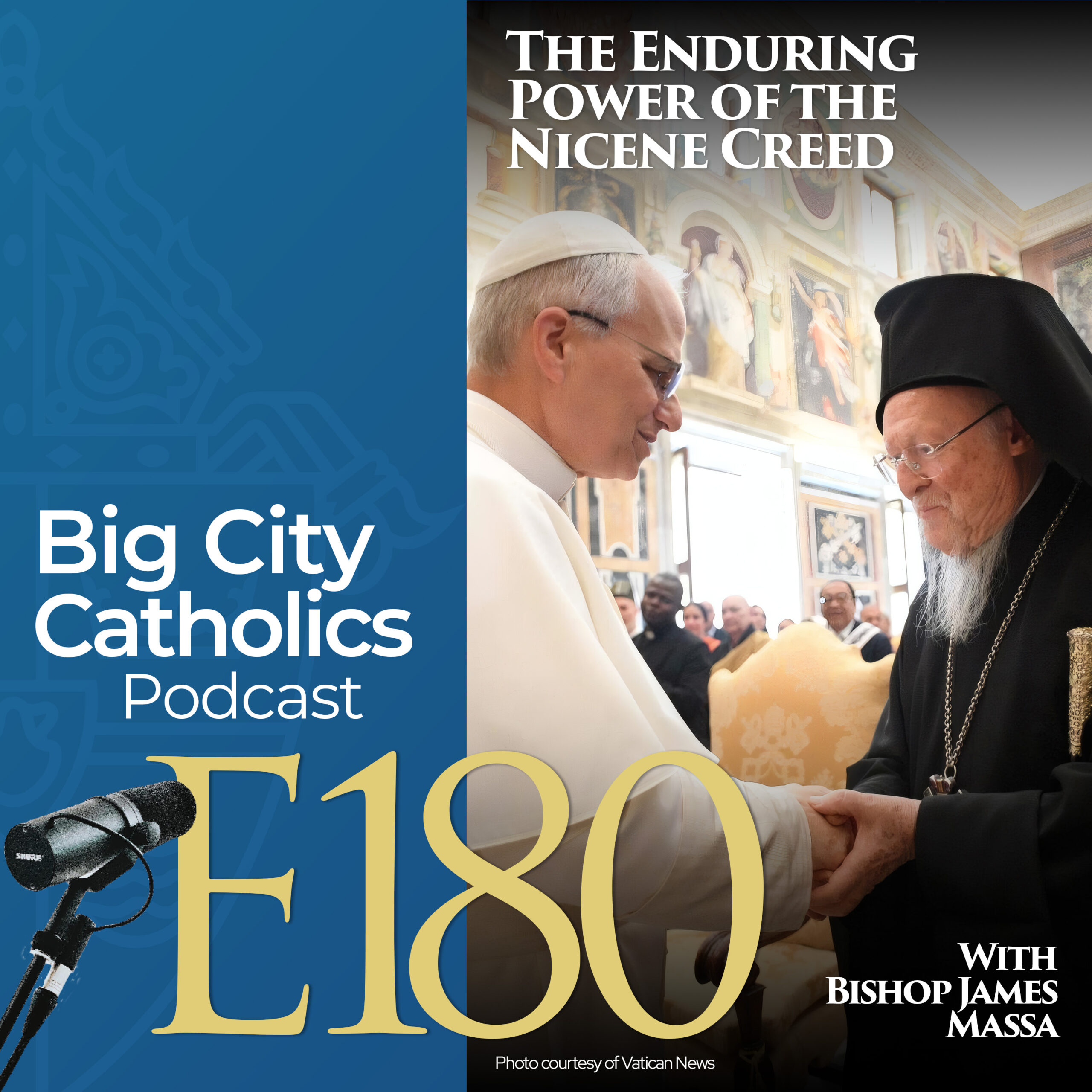
[00:17:17] Speaker C: No, it became, you know, and this is the Creed, Bishop, something you alluded to at the beginning. And we saw this last Friday, November 28, when the Pope was there with the Patriarch of Constantinople, Patriarch Bartholomew, and many other leaders of the ancient churches and of even Protestant churches where Anglican Church was represented. They were all together in Nicaea because all of these different confessional traditions, denominations, we would say they all own this as the, the. A core confession, a core profession of our common Christian faith.
And so it has it has great ecumenical implications that we can pray that creed together.
And the Pope, of course, did so with tremendous symbolism in the little Turkish town of Iznik, which is basically the very site where the Council of Nicaea took place in 325.
[00:18:24] Speaker B: Very, very, very powerful, very poignant and very relevant for today. And Pope Leo brings this out. He said in the letter, the Nicene Creed begins by professing faith in God the Almighty, the Maker of heaven and earth. And for many people today, however, God and the question of God have almost no meaning. And he actually took it a step further. He says, and we as Christians have bear some responsibility for that because we're not always great witnesses of God and the meaning of God in our lives. And so that's a real call, a call for an examination of conscience.
[00:19:00] Speaker C: Yeah, I mean, there are actual, you know, followers of Jesus who. Who rejects the Creed of Nicaea. We know that Mormons and Jehovah's Witnesses would be two groups, for example, that reject the Nicene Creed. They're small groups, but within our historic Christian churches, we're finding sometimes even clergy, members of the faithful, but clergy as well, are doubtful about the divinity of. Of Christ. He was an exemplary teacher. He was filled with the spirit of God. They'll acknowledge, you know, his greatness as a religious, as a founder of a great religion.
But that's not enough.
It's not enough because everything changes within the incarnation. What we'll be celebrating in a few weeks at Christmas, that God became man, that God, the Word became flesh, as John's gospel puts it. And everything is different now because God is among us. He's near us, and he's in us in a way that would never have occurred as something possible before the coming of Christ.
[00:20:14] Speaker B: And it's led to. The Hebrews then says, we do not have someone who is unable to sympathize with us, but one actually who became one with us. He has taken on our human nature in a very real way.
And, you know, like us in all things.
But sin, you mentioned, you know, the different churches and the approach to the creed.
That's early, even in the early days of our own nation. Right. I mean, people like Thomas Jefferson wanted to pull out all the great sayings of Jesus. He's a great moral teacher. He had a lot of good things to say.
[00:20:54] Speaker C: The Jefferson Bible, right? Yeah, that's right.
[00:20:59] Speaker C: All the miraculous, anything that refers to the supernatural is excised from the New Testament.
[00:21:05] Speaker B: Exactly. And, you know, that kind of has its hearing today, and that's what Pope Leo was getting at that even within the Christian denominations, even inside the Catholic Church, sometimes we look to reduce the power of God in our lives. And Pope, when he was in Nice, he said, this is a great occasion. Who is Jesus? It was Jesus to me. And there was a time when people would use that question, you know, from that encounter with Peter, et cetera, Philippi, you know, who do you say that I am? It was sort of like I get to define my own Jesus. I like the Jesus who's nice and merciful, but not the Jesus who's demanding, you know, Jesus is real, he's not an imaginary friend. But very often. Not that we do it consciously, but very often that's what we end up happening.
[00:21:52] Speaker A: It's.
[00:21:52] Speaker B: It's amazing how Jesus tends to be called as a witness to whatever I want him to be.
[00:21:59] Speaker A: Yeah.
[00:21:59] Speaker B: Instead of me being witness to who Jesus really is. The Pope, again, he has some very, very pointed questions. It was paragraph 10 of that letter. What does God mean to me? How do I bear witness to my faith in him? And he says, following Jesus is not a wide and comfortable path.
You know, we don't cut Jesus out to fit my path, but it's a fit. Jesus's pet. So these questions, Even though they're 1700 years old, they have a poignancy today, don't they?
[00:22:32] Speaker C: They do, yeah. No, well said, Bishop. It's. It's the. I think the Holy Father's calling us to Interiorize. Yes, interiorize the faith of Nicaea. The Nicene Creed. Yeah. It's not just dry dogma. This is something that can be personally appropriated and. And becomes a foundation for our trust in God's love and God's mercy.
It's objective. I think you're suggesting that there's a. There's a lot of subjectivism. Fancy way of saying people treat. Like an inkblot, you know, we can read into him whatever we want, you know, whatever our point of view is on this or that in the society.
But no, this is. The Church has always held up to us a God who is real, objectively real, and who is the truth, what reality is, what ultimate reality is, and what my own destiny is.
[00:23:30] Speaker A: I've been reflecting on this as well. Just that, of course, the council was called certainly as the reaction to Arianism and Arus's teaching, but we see it also as insightful and as proactively planning ahead for centuries to build on in all of our Church's councils. You can see the workings that the hand of the Holy Spirit, that while at times it's reactionary to that which is needs to be addressed at the moment, yet it's foreshadowing, it has a great foresight to that which is to come and to prepare the church to move itself, you know, led by this, the Holy Spirit, to be able to be this foundation for centuries.
You know, how beautiful that is as you reflect, we reflect on the 1700th anniversary of this council and as you mentioned, Bishop Massa, a few years later, the Constantinople. But how incredible it is that while it was meant to be, in a sense, reactionary to, yes, we need to come together and we need to set the matter straight here, it also became the building block, the foundation to move our church forward for years to come.
[00:24:49] Speaker B: Which is a good point. I mean, we talk about the ecumenical council. So when we did have difficulties, this is a gift of the Holy Spirit that the church, the bishops of the church are called together now in really extraordinary moments. I mean, we had the council, the Second Vatican Council in the 1960s.
This is a remarkable thing that the Holy Spirit gathers the church together and works through the give and take and the conversations. It's rooted in that same one creed, but meets the needs of, of the day, where you might have either a controversy or, or a need or a split. It becomes a great tool, a gift of the Holy Spirit for the church. And, you know, we're still, if you look at the scope of history, we're still in this time of unpacking the depth of the Second Vatican Council.
[00:25:45] Speaker C: Yeah, there have been 21 ecumenical councils over the course of the centuries. Nicaea was the first, the 21st was Vatican II. And along the way, in the early years, it was the emperor who called the council. But in more recent times, in the second millennium, it's been the bishop of Rome, the pope, who convenes the councils and always does so to address new problems.
But your point is a very shrewd one. Fr. CHRIS we're always building on the achievements of the past. There's no renunciation. Once a council makes a determination and says no, we believe that the Holy Spirit is the Lord, the giver of life, that was the next one, Constantine, and therefore he is God. So we have the Trinity completed, in a sense, by the end of the 4th century, there's no going back on that.
So in the 5th century, they're going to be dealing with other issues. And then in the seventh and eighth and ninth centuries, other issues, whether we can use icons, images in our worship and have them in our Churches, That'll be another council.
Jump ahead to the 16th century. We're responding to the crisis that began with Martin Luther and the Protestant Reformation and then Vatican one. You know, how does the Church define itself in the modern age?
How is it to be structured? You know, what's the authority of the Bishop of Rome, the pope, and Vatican ii?
Again, a time of renewal and finding new ways to express the faith so that contemporary men and women can appropriate it and then spread it, share it with others.
[00:27:26] Speaker B: Two other quick points. One great use and useful tool of this Creed is the catechism of the Catholic Church, that it has the four pillars, and one of the pillars is that of faith. And it really does go through the Creed. The Creed becomes the organizing principle to talk about the content of our faith.
So that is a gift again in the 20th century that goes back, that draws upon this gift of 1700 years ago, and now we have it here in the 21st century. And then the other thing, Bishop Massey, you did a great deal of work nationally and locally in terms of ecumenism. We talked a little bit about this point of unity, but as we have ecumenical dialogue, this is really the focus. It's not so much about, you know, trying to find compromise as it is seeking the truth. And this Creed is the unifying factor. This has very important ecumenical implications, even going forward.
[00:28:29] Speaker C: No, it does. You know, it's always being converted again and again and again to Christ because in him we find our unity. I think as we look at the challenges today, you know, we continue, of course, with our Eastern Orthodox brothers and sisters. We have a different understanding of church authority. There's some differences in understanding marriage and purgatory and other doctrines, but those are less significant than the authority of the Bishop of Rome, the Pope. That's still a major obstacle. And yet there's great affection, as we saw in the Pope's trip, that Eastern bishops, Eastern Orthodox and Oriental Orthodox bishops have for Pope Leo, as they had for Pope Francis and Pope Benedict and Pope John Paul ii, tremendous affection.
But that has to be sorted through in the future. Now with Protestants, there are more fundamental differences having to do with the sacraments.
[00:29:33] Speaker C: The makeup of the Church, so many other issues.
[00:29:36] Speaker A: So.
[00:29:37] Speaker C: But ecumenism comes from Jesus. It isn't something we thought up in the 1960s or, you know, it comes from our Lord.
In his final prayer, the high priestly prayer of John, chapter 17, when he prayed, father, may they all be one, as we are one, so that the world may believe.
So his prayer for unity is spoken at The Last Supper on the night before he died on the cross. If we were to say, oh, ecumenism is just nonsense or not essential, we would be denying the hopes and the desire of Jesus himself as expressed in his prayer.
So it's not an option.
It's not, as St. John Paul II said, it's not an appendage to the mission of the church. Ecumenism. The work for Christian unity is the mission of the church.
[00:30:30] Speaker A: Beautiful.
[00:30:31] Speaker B: So thank you for joining us, Bishop Massar and Father Henry. It's a busy weekend coming up. We're coming into the second Sunday of Advent already, and on Monday we celebrate the Great Feast of the Immaculate Conception. This is one of the major ones that retains its status as a holy day of obligation, but urge you to check your local parishes and get them as scheduled. But it is a great feast day, the Feast of the Immaculate Conception.
[00:31:00] Speaker A: And then when next week's podcast releases, you'll be enjoying the company of thousands at the Feast of Our lady of Guadalupe. So it's a Marian week next week. We start the week and end it with our Blessed Mother Mary. And we'll be just quickly into the third week and just planning ahead of our podcast. We know how fast this Advent season is coming and and will be. We wish all of our listeners a very blessed Advent and to enjoy this time of preparation. And perhaps even as we spent this podcast reflecting on the Creed, maybe it's an opportunity for our listeners to do the same, to just take the Creed and to reflect on the meaning and the importance of the that which we believe. Bishop, perhaps you could end with a prayer.
[00:31:46] Speaker B: And so what we'll do is we'll pray the prayer that Holy Father Hope Leo gave us at the end of this apostolic letter. Let us pray.
Let us invoke the Holy Spirit to accompany and guide us in his work. Holy Spirit of God, you guide believers along the path of history.
We thank you for inspiring the symbols of faith and for stirring in our hearts the joy of professing our salvation in Jesus Christ, the Son of God, consubstantial with the Father.
Without him, we can do nothing. Eternal Spirit of God, rejuvenate the faith of the church from age to age.
Help us to deepen it and to return always to the essentials in order to proclaim it so that our witness in the world may not be futile. Come, Holy Spirit, with your fire of grace to revive our faith, to enkindle us with hope, to inflame us with charity.
Come, O divine comforter, source of harmony, unite the hearts and minds of believers. Come and grant us to taste the beauty of communion. Come, love of the Father and the Son. Gather us into one flock of communities. Christ, show us the ways to follow so that with your wisdom we become once again what we are in Christ 1 so that the world may believe.
Amen. And may Almighty God bless you, the Father and the Son and the Holy Spirit.
[00:33:29] Speaker A: Amen. Thank you, Bishops, both Bishop Brennan and yourself, Bishop Massa. Thanks for joining us, Bishop Massa, on this beautiful podcast. And thanks to everyone who continues to tune in each and every week to another edition of Big City Catholics. Have a great week. God bless.