Episode Transcript
[00:00:00] Speaker A: Foreign.
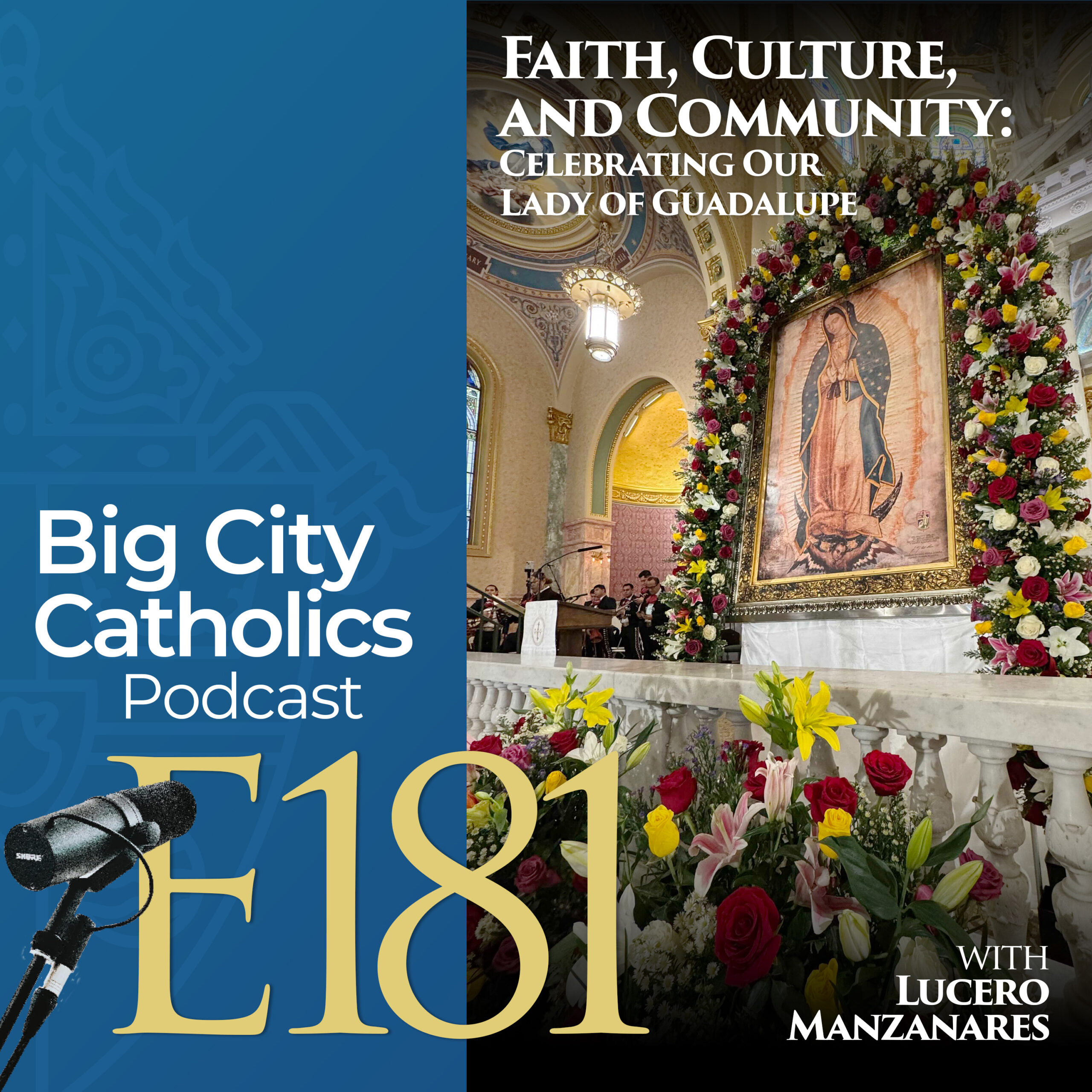
[00:00:10] Speaker B: Hello, and welcome to this week's edition of Big City Catholics. Our podcast is released today on the feast of Our lady of Guadalupe. A big, big day here in the Diocese of Brooklyn, as it is in many places in the world. So I'm very happy that I'm joined today by Lucero Manzanares, who is the Associate Director of Youth and Young Adult Ministry here in the Diocese of Brooklyn. Why don't we begin with a short prayer? In the name of the Father and of the Son and of the Holy Spirit. Amen.
Oh, God, who, by means of St. Paul Diego, showed the love of the most Holy Virgin Mary for your people, grant through his intercession, that by following the counsels our mother gave at Guadalupe, we may be ever constant in fulfilling your will and bringing your love to all, through Christ our Lord. Amen. In the name of the Father and of the Son and of the Holy Spirit. Amen. So, Lucero, welcome back.
[00:01:12] Speaker A: Thank you.
[00:01:13] Speaker B: So how has it been going? When we last spoke on the podcast, we were in Rome. And you were still pretty new in your position in the diocese.
[00:01:23] Speaker A: Yes.
[00:01:23] Speaker B: But you weren't new to Brooklyn because you were a Focus missionary prior and you served at Queens College. So you knew us pretty well.
[00:01:30] Speaker A: Yes, yes. No. It's been a pleasure to get to know you guys even more.
[00:01:35] Speaker B: That's great. So tell me, what have you been doing? What have you enjoyed as you getting around? Bringing the Good Word?
[00:01:41] Speaker A: It's been a lot of being on the ground, which is really beautiful, kind of just seeing where everything and everyone is in regards to ministry and what it is that our diocese is seeking, whether that's investing more in our youth ministers and continue to remind them of their call and their growth, of spiritual growth to our youth and our young adults and investing them in what they need. So we've had several events of just like even our monthly events that are a little bit more standard and a tool for youth ministers and young adult ministers to bring their groups and just gather together and see other people that are the same. And we do this through a lot of holy hours and young adult holy hours. The young adult holy hours are always at the San Damiano Mission, and the youth holy hours are the first of the month, and we switch through different parishes and different deaneries so that they can gather together as one as well. And we actually just had a little bit over in about a month, we had a youth day where we had quite a few people join. And, yeah, just been a lot of good work of gathering more and more.
[00:02:42] Speaker B: People, that Youth Day in November was extraordinary. Extraordinary. Last year was a big deal with about 1600 people, which we didn't expect.
This year we were prepared for bigger numbers and boy, we even surpassed it. So we had about 1850.
[00:02:59] Speaker A: 1853 was the last number that we recorded.
[00:03:02] Speaker B: There you go. And they were in. Christ the King was our host. Christ the King High School was our host, which was great because the high school gave us different facilities to be able to move around, to be together and then to move around. I was just so, so impressed by the young people who were there, but also by our team, by you and Father Caroly and all the people who work with you, the youth minist. Because it was so smooth and so worthwhile.
[00:03:28] Speaker A: Yeah, for sure. It was definitely a day that we were looking forward to from what we heard last year. And just seeing it come to life and seeing the different pockets of how people responded to the talks and to even just lunch and even you coming down to the cafeteria and taking pictures with them. Just the atmosphere of the day.
[00:03:44] Speaker B: Exactly. It's a lot of fun. It's a lot of fun. And I've been saying this. One of the things that's impressive and I. My hat's off to the youth ministers for this and to the pastors. When we were at Mass, I missed the holy hour because I had a funeral that morning. But I know that it was true at the holy hour. It was definitely true at Mass. These young people know how to act at Mass. They know how to pray at Mass. This was not a strange experience. And so that's telling me that this isn't just event centered, but that something else is going on at the local level and we can really be proud of that.
[00:04:20] Speaker A: Oh, absolutely. It goes to show just not only the work that the youth ministers are putting in for the these kids to have an encounter with Jesus, but that these kids are actually having that encounter and living out of it too.
[00:04:33] Speaker B: And part of your responsibility goes beyond the youth. You know, you mentioned the youth ministers. Some of the youth ministers are themselves young adults. And we have some very good things happening in the young adult world. And you've had a chance to interact with that, huh?
[00:04:46] Speaker A: Yes, we've had a few young adult gatherings and actually we're prepping to go to Seek, as you know, back in Columbus, which will be good to just. Yeah, we've had little touch points. We had a walking tour of Brooklyn churches. That was a pretty fun. Because we had people from the Jubilee join and that was where we got the Idea to do this event because they wanted. They saw these beautiful churches that honored their faith. They wanted to see them. And we have them within our own diocese, so why not go see them?
[00:05:13] Speaker B: That must have been wonderful. What neighborhood did you hit this time?
[00:05:15] Speaker A: We did St. Patrick's Our lady of Angels and St. Anselm's so Bay Ridge.
[00:05:20] Speaker B: We were down in Bay Ridge.
And you walked around from the different churches. I guess you prayed in the different churches. Did you get a little bit of a tour or a feel of the church?
[00:05:29] Speaker A: Yes, I did Saint Anthem, and then Father Randy helped us out with Saint Patrick's So each of us gave a little talk about just the history of the parish, how it got there, where it started, which was fun, because some of them, and interesting in the way that some of them weren't parishes at first. They were just a hall or people were meeting in a house. And then they came, and that's where this started. So just even the history of your own diocese and where your own parish, because a lot of these young adults, that was their home parish, and it was things about the parish that they didn't even know.
[00:05:57] Speaker B: And just the idea of walking around.
[00:05:58] Speaker A: Brooklyn, It's a beautiful area.
[00:06:01] Speaker B: Yes, it is. It is. Did you stop for any treats? Any big treats?
[00:06:05] Speaker A: We got coffee before. Of course, it's cold, and everyone needs caffeine.
[00:06:11] Speaker B: That's great. That's great. I think those kinds of things can be really enriching, and it builds up a sense of a community walking together. We're very different people from one another.
What unites us is our experience of faith, experience of Christ. And so to do that, walking toward the churches is a great, great idea. And, yeah, we have a great history here in Brooklyn and in Queens. Oh, yeah, you have to get to Queens. But of course, like I said before, your introduction to the diocese is really Queens.
[00:06:41] Speaker A: Queen's College served as a missionary there for two years, which was a gift. Just being able to start the campus ministry there and to even just see the hunger of the students that desired community, that desired a place of even just rest. That was the biggest theme I think I saw. They desired a place that was safe, a place that provided them comfort, not necessarily comfort from the world, but just a moment of respite. And even through the Sacred Heart chapel that was renovated and redone by the team, there even added more momentum for the students to come and continue to grow and make that place better, beautiful.
[00:07:19] Speaker B: And to take on some responsibility themselves. Yes, that's the beautiful thing. And it kind of brings us to the feast that we're celebrating today, the day that this podcast is being released, Our lady of Guadalupe. Now, you have Mexican heritage. Your parents were from Mexico.
[00:07:34] Speaker A: Yes, they were born and raised there.
[00:07:36] Speaker B: And you.
[00:07:37] Speaker A: So was I. I was actually born and raised in Mexico for the first seven years of my life.
[00:07:41] Speaker B: And then you grew up here in the United States. So you kind of bring a perspective that's probably pretty common in a lot of our dioceses in Brooklyn and Queens. It's that next generation of young people who have the roots, even literal roots, being born there, but also the experience of growing up here and tying those together. So I thought it would be fascinating that we had this chance to talk. So at the beginning of your life, you were telling me there's a connection with the Shrine of Guadalupe.
[00:08:11] Speaker A: Yes. I was very blessed to grow up in Catholic home. Both of my parents were practicing Catholics and they loved Our lady of Guadalupe. And we actually were very blessed that when I was born, we lived in Mexico City.
And very early on, I believe it was around two weeks is what my parents tell me. And there's a picture to prove it where I'm a small baby. They took me with my sister and reconsecrated my sister. They reconsecrated themselves, and they consecrated me to Our Lady. And from then on, it was as a sign to just have her watch over us and protect us.
[00:08:44] Speaker B: And tell me, so what are some of the customs you had, either whether they be back in Mexico or here growing up in the U.S. one of.
[00:08:51] Speaker A: The biggest one, obviously, is the Mass of Our lady of Guadalupe. A lot of the times it can be celebrated at any point during the day. The biggest tradition is when you do it at midnight and you sing Happy Birthday. You sing Las Manenitas, as we call it, in Mexican Spanish. And you say Happy Birthday to her. Because even though there are other Marian apparitions and we know Mary's birthday, this specific feast is for Lady Guadalupe to celebrate and honor the fact that she appeared and is still in Mexico. So just to be reminded of the fact that, yeah, she appeared on that Tilma never left. That Tilma is the original one, and that was one of the biggest ones. Mariachi a lot is always there. A lot of music, a lot of loud and always food. There's always, always food. December is always known for tamales, so it ties it back in.
And this is usually always followed by a Mass that's, yeah, very lively. I remember the mariachi being there. We usually always have the kids process with roses and the flowers to honor also Saint Juan Diego and the flowers that he carried in the tilma before she had the image imprinted on there. And a lot of the kids, when you're younger, I would say elementary school kids will dress up as either Saint Juan Diego or Lady Guadalupe, or they'll dress up as, like, the little people of the town just to. Yeah, kind of. A lot of us didn't grow up in Mexico. We didn't see these traditions that were part of who we are, part of our country, part of our culture that our parents do have. So they bring it here with us. And it's just a moment to be able to mesh both worlds together into one.
[00:10:24] Speaker B: That's great. That's beautiful. And we talk about the encounter of St. Juan Diego, that here is a relatively humble, simple man, you know, not somebody in a position of authority, married to Maria Lucia, going to Mass. He was on his way to Mass when she first appeared to him, but not somebody who was running things. And this encounter with Mary is a very profound one that she chose Juan Diego and then he became the mess, her messenger to the world.
[00:10:58] Speaker A: Yeah, it's something really beautiful. And just even the quote that we have of him saying, I am nobody. And in a way, he. He wasn't. And that reminds us of our own littleness. But at the same time, the duality of she chose him and she can choose anybody. God can choose anybody in these situations to go and proclaim his word and his love. And for her to choose somebody that was of the people, to also kind of just like, be reminded of, we're one universal church, one more, we're one body. Anybody is called, and we actually are all called to be saints, so.
[00:11:31] Speaker B: Exactly. And, you know, after this all took.
He became the missionary. And it's interesting, you know, the church sent, with the encounter in the New World and the encounter in Mexico, missionaries and bishops and religious orders and they were kind of struggling to get the message of the gospel. But this common man who had this encounter with the Blessed Mother had more success than everybody else combined. She was working through him.
[00:12:01] Speaker A: And it's a beautiful reminder of just. Even how she works through us, of just like, there's really not much that we have to do as long as we're docile to the will and the plan of the Lord.
And that goes to all of our everyday life, even in ministry.
[00:12:17] Speaker B: Yes. Tell me about that a little bit. You know, you are a missionary, so you have a role now in our evangelization and catechesis here in an Institutional way, diocesan way. But your journey kind of began as a missionary, a focus missionary. You were sent to different colleges, ultimately to us here in Queens. Do you think that some of that, either the message or the methodology, does any of that ring true to you in your own missionary experience?
[00:12:48] Speaker A: Oh, absolutely.
It's always something that you kind of have to learn.
It's hard to go into missionary work and be reminded of your littleness. It becomes very evident. And if that's not at the forefront of your mind, where it's not you trying to do the work, you can't. You don't have control over everything. You can't control how somebody encounters the Lord or how it happens. You can facilitate things and it's all through. Yeah, kind of like even the quote of Mother Teresa, like, I'm just a pencil in the Lord's hand.
And I saw it a lot coming to Queens. I talk a lot about coming to Queens. I loved my time. My first two years as a missionary at temple. Coming to Queens, I felt like I was home. It was so familiar to me to be in a melting pot of cultures where, yeah, it was Ecuadorians, Chinese and Colombians all together in one room, but there was that same sense of love and same sense of respect as if we were just the exact same all around.
And, yeah, kind of just to come to Queens and continue to be reminded, this isn't about me. This isn't me trying to change somebody else. This is the Lord coming in and trying to encounter somebody. And a lot of the times in these encounters, you are the first face of Christ to these people. And the only way that they're going to see who the real and true Christ is, if you are also connected to him. So continuing to be reminded of, oh, yeah, my holy hour, my prayer, my connection to him is where everything flows out of. And like Saint Juan Diego saying, I. I'm no one. I'm at the last line. And it's like, But I will allow for him to work through me if that is what he's calling me to do.
So definitely very prevalent and heavy in missionary life and especially coming to cultures that the east coast culture is definitely a lot more different than the Midwest. So definitely had to adapt to that.
And even coming into New York, you guys have your own culture. And now just even being adapted into that has been beautiful. And even learning my ways, I also get frustrated when the subway's late now. Now I'm one of those New Yorkers. So it's. You see the little ways that your heart Gets softened too, in it.
[00:15:01] Speaker B: Isn't that beautiful? And that is part of what the missionary experience is. And that's what Mary did. It's to not surrender to the local culture, but to immerse yourself in it and to become one with. To become part of that local culture and then to bring the joy of the gospel into that world. First of all, that's what Jesus himself did. He, you know, though he was in the form of God, he did not deem equality with God something to be grasped, but rather he emptied himself himself coming among us in human form. So, you know, that's like the. That is the first missionary journey.
But right behind it was Mary herself. You know, the gospel for the feast of Guadalupe is the gospel of the visitation. Mary hears the word from Gabriel and what does she do? She gets up and runs in haste to share it with her cousin Elizabeth. You know, what does Mary do at Tepayak? She is a missionary.
This is an interesting thing. She appears as an indigenous woman of the time, expecting the child Jesus. And she speaks in the indigenous language, not the sophisticated Spanish, not some archaic language.
She meets Juan Diego, where he is. Does that have any implications for ministry in that specifically?
[00:16:27] Speaker A: That's what we do as focused missionaries when we get sent to different college campuses. You're there to encounter the students. You're. You're there to see where they are and where it is that they want to be guided, where you're a tool in the best way possible. And it's really beautiful because you get to know them in a way that maybe they have never been seen before, maybe in a way that they've never been known before. And you get to love them. And for them to be seen, known and loved in the. By just them being themselves is sometimes an experience that they. They've had in. In that they come to see omc known and loved by also my Creator. And we didn't do anything but just grow in friendship with them, get to know them, go grab lunch, grab a coffee, go grocery shopping, all these little things where maybe they seem insignificant, but it's in the mundane, in these sweet, ordinary moments that they can find a deeper encounter in their identity and a deeper encounter in the Lord.
[00:17:25] Speaker B: That's where that connection is. So it's not that you. You start off to use, put it in a pejorative sense. You don't start off with pumping is certainly bringing the good news of Jesus Christ. You're not hiding it, but you're grabbing a coffee. You're meeting the culture where the culture is that's what Mary did with Juan Diego and then what Juan Diego did with his fellow townspeople. Yes. And you know what she does, though, is she uses. She peers like one. She engages the culture, and then she also challenges it.
So the coming of the gospel challenged some of the things about the polytheistic ways, the worship of different gods and some of the practices of those superstitions. The message of the gospel is a liberating message. It's not a bunch of gods who were there to get you. It's one God who created you and who loves you.
[00:18:15] Speaker A: And a lot of the times we need even that reminder. And these students, these, these people that we're encountering, that is what they're seeking. They're not seeking for somebody to once again list of the ten Commandments for them and tell them these things that they can and can't do and see church and our faith as just of culture and something that their parents do and then they sometimes do. But rather as who is it that you're encountering? And the things that are set in place are for your good, because he desires your good. And even in that, to challenge them of like, okay, I see that you've been living your life in this way. And because I love you and because we are now friends, I feel the need to tell you and call you higher to not either do these things or change these things that are not drawing you closer to him, to who you are meant to be in relationship with.
And that Mary very much did that when she appeared in Mexico in Tepayac, because it was a call to conversion. It was a call to if Jesus Christ really is Lord, are you living your life for it or not?
[00:19:19] Speaker B: Well put. So, so well. But now here in Brooklyn, we're going to celebrate in a big way. While you were a missionary, have you been to our Guadalupe, Miss? I have.
[00:19:28] Speaker A: I've been to a few. My first year, I got to go to St Leo's and they we did to the midnight, the midnight Mass, so.
[00:19:34] Speaker B: So, yeah, that's just it. People start celebrating from, as you say, midnight.
[00:19:39] Speaker A: Yes.
[00:19:40] Speaker B: The morning of people arrive early. Now we've had to split it. My first year there was so many people that we had to split it. So we have two Masses at the Coke Cathedral. I think in all we come up with like three or four thousand people who are coming to Mass at the Co Cathedral on a diocesan level. But they're not just arriving. They've already been either at mass or some kind of a prayer. Las Mananitas, perhaps at midnight, perhaps early in the morning. And they make a pilgrimage. You know, we talk about the whole year and a pilgrimage of hope. They make the journey that they call cathedral. They all come in their uniforms. They pre register. They all have their hoodie sweatshirts and their small backpacks. But when mass is over, it's not a party. They don't go downstairs for food, for coffee and cake, or even for tamales or anything like that. They go right back out on the road. They carry a torch. We light the torches. And as parish groups, they run. They're actually called runners. Right.
And they're running back to their parishes carrying a torch.
[00:20:45] Speaker A: Yes.
[00:20:46] Speaker B: Which is a beautiful thing because we carry. When we leave church, we carry the. The gospel. We carry the torch, the light of Jesus Christ in the gospel. And they're doing that in a symbolic way, bringing it back to the parish. But yet there's yet another.
Right?
[00:21:01] Speaker A: Yes.
[00:21:02] Speaker B: More prayer.
[00:21:03] Speaker A: They really do take the whole day and celebrate. It's a feast for sure.
[00:21:07] Speaker B: It's a feast for sure. And don't get me wrong, the food, that's a big part of it, and that's a good part of it.
So we're looking forward to that day. And then the other part of it all is the music. Right.
You know, you have the mariachi bands. There's a very particular sense to the Mexican music and to the mariachi bands on that day and really throughout the year.
[00:21:29] Speaker A: Yeah, you can definitely tell when even the music in the mass will be a little bit different. There's a little bit more clubing. There's a little bit more. Yeah, just an emphasis specifically on Mary. I would say that Mexicans are very Marian, thankfully, because of Our Lady Guadalupe.
[00:21:44] Speaker B: Yes, indeed. And she accompanies them through. And, you know, you spoke earlier about being concentrated and having that sense of being protected, watch over. I love her message to Juan Diego. And really, it's a message to all of us. You know, she said, fear not. Am I not here, I who am your mother.
And you can hear those words that she spoke to Juan Diego echoing through the generations as she watches over us, protects us.
The first words or the early words of the angel, that first message of the Angel Gabriel's, the Lord said to her through the angel Mary, fear not.
I can picture Mary telling Jesus as a little boy, fear not. Am I not here? Who are your mother? And raising him? She speaks Juan Diego, and she speaks to us because, you know, maybe life in Juan Diego's time wasn't so easy, but Neither is it very easy for people today.
A lot of people struggling, a lot of people trying to get by. A lot of the people who will join us are living tough lives. We encounter people. You encounter them on campus. You encounter people in youth ministry and even people in our own family of the church who, you know, living with tough realities. And Mary speaks tenderly to us. Right. Fear not. Do not let your heart be troubled. Am I not here? I am your mother. I think that's just so, so beautiful and a great way to sum up the message of the day.
[00:23:12] Speaker A: Absolutely.
[00:23:14] Speaker B: So thank you for joining us today, Lucero and I hope that you will enjoy your celebration of lady of Guadalupe. We have a lot of exciting things taking place in the new year with youth and young adult ministry starting off, as you mentioned, right away with Seek for both of us. It'll be a little bit of a homecoming for me. I'm going back to Columbus where I spent two and a half years before coming here. And for you, the connection with Focus, where you had a lot of your formation.
[00:23:42] Speaker A: Yeah, it'll be really beautiful. And even just to go back as not a student, not a missionary. This is my first time going to Sikh as an attendee. So it's really exciting to just even be there.
[00:23:53] Speaker B: That's right. Leading a group of pilgrims. So enjoy. We'll see you.
[00:23:56] Speaker A: Sounds good.
[00:23:57] Speaker B: Thank you all for joining us today. For big city Catholics, please join us again next week for a new edition as we get closer in the later days to adventure. And why don't we pray with a prayer, and that's often used in Advent. To our Blessed Mother. In the name of the Father and of the Son and of the Holy Spirit. Amen. Loving Mother of the Redeemer, Gate of heaven, Star of the sea, assist your people who have fallen, yet strive to rise again to the wonderment of nature. You bore your Creator, yet remained a virgin after. As before, you who received Gabriel's joyful greetings, have pity on us poor sinners.
Our lady of Guadalupe. Pray for us. Saint Buon Diego. Pray for us. In the name of the Father and of the Son, of the Holy Spirit. Amen.