Episode Transcript
[00:00:00] Speaker A: Foreign.
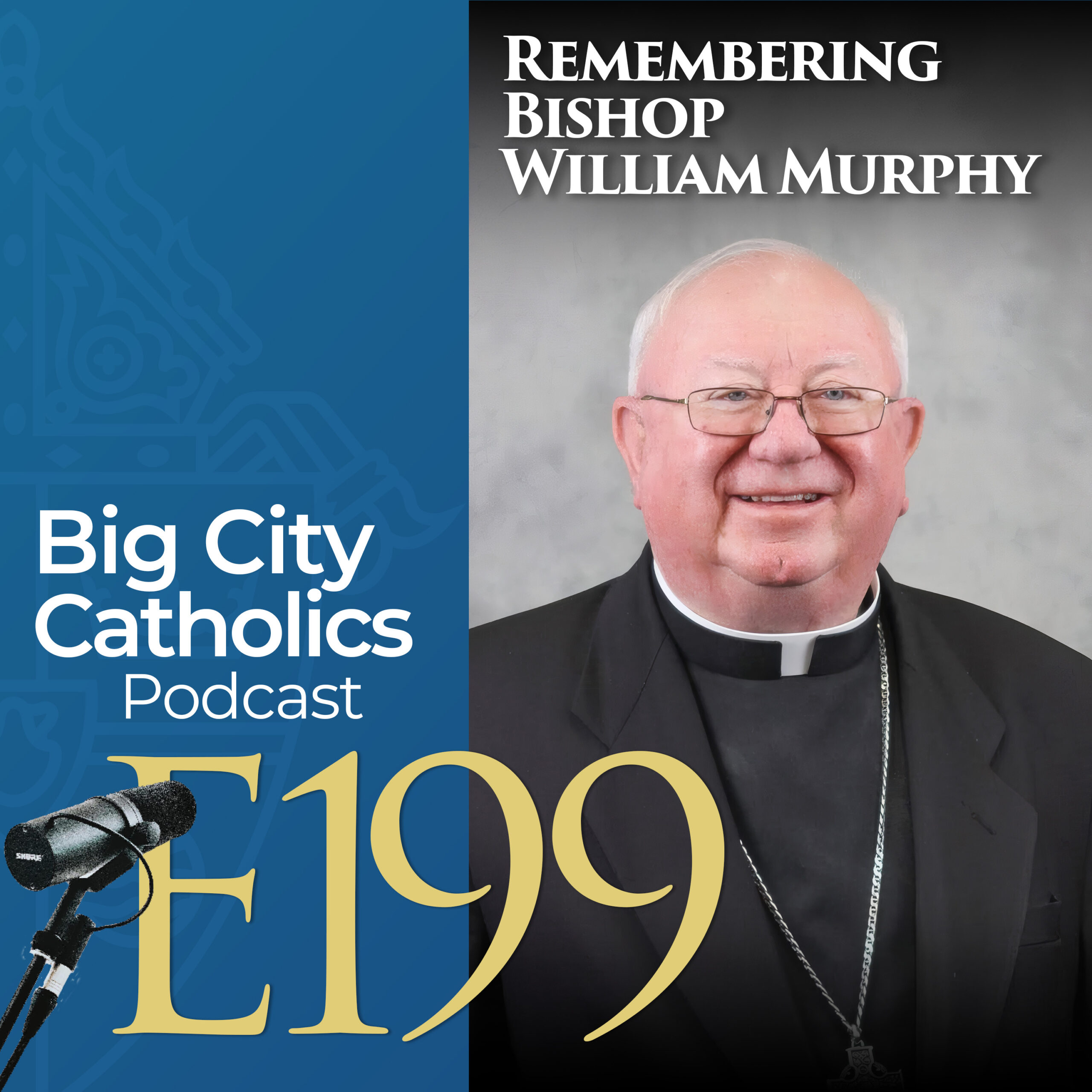
[00:00:10] Speaker B: Welcome to a new edition of our diocesan podcast, Big City Catholics, with Bishop Robert Brennan, the Diocesan Bishop of Brooklyn, serving in Brooklyn and Queens, and myself, Father Christopher Henyu, at St. Joan of Arc Parish in Northern Queens. Today is a special two part episode, remembering the life of Bishop Murphy. We are joined by Monsignor Joseph Degro who will speak with Bishop Brennan in an in depth conversation remembering their experiences with Bishop Murphy. We begin though in prayer. In the name of the Father, Son and Holy Spirit. Amen. As we remember the life of our dear Bishop Murphy and commend him to the care of our Blessed Mother Mary, we pray.
Hail Mary, full of grace, the Lord is with thee. Blessed art thou among women and blessed is the fruit of thy womb, Jesus.
[00:00:58] Speaker C: Holy Mary, Mother of God, pray for us sinners now and at the hour of our death. Amen.
[00:01:03] Speaker B: In the name of the Father, Son and Holy Spirit, Amen.
[00:01:06] Speaker C: So, Father Hanyu, happy Easter.
[00:01:08] Speaker B: Happy Easter to you, Bishop. Yes.
[00:01:10] Speaker C: We haven't been together since Holy Week. That's right. And we had the Chrism Mass for the Holy Week episode and the Easter Mass for the Octave episode. Just before Holy Week, we got word that Bishop Murphy had died and funeral was during the Octave. There's beautiful appropriateness to that because it was really a celebration of the resurrection. That's right. It's the resurrection of Jesus. We proclaim Jesus risen from the dead and that promise of eternal life given to all of us. I remember those words from the Vigil Mass that we who share in the death of Christ through baptism now rise, will share in his resurrection as well.
[00:01:52] Speaker A: So that's right.
[00:01:53] Speaker C: So we celebrate that death and resurrection of the Lord and that becomes our hope and our consolation. How was Easter in Jackson Heights?
[00:02:01] Speaker B: It was a beautiful Easter as well, Bishop. Lots of big crowds. I think as we were being reported in a lot of our parishes, we had six baptisms and an additional seven to receive the full sacraments of initiation. It was a great, great excitement and it was really, it was nice. For my 10 years of priesthood, I've always served at a vigil with a bishop, whether it was Bishop Cisneros at Holy Child or. Or with you. So it was kind of interesting to be out on my own this year.
[00:02:31] Speaker C: Good for you.
[00:02:32] Speaker B: But, Bishop, you know, you mentioned at Bishop Murphy's funeral, and I was happy to be able to attend it. You mentioned that this would be a very unique Easter for him as he would to celebrate Easter in the presence
[00:02:44] Speaker C: of the risen Lord. Exactly.
[00:02:45] Speaker B: And I agree, I agree. And as we'll hear in your conversations with Monsignor Di Graco just great examples of the joyfulness of Bishop Murphy. And currently, as you know, one of the things that I assist as here at Pope John XXIII National Seminary in Weston, Massachusetts. I'm currently here in Massachusetts, and a number of the Boston priests had come down for the funeral. It was really beautiful to see. And they're actually still talking about it here and planning a memorial Mass here for the priests of Boston, which is great to keep his memory alive. So I think we should take a listen to your conversation now with Monsignor Di Graco.
[00:03:26] Speaker C: Monsignor Joseph Di Graco is the pastor of my home parish of Our Lady Perpetual Help in Lindenhurst. But we go back more than 40 years as friends. We were buddies together in the seminary. As a matter of fact, Monsignor di Crocco was a year ahead of me in the seminary, and so was sort of an elder brother to me in my first year, which. Which was a big help to me, and we've been friends ever since. We both had the honor, the pleasure of serving as Bishop Murphy's priest secretary. I did it when he first arrived, and Monsignor di Crocco picked up a year after that. Mancino de Crocco went on to be a professor of Sacred Liturgy at the Seminary of the Immaculate Conception in Huntington. So welcome, Monsignor Di Graco.
[00:04:14] Speaker A: Thank you, Bishop Brennan. It's a pleasure to be with you today.
[00:04:16] Speaker C: It's always a pleasure to be with you.
And we celebrated, and you might say with great solemnity, the life, the ministry and the eternal life of our friend Bishop Murphy. What a gift it was to be able to work with him over the years.
[00:04:33] Speaker A: It was. He was really a hub, a focus in so many ways for bringing so many people together. But certainly personally, you and I, having been friends before that, but then we had the opportunity to work together under Bishop Murphy. You were serving as Vicar General when I was his secretary and when I was professor of liturgy, and there was just such great synergy. I think that was one of the gifts of Bishop Murphy. He had this ability to bring out synergy in others.
[00:05:00] Speaker C: Yes, I think you're right. Exactly. And very different people sometimes. You know, we were great friends, but he also brought in people from other circles of life, and he always treasured his friendships, lay and priest.
[00:05:13] Speaker A: Yes, yes. You know, one of the comments that I made to someone was, as parishioners here at Our Lady Perpetual Help heard of Bishop Murphy's death, the comment that I kept hearing over and over again was.
I liked him. He was always so joyful and friendly, and he really brought that very personal touch anytime he went to parishes for events and so on. He loved being with his people. He loved bringing people together, and he loved celebrating the goodness of people and the goodness of the life of faith, the goodness of the church.
[00:05:46] Speaker C: You know, when that struck me, and it is true, I heard the same thing from so many people. But Catholic Faith Network did something of a photo montage, and it was playing. I. I saw it. I had a link to it. But I saw it during the week and. And in the church hall. But those photos, there was always a big smile. Big smile, and it was genuine. He enjoyed being where he was, and
[00:06:13] Speaker A: he enjoyed being a bishop. I'll tell you the truth, my first memory, I haven't told this to too many people, but at his installation Mass, I was there, just as one of the priests of the diocese, to be there with our new bishop. I had not met him personally. I knew nothing about him. But throughout the entire installation Mass, the phrase that I came up with in my head and please, I don't mean this disrespectfully. I mean this as affirmation. He was like a kid in a candy shop. He loved having this diocese. Being now a diocesan bishop. He had been an auxiliary in Boston. But the joy.
The joy that was exuding from him that day, that's what first impressed me about him. He just thoroughly loved, if you'll allow me to say it this way, finally having his own diocese.
[00:06:58] Speaker C: He did. He really did. And he loved that church on Long Island. He loved being on Long Island. He became a Long Islander very, very quickly.
[00:07:07] Speaker A: Yes.
[00:07:07] Speaker B: Yes, he did.
[00:07:08] Speaker C: He loved the Long island culture. He loved being near the city of New York. He was a great fan of the opera. I never thought of myself as an opera person. And yet he introduced it to me and, you know, like, broaden my horizons there. But it's interesting. He had these vast experiences around the world.
He had these experiences in justice and peace, working in the Vatican. But in the end, what he really loved, as you said it, was being the bishop of Rockville Center.
[00:07:40] Speaker A: Yes. But he was able to bring the two together also. And that's where he certainly broadened my priesthood, my spirituality, my sense of church, is that he really brought that sense of universal church with him.
But not, you know, people may kind of have a sense that, well, then that's the institutional church, and that's a negative. No, he was very much a man of the church. And the institutional church, but not from a legalistic or institutional sense, because he deeply believed that it was through the church that you encountered Christ.
Christ founded the church, and Christ continued to work through the church. And therefore all of the structures and all of the institutional aspects were there. Not institutionally, but spiritually, because it's what Christ found. And that is where you met Christ.
[00:08:31] Speaker C: Yes, exactly. And, you know, again, he loved Rome, he loved the food, he loved the interactions. But that love for the church and for that universal church gave him a great love for the missions. I mentioned Africa and Haiti. He made several trips. I made a trip to Africa, and I'm going to be going to. To Nigeria again probably this year, thanks to Bishop Murphy. We were there 25 years ago, and the coadjutor at the time, now Archbishop Valerian, has been now since 25 years of Bishop, and so he's asking me to come back. And we have a great Nigerian population here in Brooklyn, so I'm getting a lot of encouragement.
[00:09:12] Speaker A: But isn't that a great example, too? And I think one of the things that Bishop Murphy left us and what he exemplified, this vastness, this universality, I mean, there you are going off to Africa, and yet there's a oneness. There's almost, if you will, a smallness about it because it's our unity in the church. It's our oneness. And Bishop Murphy, the sense of unity was our oneness in Christ was so important to him. So important to him.
[00:09:38] Speaker C: One of his real missions on Long island was to be an agent of reconciliation.
[00:09:44] Speaker A: Yes.
[00:09:45] Speaker C: To bring people together, to kind of shut down some of the divides. And he did that in very heroic ways.
[00:09:52] Speaker A: Yeah, that's a side of him that I'm not sure that everybody saw, because he was certainly very good at making decisions, and he had no problems holding to the decision. And this is it. But there was always listening. What people didn't see a lot of times was there was a lot of listening and a lot of agonizing that went on before that. He. I know how much he spoke to you and prayer, how much he spoke to you privately. But even just, you know, as he would do with his. With you as vicar general when you were his secretary or with me when I was a sec, sometimes he would just kind of think out loud and bound and he, you know, what do you think of that?
He was not afraid to get other
[00:10:27] Speaker C: people's opinions on the light side of things. He was also one. I always talk about Murphy's Law, you know, if anything can go Wrong. It'll go wrong. I say there's a corollary to Murphy's wrong. If anything's going to go wrong, it's going to go wrong for Bishop Murphy.
I think that's there. If there were six computers in an office, the one that would fail would be Bishop Murphy's compute.
[00:10:51] Speaker A: Well, I found the same thing to the point where it became a little bit of a joke among us because if, you know, we were going out somewhere and you know, it was going to rain or something, he might say, it's going to rain today. I would say to him, and it's your fault, you know, Exactly. And that he would laugh and that kind of.
[00:11:08] Speaker C: Yeah, that's right. That's good. So, you know, one of the things, and you were really, I think, a great source of assistance and wisdom on this. I think of some of his pastoral letters and there are a couple that really stand out for me. Two of them had to do with. With Sunday. You were a great part of that. And he was a great proponent of getting people to recall the importance of Sunday. The one I remember most is Rediscovering Sunday. And you were telling me there's another that he did shortly after.
[00:11:42] Speaker A: Yes, there was one that he did a number of years later sine Dominico non possumas, that kind of well known phrase from the North African martyrs in around the year 303. I believe without Sunday we are nothing. But why was that so important to him? I think he gets back to that sense that a sense of church. We have to gather as church, as the ecclesial body, and it's there that we encounter Jesus.
So. And he talked about this in Rediscovering Sunday.
Yeah, there's an obligation, it's church law.
But it's almost like that's not the starting point. The starting point for being there on Sunday is because it's. It's the way God made us. We have to be there to be who we are as the body of Christ. We don't have an identity without that. And hence that second pastoral letter. Without Sunday, we are nothing. And even the initiative that he put forth in the diocese belong more deeply.
[00:12:35] Speaker C: Oh, that's right. Belong more deeply.
[00:12:37] Speaker A: Again, it's all connected. It was all, you know, you have to encounter Jesus Christ. The way you do that is through the church. And you do that preeminently at the gathering, the Sunday gathering of the Eucharist. Preeminently, of course, as theology teaches us, gathered around the bishop, but in the parish setting as well. And to him, that was. That was everything, you know, to him, that was everything.
[00:13:00] Speaker C: It was. And that's that taking of that universal church and bringing it locally.
[00:13:06] Speaker A: Yes.
[00:13:06] Speaker C: To the church in Rockville center that he used to shape at the expression, we are the church. Because he would say, no, no, the church is all of us together, but the church belongs to Jesus Christ. It's Christ who gathers us together.
[00:13:20] Speaker A: That's right. That's absolutely right. It's. It has. It's something that has been entrusted to us.
Therefore, it's not ours in terms of ownership. I mean, it's ours in terms of. We have to belong to it, but we don't own it.
[00:13:32] Speaker C: We don't own it, and we all belong to it.
[00:13:34] Speaker A: That's right.
[00:13:35] Speaker C: And that goes back to belonging more deeply. It's. It's something that shapes us, not that we shape it.
[00:13:43] Speaker A: Exactly, exactly. And as you know, as the liturgy professor during his years, I very much appreciated that because he had that sense. There were times that he had to issue some directives and some correctives and things, but it was coming from that sense that the liturgy is not ours. The liturgy is Christ's action, and therefore we have to be faithful to it. And therefore, that's why it has to be celebrated. Well, it's something that's entrusted to us. He very much had that sense that what we were doing was not ours, it was Christ's. And that's why we had to do it. Well, because people had the right to encounter Christ, not to encounter the degree
[00:14:22] Speaker C: Father Brennan and the Father Brennan show.
[00:14:26] Speaker A: Right, exactly. Priests have their own different styles, and bishops have their own different styles and everything. Bishop Murphy, as a bishop, was very faithful to submitting himself to the liturgy. He didn't do his own little quirks or his own little innovations or something.
[00:14:44] Speaker C: Right. And in that rediscovering Sunday. And he spoke about Sunday not only in terms of gathering for the Eucharist, but that Sunday is the Lord's day.
And that sense, that wider idea of Sunday being different from the other days and belonging to the Lord, and that's a hard one for us, especially as Americans.
[00:15:05] Speaker A: Exactly. He spoke about it at one point about it being a day of formation, that when we take that time aside to set Sunday as a different type of day, a day of spirituality, a day of family, a day for worship and so on, that it forms us, it transforms us, it has an effect on us.
So he took that very seriously. Yeah, yeah.
[00:15:26] Speaker C: And the other. We talk about the Eucharist and Of course, he had that firm faith in the Eucharist and. And promoted all kinds of devotions, like with the holy hours with young people and all of that.
But it was really all leading us to. And flowing from the celebration of the Eucharist, particularly Sunday Mass. And that was his other letter, do this in memory of Me.
[00:15:51] Speaker A: Yeah, he very much in that letter focused on. He was focusing on the difference between communion services and Sunday Mass and the difference, what it means to participate in the offering of the sacrifice. Very interestingly, that letter, do this in Memory of Me, kind of went national.
It was published and written up in different journals, scholarly journals commented on it, kind of promoted a nationwide discussion about this focus on the ecclesial meaning of offering the sacrifice and participating that which, as you know, liturgists love that because it moves the focus away from simply just receiving communion in a devotional sense and truly participating. You know, what the council moved us towards with Sacrosanctum Congellium. The entire body, the entire church, hierarchically organized under the bishop and so on, but the entire church participating in the offering of the sacrifice. I think Bishop Murphy, I know he was pleased and I think he was almost a little. He didn't expect that it would gone, that his letter would garner that type of attention, but somehow it caught on. And I remember him telling me that, you know, bishops from across the country were calling him, can I use it or can I do this with it, or, you know, we want to publish it here. So he was very pleased for that. And, you know, he should be congratulated for pushing that agenda, so to speak, in a positive sense, you know, of helping us to focus on the true and deep meaning of what it means to gather to celebrate the Eucharist.
[00:17:26] Speaker C: Those are some of the examples. But again, an intellectual person who had that pastoral approach, knew how to bring it home to the people and to families. Family life was something that was so important to him, too. He wanted to encourage families and build up family life on Long Island. We were there when he started. You went back to that installation Mass and the first impressions you had of him. That was on September 5, 2001. It wasn't a week later that I remember it well. We were walking to the office, 50 North Park. Somebody said that a plane had hit the World Trade center. And the first reaction was, oh, boy, that, you know, that I'm thinking a small plane and somebody kind of a little wayward. We sat in the office and saw the smoke coming from the towers. And I remember he wanted to get out and about. He wanted to go to Mercy Hospital, Catholic Health Services, to donate blood and to mobilize responses that we could have on Long Island. Sadly, those weren't needed because it turned out to be a situation that either you made it or you didn't. And there was a terrible loss of life. I remember visiting a couple of families of people that. That day who were waiting for news.
Some turned out rather tragically, but he mobilized again. Brand new bishop. He was a big one for the month mind Masses, the tradition of a month mind Mass. And he just said, I love this. He said, we're going to have a month mind Mass. So on, you know, October 11th, we're going to have a mass and we're going to go to Nassau Coliseum.
And everybody said, amand, how can you do that?
He did it.
[00:19:14] Speaker A: We did it. It was such a defining moment. Was it?
[00:19:16] Speaker C: It really was.
[00:19:17] Speaker A: He was right. He was right. I know I wasn't with him as you were, but I know that 911 deeply, deeply affected him. And what you're describing shows his.
His pastor side coming out because his.
His whole intuition was to go out, go out to the people, to go to them and be with them. And then, as you're saying this Mass that he had at the Coliseum, it really did wind up being a beautiful moment and a very defining moment for Long Island. It was what we needed at the time.
[00:19:49] Speaker C: And he had that sense we needed that healing because there was so much uncertainty after that happened. And closure is not the right word, but so many people who were left hanging without answers and waiting, and still we needed something to bring us together to pray.
[00:20:08] Speaker A: Yes.
[00:20:09] Speaker C: And that was it.
We saluted all of the first responders. I remember when they all came in, in procession before the Mass and took the seats on the floor of the Coliseum. But people were just so incredibly grateful.
[00:20:24] Speaker A: Yeah.
[00:20:24] Speaker C: So grateful.
[00:20:25] Speaker A: And then a year later, by that time, I was his secretary, and I recall bringing him to a couple of different events for the first anniversary of 911 that he wanted to be present for in Nassau county and a couple of other things.
And he was, you know, as you well know, he wasn't one to kind of sit in the office and wait for something to happen.
We were constantly on the road going to places so that he could be at these events, not just for 9 11, but parish events, things going on in the diocese. He was missionary in that sense, not only around the world, but missionary.
[00:21:01] Speaker C: You know, my first Sunday with him, my first weekend we went, he wanted to go to a place where There was some amount of poverty where people were struggling, and he wanted to go to the farthest end of the diocese. Two instincts. And we went that Sunday to Roosevelt, Our lady of Queen of the Rosary, and we went out to St. Therese in Montauk. We went his first Sunday in the diocese, we went to Montauk Point.
[00:21:35] Speaker A: Typical Bishop Murphy.
[00:21:37] Speaker C: Yeah, exactly.
[00:21:38] Speaker A: The instinct. Yep, yep. To be with people and to make those kinds of gestures that are noticeable, you know, just a little bit out of the ordinary, even just a little bit of a flair to them. That was. That was. And you remember them.
[00:21:52] Speaker C: And you remember them. That's right. When senior degree, it's wonderful to be able to reminisce, but it's more than reminiscing. It really is an appreciation of the impact that he left on us.
[00:22:03] Speaker A: Yes, yes.
[00:22:04] Speaker C: But also on the church in Martial Senna.
[00:22:07] Speaker A: Absolutely.
[00:22:08] Speaker C: You know, a real imprint.
[00:22:10] Speaker A: He was very much a mentor. He's the first bishop that I got to work with and got to know closely. He was very much an influence on my life.
But, you know, as you well know, he was also very interested in every priest.
He wanted to know their history, know their story, and have a personal relationship.
Being a bishop for his priests and ministering to his priests was really one of his high priorities.
[00:22:37] Speaker C: And he really did admire the priest. He.
[00:22:40] Speaker A: Yes.
[00:22:41] Speaker C: We would hear about it in the car, you get in, and he'd say, wow, you know, they're doing great things here. Or he, he was so impressed by the fellows he met and then eventually became part of the family, you know, very quickly. You know, like you say, sometimes you have to make tough decisions, but that was a high, high priority for him. You know, as long as we're talking, I did want to note that there were some people, you and I had the honor of serving with him for a short time in the secretary role, but then to work with him in other areas. Monsignor Bob Morrissey and his office staff, particularly for the long haul with Catherine Mehck.
[00:23:20] Speaker A: Yes.
[00:23:20] Speaker C: Just really. And they were so good to him.
He really appreciated it.
[00:23:28] Speaker A: Yes. And Monsignor Morrissey served him extraordinarily well, not just in terms of length of service, but just for many different things that came up along, you know, through those years. And Bishop Murphy at one point, and even had some surgery, I think, at one point.
[00:23:42] Speaker C: Yeah.
[00:23:43] Speaker A: So Monsignor was very personally, very personally present to him and everything.
[00:23:48] Speaker C: Lucy, too, you know.
[00:23:49] Speaker A: Yes.
[00:23:50] Speaker C: He was another she. Especially when he was ill, too. But always Lucy Paul. A lot of people who who really cared about him. The people who worked for him really came to care about him.
[00:24:02] Speaker A: That's exactly right. And that, that's a great testament to him. They, they loved him and were faithful to him and loyal to him because of who he. And he was faithful and loyal to them too.
[00:24:13] Speaker C: And there were many others, but those are some of the ones that had, like the long time service. I say a word of appreciation to all of those, those people and, you know, if I may say so, to the diocese, to the church in Rockville center, the funeral rites were really just beautiful. They treated him with great. He was given great honor, dignity, respect and affection.
And I was glad to see that his last two were tough years for him. He was, he had to let go of things little by little, and he was not one to let go of things, but he, he, you know, and his health just failed him. But with the funeral rites, it was so appreciative. So we give praise to everyone who put that together, you know, to Bishop Baris, to the liturgy office of St. Agnes Cathedral. It was a fitting, A fitting tribute.
[00:25:06] Speaker A: Well, speaking with priests in the days leading up to the funeral rites and at the two liturgies themselves, there was a lot of affection, a lot of good reminiscences, just a lot of love and gratitude to him and a good
[00:25:20] Speaker C: amount of laughter because he really did make us laugh.
[00:25:23] Speaker A: Oh, absolutely. He, he enjoyed a good meal, as you said in your homily. He enjoyed, he enjoyed good socialization as well and had great stories to tell.
[00:25:33] Speaker C: Funny stories. Great, great stories.
[00:25:36] Speaker A: Yes. Yeah.
[00:25:37] Speaker C: So, well, thank you for sharing these, this with me. You know, this podcast is really meant to be an informal, almost like the fireside chat rather than any kind of real teaching moment, but it's a family conversation and this is what families do at the time of loss, and we do it in that sense of hope. You know, I chose for the funeral Mass that epistle reading, no one lives for himself, no one dies for himself. We heard that a lot, A lot.
[00:26:06] Speaker A: That's a guy said, oh, every time he went to awake, that was it.
[00:26:11] Speaker C: That was it. And that's the other thing. He gave us that joy, that hope of eternal life of Jesus Christ risen from the dead and that we were made for eternity with God. And now we commend him to that loving care of God in the resurrection.
[00:26:33] Speaker A: I truly believe that he heard the words, well done, good and faithful servant indeed.
[00:26:38] Speaker C: Thank you for joining Big City Catholics this week. We had a little bit of a. Scheduling issues. I tried to get Archbishop Perez and Monsignor Dragaco together. We used to do a program on the Catholic Faith Network called Insight. I think we're going to just have to find another reason to get together and have a little bit of fun, but also some good conversation. We'll find an opportunity for that.
[00:27:02] Speaker A: If you invite me, I will be there.
[00:27:04] Speaker C: Excellent.
[00:27:05] Speaker A: Thank you very much for having me.
[00:27:06] Speaker C: Thank you. So thank you for joining us this week for big city Catholics. Join us again next week. My hope is to have part two, a conversation with Archbishop Perez. Archbishop Perez and I were ordained together as bishops by Bishop Murphy and served together as auxiliaries with Bishop Murphy. So we'll have a chance to have another conversation. In the meantime, we're in this season of Easter and we close with prayer. I always use the Regina Cheli, the Queen of Heaven, rejoice. So we'll pray that in the name of the Father and of the Son and of the Holy Spirit. Amen. Queen of Heaven, rejoice. Alleluia. The Son whom you merited to bear Alleluia.
Has risen as he said. Alleluia. Pray for us to God. Alleluia. Rejoice and be glad, O Virgin Mary. Hallelujah. For the Lord is truly risen. Alleluia. Alleluia. Alleluia. And may Almighty God bless you. The Father and the Son and the Holy Spirit. Amen.
[00:28:08] Speaker B: Amen.
Thank you, Bishop. And thanks to all. God bless.