Episode Transcript
[00:00:00] Speaker A: Foreign.
Welcome to a new edition of our diocesan podcast, Big City Catholics, with Bishop Robert Brennan, the Diocesan Bishop of Brooklyn, serving in Brooklyn and Queens, and myself, Father Christopher Henry, here at St. Joan of Arc Parish in Northern Queens. As we begin each and every podcast, we do so in prayer. In the name of the Father, Son and Holy Spirit. Amen. We ask our Blessed Mother's intercession upon us and our faithful, those who join us each and every week, our parishes and all those in need of our prayers as we say, Hail Mary, full of grace, the Lord is with thee. Blessed art thou among women, and blessed is the fruit of thy womb, Jesus.
[00:00:46] Speaker B: Holy Mary, Mother of God, pray for us sinners now and at the hour of our death. Amen.
[00:00:51] Speaker A: Father, Son and Holy Spirit. Amen. Bishop, we're in the midst of very busy times.
[00:00:56] Speaker B: We are the day, we're recording. This is the afternoon before we have our annual Futures in Education Dinner. And we're expecting about 850 people, all in support of scholarships for children from Brooklyn and Queens to attend Catholic schools and academies. And that 850 people, those are 850 people who are giving support by their presence, but they're backed up by a whole bunch of other people who are giving through the angel program or corporate sponsors. So a lot of people out there supporting our Catholic educational efforts.
[00:01:31] Speaker A: It's a great thing. And now, you know, here at St. Joan of Arc, we see this added push, this continued push to support local education, our Catholic school here at the parish and around our diocese. So we'll be proudly there. I'll be there with some members of my parish as sort of a way to. To thank even them, the donors who are part of making sure that our parish stays strong. But also we're bringing along our principal and those members and the staff that are, as a way to thank them and appreciate them for the good that they do. But it's a great venue, too, isn't it, Bishop?
[00:02:05] Speaker B: It's a beautiful place down on Wall street at Cyprianis. Yes, it's a great evening and it is a celebration of life here in Brooklyn and Queens, even though we crossed the river to get there. It is a celebration of the people of this diocese, 850 of them, getting together, all with the same motivation. So that's a good thing. Last weekend, I had Mass at St Joseph's Co Cathedral, where I had the annual Provita Mass sponsored by the Knights of Columbus.
[00:02:34] Speaker A: Bishop, Normally that's something that happens in
[00:02:37] Speaker B: January, no, very close to the March for Life. It's usually the weekend before or after that. But this year we were snowed out. If you remember, we had a couple of weekends.
Yeah, you know that very well as a pastor.
[00:02:50] Speaker A: Yes, yes, very well.
[00:02:52] Speaker B: We had a couple of weekends where the snow or the forecast of snow was dire, and we did that. I remember that Sunday, that Sunday in January. That was the one where we had a lot of snow, but it stayed cold for a long, long time, you know, so we had to reschedule that. We rescheduled it for this past weekend. And then of course, we would normally have it at St James Cathedral, but then we realized that the Brooklyn Half Marathon was. Was taking place right past the Cathedral Basilica. So we had to change gears again. And even there, people had to drive in all different directions to get into the area. Wouldn't have been possible to cross Flatbush Avenue.
[00:03:31] Speaker A: They didn't make it easy. But still, a great number of knights and people from all over the diocese were still able to come out. I know that it was quite difficult, and I even heard some stories of a few that may have missed the memo or had forgotten the memo that it was no longer at the. At St. James Cathedral.
[00:03:49] Speaker B: They tried to get up there and
[00:03:51] Speaker A: went there and then had to go over. So it was a. Quite a journey for them. But they still made it. They still made it and proud to make it. And there's a great article, Bishop, in this week's edition of our diocesan newspaper, the Tablet, about this Pro Vita Mass. Pro vita, of course, a pro life Mass. And your homily is quoted. It's a great opportunity for us as the church. Right. To talk about these really important issues.
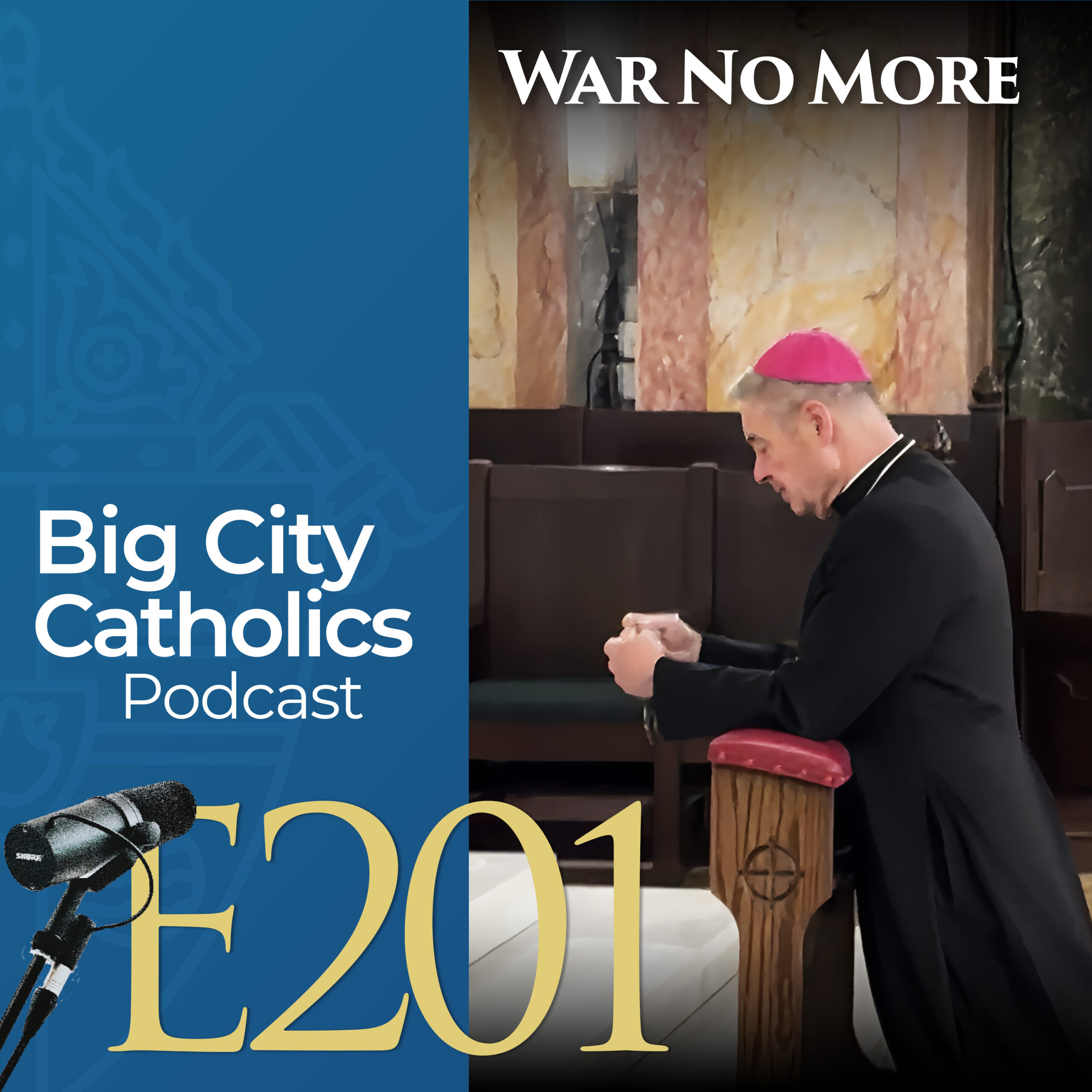
[00:04:17] Speaker B: Yeah, some very, very, very serious issues of the day. You know, three or four weeks ago was this fourth Sunday of Easter. Pope Leo at the Angelus on Easter Sunday asked the church to gather in prayer to pray the rosary for peace. He's looking at the situation certainly in Iran, but really all around the world. I mean, so many situations where there's war and violence. He called on leaders to work toward peace, to seek dialogue, but he called on us as the faithful to gather in prayer. He himself led a rosary vigil on the Saturday of that octave of Easter, the eve of Divine Mercy Sunday. And many people tuned in through the different social media platforms to get the Vatican news and prayed with him the rosary. And we looked for an opportunity to do the same, looking ahead to be able to get the word out. And the Provita Mass seemed like the perfect opportunity for a couple of reasons. First of all, the Knights of Columbus themselves were involved and committed. And you know what? God bless them. Most of them were there by 10:15 so that we could say the rosary at 10:30. And that was. That was a beautiful thing. And a number of our parishioners at the Coke Cathedral were there. Some stayed after the Haitian Mass, others came early for the 11 o' clock English Mass. And people came just because they had heard that it was a special prayer for peace.
But the other reason is those issues tie together because our concern for peace is itself a life issue. And one of the things that Pope Leo is talking about, I'll use my word, this ongoing dehumanization, this spirit of dehumanization, and that's what that culture of death going back to Pope St. John Paul II has really denigrated into this whole deep dehumanization of people. So, yes, peace is the life issue. So we gathered at the Coke Cathedral to pray in thanksgiving for the gift of life, but also to tie that in with peace. And it was beautiful. You know, last Sunday was Good Shepherd Sunday. But the last line in the Gospel, as Jesus talks about being the sheep gate and letting the sheep in and the sheep out and then leading them, knowing his voice, he says, I came so that they might have life and that they may have it more abundantly.
I came that they might have life and have it more abundantly. Jesus came that we might have life, but that our lives might be meaningful and in fact, through his resurrection, eternal. So it was a great setting for all of these issues. And then, of course, and we'll get to all of them. But we went to bed Saturday night kind of in horror about the violence that took place at the White House Correspondents Dinner and yet another assassination attempt.
So it's all very, very concerning. So, yes, this is an invitation that Pope Leo gave to us to pray, to pray our hearts and pray fervently for peace.
[00:07:19] Speaker A: Bishop, you recently also had a chance to publish a letter in the Tablet and for our diocese in speaking on the topic of Pope Leo, who speaks, as you say, not as a politician but as a pastor, and how true that is. There was a period of time there for the brief maybe week and a half, it seemed like there was this tete a tete between our Holy Father and our president. And it clearly was a misinterpretation of the media and big news corporations trying to make something out of this. No, our Holy Father speaks as a pastor, not as a politician, and speaks to preach peace to our world, not just to the United States. But to the world.
[00:08:00] Speaker B: Precisely. And to say that he preaches as a pastor doesn't mean to water down his message. It doesn't mean that he's just being religious. And you put it on the side. You know, you look at the first pastors again in that reading last week. You know, Peter gets up on the day of Pentecost and he tells it like it is. You know, speaking as a pastor means being, in a sense, the conscience for the world. He speaks the voice of conscience. It has a certain moral authority. It's not like I'm watering it down by saying, oh, you know, he's just a pastor. He just has to say nice things. Oh, no, no. It's a real concern.
The Pope is looking at the whole world.
He's looking at the whole world and he's seeing the suffering. And his message is war no more. I can trace that in my own lifetime. I can. I remember hearing those words from Paul vi, from John Paul ii, John Paul I in his very short reign, Benedict Francis, and now Leo, War no more. And he's been from the day he was elected. Do you remember his first words?
[00:09:05] Speaker A: That was incredible on the balcony? His first words spoken, peace be with you.
[00:09:10] Speaker B: That's how he greeted us.
[00:09:11] Speaker A: Yeah.
[00:09:12] Speaker B: So this is a consistent message and it's an important message. It's a very important message for the world. And yes, you know, it should challenge us. It should make us think about our preconceived notions. It should make us a little bit uncomfortable because war is a terrible thing. It's a terrible thing. And Bishop Massa is the chair for doctrine for the usccb, and he made some clarifications about the just war theory. And again, you know, no matter what the circumstance, nobody, nobody loves war. And even when you get dragged into something, it's because the ultimate goal is to protect life. And the collateral damage isn't so collateral. I mean, when innocent people are hurt, it's a real, real tragedy. And so on the return trip from Africa, Pope Leo very, I'd say, very even handed, very good message for the world. Again, speaking with that moral conscience as a pastor, calling on all nations, all regimes to end the violence. And his words were, too many people are being killed.
[00:10:18] Speaker A: Yeah, those words are striking. And that's condemning violence. And this pro vita message is a message that starts, like you said, it starts with peace. Peace, certainly that prevents war, but even peace that would, a peace that reigns in our lives, that would prevent families and mothers in crisis, pregnancies fall into despair. And to consider Boarding their child's life. It's a peace that reigns in our hearts that would respect the dignity and value of all human beings. That. That no one, as you said in your homily, that no one is expendable, no human being, new human person is expendable.
[00:10:59] Speaker B: We were all created in the image and likeness of God. And that's true for every one of us. For the child in the womb, the terminally ill person. We just dealt with the question of assisted suicide here in New York State. Yes. Even the hardened criminal. And then you think of innocent people who are caught in the crosshairs of war and violence. Political opponents, we saw that this weekend. And, you know, even just people we just don't like. But that dignity of human life created in the image and likeness of God makes them worthy of dignity and respect. Wow. Is that sometimes difficult? Oh, boy, it is. It is. But that's, you know, that's the bedrock, and that's always been the bedrock of Catholic social teaching.
We were created in the image and likeness of God.
We bear God's image. So an attack on another person, any kind of violence, crime, abuse, is an attack on the image and likeness of God. That's a heavy burden.
[00:12:00] Speaker A: As we were mentioning in preparation for this week's podcast, is this sort of a desensitizing of the young, younger generations, breaking them down into different groups of age? But as you pointed me to this Gallup Poll, that was this article that was released just in December of 2025, asking if political violence is ever acceptable. Right. If it's ever acceptable.
Sadly. Right. The percentage is 30% of people aged 18 to 29. 30% of people say political violence is sometimes okay.
4% of over 60 say it's sometimes okay. You know, so just by generation, you see an incredibly desensitized 21% of people
[00:12:50] Speaker B: between 30 and 44, and 13% between 45 and 59. The number has to be zero.
Yeah, the number has to be zero. That's just remarkable. And unless taken by the breakdown in age and more taken by the fact that just anybody, like a third of any significant group would think that there are times that it's okay just because of political ideologies to commit acts of violence, it reflects on a lot of what's been happening in the world. You know, obviously this nation is built on debate.
Self governance means you have to hash out the issues.
So debate has to be built into it. So there are going to be people, different political motivations. That's just who we are. And that's in itself actually a good thing. That's not necessarily. That's a good thing. We, we have to be able to hash things out. But people of goodwill can disagree, disagree very strongly, but be respectful. And that's what this concern reminds us of, that we need to be able to find the ways to express our concerns, our differences. It's some of our passionately held beliefs in a respectful manner and even just personal disagreements along the way. You know, I was looking at that Gallup poll a little bit more and you know, two other indicators. It's something that might surprise you. The education level. The higher the education level, the higher percentage of people saying it's okay.
Yeah, that's deeply concerning.
[00:14:33] Speaker A: You would think it would be the opposite, right?
[00:14:36] Speaker B: Exactly.
[00:14:36] Speaker A: That's concerning.
[00:14:37] Speaker B: And the other one is that determines the amount of time spent on social media.
And I've kind of lost touch on some of these things. But you hear a lot of talking about the gaming industry, the video games. You know, I'm still thinking video games are like Mario Brothers, believe it or not.
[00:14:56] Speaker A: Frogger. Frogger.
[00:14:59] Speaker B: Well, you know what it is? I go back myself to the days of like Pac man and all of that. That is like I'm really in the end of the world when it comes to the gaming industry. But like I remember when my nieces and nephews were younger and you know, playing games like Game Boy and all of that and it was, yeah, like Mario Brothers working your way through puzzles and all of that. Or the big thing was like a fantasy baseball of sorts. Yeah, putting. You'd play games of baseball.
But my understanding now that there are some games that are truly disturbing that have to do with killing and some of them based on real life situations.
[00:15:38] Speaker A: The gaming industry that is incredibly gory, whether it be some sort of a soldier game or just walking around as a menace to society and hijacking cars and a sad state of affairs really. And so you can see it, you can see. And the gaming industry gets more and more realistic. They get more and more violent. The attacks get more and more real. And so we do often hear of these connections between it. It's a sad. It's a sad state of desensitizing, you know, our whole entire young culture to this, this.
[00:16:16] Speaker B: You know, I want to pick up on something there because I think it's very, very important. My concern, like I said before, is that anybody, let alone large swaths of people would say that sometimes it's okay to commit violence for political purposes. But it was not meant really to focus in on the age group. It's just that the numbers were kind of shocking. The fact of the matter is that the great majority of our young people do reject the violence. It's concerning that. It's not 100%. A lot of them do reject the violence. And we've been talking a lot, especially since Easter, about the role of young people in the life of the church and the numbers of people who are coming.
And so while you have these segments in our population at all ages, you also find that there are very good people who are rejecting this culture of death. And I think this is where the Church comes in, and I think where Pope Leo is drawing us, he's drawing us to go deeper. The silent majority is silent no more.
And they're getting themselves involved and committing themselves to the Lord. Many people go into church. We have some really exciting things coming up in our young adult ministry. I'll talk about it some other time, but our chapter of Young Catholic Professionals is going to launch very soon. The end of the next month. I should say the end of this month. We launched this episode on May 1st.
[00:17:45] Speaker A: So that's right. True. Yeah.
[00:17:47] Speaker B: So at the end of this month, we have ycp. So the real story of our young people is about the 70% we've got to celebrate and encourage and enhance that. That's where Pope Leo is reaching out. He knows that he's reaching out to those who do reject all the violence and saying, we need to band together. We need to be united in solidarity. We need to be united in prayer. The people of all ages, the young and the old, can be the voices, if you will, for peace, for reconciliation, for respect for human life, for respect for one another. And we really want to encourage and build on that. You identify the good and you really try to expand that out.
[00:18:33] Speaker A: Bishop, as we started this podcast talking about the great work of futurist and education supporting Catholic education in our diocese in Brooklyn and Queens, isn't this exactly why this dinner exists? Isn't this exactly why these opportunities for donors to support. Support Catholic education in our diocese, to support and invest in the youth exists, is to make that investment in the
[00:18:57] Speaker B: youth, to plant those seeds, to plant the seeds of friendship with Jesus Christ so that they can know him who came, that we might have life and have it more abundantly? You know, I love that line. Jesus doesn't want us just to have life. He wants to have it us to have it abundantly, not just to get by, to have the fullness of life. And yes, we plant those seeds in our schools and we give that opportunity to families so that that education becomes available. Yes, indeed.
[00:19:20] Speaker A: If those who are listening would like to support futures in education, it's very simple. FutureEducation.org is our website for supporting changing lives through the gift of education in Brooklyn and Queens. And it's very easy to donate. You can become an angel. You can really help give that gift of an education to a deserving child and a deserving family and help make that impact which will change the world to come. So I say than because I know that, you know, as St. Joan of Arc, we're also recipients of some of that kindness. So I have an invested interest in this as well.
[00:19:55] Speaker B: Indeed. Indeed.
[00:19:56] Speaker A: Bishop. Perhaps as we close, you could end with a prayer and a final blessing.
[00:20:01] Speaker B: Absolutely. In the name of the Father, and of the Son and of the Holy Spirit. Amen.
[00:20:06] Speaker A: Amen.
[00:20:07] Speaker B: And as we get into these later weeks of the Easter season, we continue to pray that Antiphon in honor of our blessed Mother, the Regina Chaley, Queen of Heaven. Rejoice. Alleluia. The son whom you merited to bear. Alleluia. Has risen as he said. Alleluia. Pray for us to God. Alleluia. Rejoice and be glad, O Virgin Mary. Alleluia. For the Lord has truly risen. Alleluia. Alleluia. Alleluia. And may Almighty God continue to bless you and your family these days of Easter. And always. In the name of the Father and of the Son and of and of the Holy Spirit. Amen.
[00:20:42] Speaker A: Amen. Thanks, Bishop. And thanks to one and all for joining us each and every week on this D podcast. We hope you'll join us next week. God bless.