Episode Transcript
[00:00:00] Speaker A: Foreign.
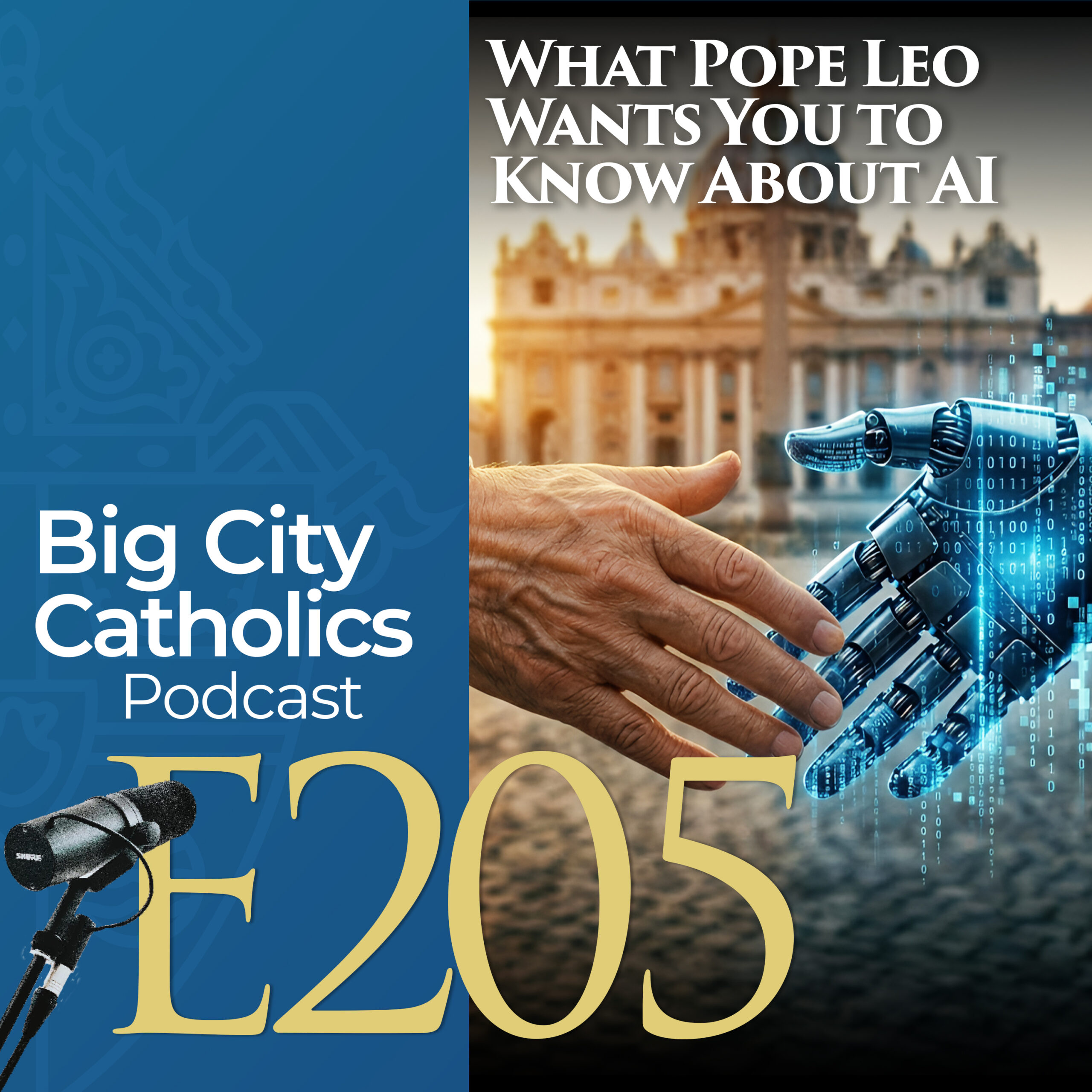
[00:00:10] Speaker B: Welcome to a new edition of our diocesan podcast, Big City Catholics, with Bishop Robert Brennan, the Diocesan Bishop of Brooklyn, serving in Brooklyn and in Queens, myself, Father Christopher Henry, here at St. Joan of Arc Parish in Jackson Heights. Today we're joined two special guests, Father James Carolly, the Director of Youth and Young Adult Evangelization Office here in the Diocese of Brooklyn, as well as the rector of Cathedral Preparatory Seminary and High School. We're also joined with Father Joseph Zwasta, academic dean at Pope St. John XXIII National Seminary in Weston, Massachusetts. Both guests have been on our podcast before. Today we're talking about the newly released document, the encyclical by Pope Leo xiv, Magnifica Humanitas, Safeguarding the Human Person in the Time of Artificial Intelligence, released on Monday, May 25th. So we begin. I chose to begin at the end here, quoting from this document the last two paragraphs which speak of our Blessed Mother Mary, Blessed Mother, whom we ask for her intercession at each and every time we come together. So we'll pray. It's Father, Son and Holy Spirit. Amen. Pope Leo writes, the Blessed Virgin Mary not only teaches us to recognize God's invisible work, but also directs our gaze to the point at which humanity is broken and the world becomes distorted, the contrast between the humble and the powerful, the poor and the rich, the satiated and the hungry, teaching us to look at the world from a lower position through the eyes of those who suffer rather than the mighty. To view history through the eyes of the little ones rather than the perspective of the powerful. To interpret the events of history from the viewpoint of the widow, the orphan, the stranger, the wounded child, the exile, and the fugitive. The Blessed Virgin thus becomes poet and prophetess of redemption, because on her lips is proclaimed the strongest and most innovative hymn ever articulated, the Magnificat. It is she who reveals the transformative vision of the Christian economy, the historical and social result that still draws its origin and strength from Christianity. With the same faith as Mary. Let us become weavers of hope in our world, sharing who we are and what we have, so that the presence of Jesus may grow among us and his kingdom takes shape in the humble fidelity of daily life. Even the era of AI can become a time in which the Holy Spirit brings about the civilization of love in our lives. Indeed, the Lord continues to make all things new and offers every era the possibility of becoming part of salvation history. In the light of the Incarnation. I entrust our desire to the Mother of Christ, to the woman of the Magnificat, that she may Guide our steps through this time of change and preserve in each of us through faith in the gospel, so that we may bear witness to the grandeur of humanity in which God has made his dwelling. We pray together. Hail Mary, full of grace, the Lord is with thee. Blessed art thou among women and blessed is the fruit of thy womb, Jesus.
[00:03:06] Speaker A: Holy Mary, Mother of God, pray for us sinners now and at the hour of our death.
[00:03:11] Speaker C: Amen.
[00:03:11] Speaker B: In the name of the Father, Son and Holy Spirit. Amen. It's great to have these two guests on with us, Bishop. To discuss this newly released encyclical, 40,000 word document. I guess we'll be here for a few hours today recording this podcast.
[00:03:26] Speaker C: This was a big week. Pope Leo's first encyclical. This is very serious teaching and it's no surprise because he's been talking about it from the beginning, that he would be concerned about artificial intelligence. He chose the name Leo because of Leo XIII and Leo xiii who spoke about the Industrial Revolution. He sees us on this same pathway at the cusp of an important moment in time, a pivotal moment, as he describes it, with the advance of technology to this new reality of artificial intelligence.
So following in the shoes of Pope Leo xiii and we get a lot of our Catholic social teaching from his document, Rerum Novarum, Pope Leo XIV is speaking to the present generation, meeting the needs of the world today, but speaking with the eternal truths of the Gospel. Welcome, Father Karolyi and Father Zwasta, thank you for joining us today.
[00:04:23] Speaker D: Thank you, thank you.
[00:04:24] Speaker A: Great to be here.
[00:04:25] Speaker C: Father Zlosta, you can ground us well in that tradition of the social teaching of the Church, but I think it's important that we start from where Pope Leo is speaking, the whole point of this document. I remember when I went to the adlimina in Ohio, Pope Francis, at one point he was talking about Laudatu si. And it's almost like he shook his fist. It wasn't quite that emphatic, but he was making an emphatic point. He said, laudato si. It's not about the environment, it's about the human person. And I think you probably could say that this too, it's about AI, but it's not just about AI. It's really grounded in the human person. Yeah.
[00:05:04] Speaker A: And I think you mentioned Ray of Navarre, which is kind of seen as the inaugural social doctrine encyclical in the Church's Magisterium, that the Church is teaching from 1891, 135 years ago. But even, even that was grounded in more timeless principles, moral principles grounded in, you know, the aspects of the Church's teaching that are centered upon the safeguarding of the dignity of the human person.
And I think Pope Leo very well kind of grounds what he says, all the very kind of specific things he says about the modern challenges, the contemporary challenges in those principles. And he especially grounds what he says, the dignity of the human person in the reality of the Incarnation of Christ.
And he begins with that very well known quote from a document from the Second Vatican Council, gaudium et spes. I'm paraphrasing here. That council says that it is in the mystery of the Incarnation of Christ that the mystery of humanity is fully revealed, so that Christ reveals the full dignity of humanity to us in the Incarnation of the Son of God. So that's the foundation of everything specific that is being addressed in this text and in all the other texts of what we put under the umbrella of Catholic social teaching.
[00:06:30] Speaker C: Yes. You know, I often kind of condense it. I say God became human to teach us how to be human and then to raise us up to his divinity. So we learn by lifting our eyes to Christ in the mystery of the Incarnation. I love the biblical image that he begins with, that we're at a pivotal point where we choose either to construct a new Tower of Babel or to build a civilization of love. And he contrasts the biblical image of the Tower of Babel with Nehemiah, who was centered on rebuilding the city after the exile, calling people together to place God at the center of their lives.
[00:07:13] Speaker A: Yeah, that's a beautiful image. That contrast between those two biblical images of the Tower of Babel and the rebuilding of the walls of Jerusalem.
And what is the contrast between them is that in the building of the Tower of Babel, God is excluded. There's a. An attempt to kind of have this sort of utopia, might say this perfect human situation without God.
And in the case of the rebuilding of Jerusalem, it's very much grounded in putting God at the center. And there's working together among the people of Jerusalem to rebuild Jerusalem. And that's a key theme throughout this encyclical.
[00:07:53] Speaker C: Yeah, he says we can't be afraid to get our hands dirty on the construction site of this civilization where God has chosen to dwell. That God dwells among us. Exactly. And another point that he makes, Father Karoli, he talks about how AI in paragraph nine, he talks about technology.
It's not the answer to everything, but it's a help and it has the power to heal, connect, educate, protect. But it also has great power to divide and exclude. You see a lot of the power among our young people, and particularly in the academic setting, that these are good tools, but they're not neutral. They have to be used in a particular way.
[00:08:36] Speaker D: Absolutely. And you know, what I love about Pope Leo's words is he recognizes the reality of technology and AI, and he says, you know, AI is not evil, but it's not neutral either.
And so what happens in society is the temptation to value efficiency over dignity. And he speaks beautifully when he says, you know, intelligence doesn't mean wisdom, and information doesn't mean truth, and efficiency doesn't mean goodness. I often say, you know, better technology, smarter machines doesn't mean better and smarter human beings. We have to use it to. As an instrument, but that cannot be. And a means to seek out the truth, but it cannot be the truth itself. And so therefore, really, you know, one of the things that he speaks about is that the sense of formation, the formation of the human person cannot just rely on AI, cannot rely on technology, but the formation of the human person relies on Christ himself.
[00:09:40] Speaker C: And, you know, AI is this new technology, artificial intelligence, this new technology. And I know for a lot of people, it's hard to wrap our heads about what this actually is, but we can look at it in even earlier generations of technology. I think of the cell phone and social media and all of that, wow. We have the power to connect with one another instantaneously around the globe. In some ways, beautiful. A great power to unite us, a great tool to bring us together, bring people together.
But we also see that it has this power beyond us, to isolate us. I get a kick out of when you see a crowd of people sitting at a table, and instead of talking to each other, each person is scrolling or looking at text or something like that. It's the same reality, but it has power to unite, bring together, or to divide. So we see it already, and I guess we can see it now, even exponentially, with this new generation of technology.
[00:10:41] Speaker D: And Pope Leo certainly warns that AI could weaken, like, authentic human connection, that technology can even make more loneliness and replace friendship with simulation. And kind of even the sense of our identity comes from who we're trying to be online.
All of these things that the Pope really does warn us, and specifically our young people against.
[00:11:07] Speaker C: And he's been talking to the young people. He used technology. We saw a great example of this at a gathering of the youth of the United States in November, where the Pope used technology to connect live. So there was a dialogue with The Holy Father, he being in Rome and we being in Indianapolis. And it was a live conversation, dialogue. Wow, what a great use of technology.
But at that very moment he used to the opportunity to raise these concerns about substituting technology with real human relationship. It certainly is a clear preoccupation. The other thing he says is that my words, artificial intelligence, artificial means created. Again, it's not neutral, it's not a real intelligence. It's somebody else's input that then gets generated. So it's not unbiased. It's not unbiased at all.
[00:12:01] Speaker B: There's a few aspects too that I think are worth delving into. I mean, we recognize it's a long document and it covers numbers of different aspects. Even as you mentioned. One of the things I like about the document is it covers AI's role in education, AI's role in medicine, AI's role in tech addiction. It also gives concrete examples on how to maneuver through those aspects of life.
It's not a document that is, you know, that could be received by the world as the Church is afraid of AI or the Church is anti AI. It's a dialogue and it kind of continues that aspect of synodality. This is a conversation that has been happening. I thought it was quite beautiful that the release of this document, that Pope Leo himself would be present for it and that the co founder of Anthropic, one of the leading artificial intelligence agencies, Christopher Olav, would also be there as a guest and received really praise by the Holy Father just for his presence, for his conversation, for his work. But there's so much to talk about in the document. I think if we could just perhaps move through some aspects of it as a panel. We know that we begin in that context of Catholic social teaching. And Father Zvasti, you were speaking a little bit about that, about the social doctrine. You know, this Sunday we celebrate the most Holy Trinity. And there's even aspects of that that we can quote from the document. The image of the Triune God. Father Zosta, any aspects of Catholic social teaching that you'd like to bring to the conversation today?
[00:13:37] Speaker A: Well, that first chapter, giving a kind of summary of the modern Catholic social teaching from Reverend Novarum of Leo XIII in 1891 through the present, so through 135 years. And it kind of gives a summary through the various popes and through some of the documents of the Second Vatican Council that touch upon these themes and it talks about some of the concerns that brought about these different texts. So oftentimes popes down through the 20th century and into the 21st century, would write social doctrine encyclicals that commemorated a certain anniversary of Rerum Novarum. So, for instance, Pius XI, 40 years after Renav writing in 1931, which, if we think in history at that time, that was right after the beginning of the Great Depression. And so Ram Navarrem, as bishop says, looking at some of the very pronounced problems that came from the Industrial Revolution and the exploitation of workers, but also the kind of growth of socialism, and it gives a great specific critique of socialism as a solution that is proposed to those problems. Then in 1931, Pius XI was confronting the situation surrounding the Great Depression. And down through the decades, again, the popes were very much grounded in the principles that the Church has always espoused with regard to the dignity of the human person, the rights of workers, but also the importance of sound economic and social and political realities without getting into endorsing specific candidates and that kind of thing for office. So that's the balance that the Church and the popes down through the decades of Catholic social teaching have tried to maintain.
And this text from Pope Leo XIV gives a very good summary of those efforts down, you know, basically since 1891 through the present.
[00:15:39] Speaker C: There are individual circumstances, concerns particular to the time, but the principles are eternal, the principles are universal. So it's good to reflect on why he wrote the document. Why does the Church have something to say about artificial intelligence? I can see people just saying that you're out of your lane, but we're not trying to regulate artificial intelligence. We speak as the conscience speaks to the soul, that there are questions we have to ask, and it really is rooted in human dignity. You know, Pope Leo, he makes great use of the Second Vatican Council, Gaudium et spes, but also lumen gentian. What is the role of the Church? To be the sacrament of communion, you know, the sacrament of communion in the world, among people and with God. We have an important role. We're not speaking as politicians speak, we're not speaking as business people speak, but we can't be sidelined either. And that's an important part of the dialogue. And what's that principle? Human dignity, humanity? It's the same principle. When we talk about pro life and abortion and euthanasia, about human dignity. When we speak about poverty and justice, it's about human dignity. When we speak about the care of the immigrant, it's about human dignity. When we speak about technology, it's about human dignity. And I basically, we claim to know the maker, God, and we have there's something important that needs to be said. God created each of us in his own image and likeness, and that becomes the lens through which we look at all of these problems. So I think it's. It's a great lesson that chapter one, it was felt like I was back in college going over, reading through the history, social teaching of the Church. It was. It's quite well put.
[00:17:31] Speaker B: I'm sure many professors will be using this document now as a means to guide their classes. Bishop, you're touching certain aspects of human dignity. And one of them that was, as we're at the end of this week and this document is still on the mouths of the media, it's still being discussed, which is great. It's receiving a lot of traction, which is certainly very, very positive. One of the aspects was regarding. Well, two aspects, certainly. One was slavery. The topic of slavery was discussed and just war. And I think both are important. Perhaps if we could touch on them a little bit today during this conversation, a topic, you know, a headline that was in the media. Pope Leo publicly apologizes for the Church's role in slavery. This is a big aspect of this document in the breaking the chains of a new form of slavery. And also the role of technology, like you said, can be used for the good. It could also be used for the bad. Father Karolyi, in your world with youth and young adults, I mean, how can you perhaps respond to those who are saying, you know, being sort of enslaved even by technology? And as Bishop was mentioning, seeing young people sitting at tables and just being on their phones instead of those conversations.
[00:18:50] Speaker D: Yeah, I guess it goes to that question, can technology serve the human person instead of replacing the person? And not just in the workforce, but just in relationships, in friendships, you know, ultimately asking that question, you know, do we own the technology or does technology own us? And so all of those questions, you know, you can be enslaved to your phones and to social media, enslaved not just by the object itself, but also by what they are trying to portray as truth, what they're trying to give as their own identity. You know, how many likes do I have? How many people are following me? All of these things where we're really ultimately, as the Pope said and as we already discussed, right, that beautiful image of Babel, the Tower of Babel, where it's about pride, it's about domination, it's about confusion, humanity trying to become godlike. That's the story of Genesis, and that's kind of the story of technology. And so, again, the Church is not trying to reject outright technology, but trying to engage technology ethically so that we can use it for what it's supposed to be, which is a good.
[00:20:03] Speaker B: This aspect is discussed in the fourth chapter of this document, as well as, again, the dignity and value of work, as discussed. But the idea that the Holy Father sort of summarizes this idea of new forms of slavery are fueled by economic chains and digital infrastructures. Therefore, action is required on several fronts. And what I love about this document is it gives those concrete ways in which action can be brought about. We see the role of technology sort of enslaving in social forms, as you mentioned, not just even on Instagram, but even the use of technology in certain countries that lower or help to raise someone's social status in terms of the use of constant surveillance, countries like China, which do use that form of technology to monitor, constantly monitor and surveil their people losing social status by jaywalking or et cetera, these are the stories that are being published as using technology as a form of slavery, enslaving people by constant surveillance. But also to speak a little bit about the just war theory, Father Zlosta, can you talk a little bit about what the Pope is speaking of here?
[00:21:19] Speaker A: Well, that's one of the applications, certainly, of this text, and this has been something, of course, over the last year, plus of this pontificate that Pope Leo has been talking a lot about because, you know, and often, of course, we have a tendency to.
To interpret everything from the American context. And with the American Pope, it's even easier to do that. But he, of course, has a more international perspective. So what he's saying is applicable, you know, throughout the world.
But, you know, the Church's just war doctrine is, you know, again, it's grounded in centuries of reflection upon different principles. I think the Holy Father is very concerned today about, you know, from one perspective, the sheer, you know, power of modern weaponry.
So the ability to inflict grave damage and harm upon those in warfare, let's say, in general, you know, is orders of magnitude higher than it's ever been. In particular, AI is able to, in terms of carrying out of warfare, is able to have really very powerful effects. And so that's something that Pope Leo is very concerned about in this document. And he doesn't really get into very specifically the principles of just war. He just kind of mentioned that he thinks that AI is really going to have such an effect upon the carrying out of war that all of our previous reflection upon this topic may be really quite behind the times.
So that's something that I think we'll be hearing a lot more about in the. The coming years.
[00:23:07] Speaker C: And we've been seeing the unfolding of this. The principle of just war theory. The principles remain. The principles are the same principle, but the application of those principles have to be reflected on the context of the modern times. So principle of just war theory, the right to defend and all, that's all there. But the question of proportionality, that's scary now because we can do so much more damage. So when you apply those principles to the weapons today, the possibility for mass destruction. We went through this conversation globally with the proliferation of nuclear weapons, and now with AI, we're already seeing it played out.
Unfortunately, the world is at war. We see some pretty serious modern wars going on in different parts of the world. The United States are engaged in war in Iran. And we're seeing the work that AI does and the damage that it can inflict. So it has to make us stop and ask some very important questions.
[00:24:06] Speaker D: You know, Pope Leo speaks, really warns about that distortion of truth. See that? Right? The fake videos AI generated advice, psychological help, misinformation, this erosion of truth, right. Political manipulation, all of these things. And how is that going to help in the formation of our people? You know, what happens to evangelization when nobody trusts what they see or what they hear online?
[00:24:31] Speaker C: You know, that's a good point. And you already face this in the academic world. AI now makes it harder to detect plagiarism and things of that nature.
But also it has, like, AI could be a help in terms of research, it get us to a point. But academically, we have to remind ourselves, we have to go back to original sources. Right? That becomes a real key thing in this.
[00:24:56] Speaker D: Absolutely right. And you know, AI, again, is just that tool that. That can be used, but it cannot replace human wisdom and human knowledge.
[00:25:05] Speaker C: You know, I was interviewed by the tablet about a week or two ago before the Pope's letter about. I guess it was something about an AI version of Jesus where you could talk to.
[00:25:16] Speaker B: Yes, you Pay. You pay $2aminute or something like that to talk with an AI Jesus.
[00:25:23] Speaker C: But, you know, that's a modern construction of idolatry, because it's not neutral, that person of Jesus, somebody's input, and then it gets developed, but it makes Jesus an imaginary friend.
[00:25:36] Speaker B: Yeah, we see it. I know this is not. We're straying a little from the actual document, but we see it in these young people using AI for counseling. And we see that sometimes the disastrous effects of that in terms of young people taking their own lives because of this, you know, seeking counsel from ChatGPT or from one of those sources. So there are certainly dangers to this. And the beauty is, as rerum nivaram translates to, of new things, of things that are new. This is something that is new, as you mentioned, Bishop. And it's, it's wonderful that we belong to a church that wants to be a part of that conversation, wants to engage young people in that conversation, and wants to have a seat at the table as we help to direct this society, navigating through a very new form. This document was not a document where the Holy Father comes out and says priests should not be using AI to write their homilies. It's not in that document, but that has been spoken by the Holy Father on other occasions. It's not just a document about priests using it to, to write a homily or something like that. It's a very, very in depth, well rounded document that has a lot of aspects that we really will continue to explore for, for years to come.
[00:26:57] Speaker A: I think one, if we wanted to sum up maybe, you know, in one question, you know, what, what Pope Leo wants us to think about when it comes to AI and other technologies, other kind of, you know, contemporary developments, the question is, when we use this technology, is it making our life more authentically human or less authentically human? I think that's kind of the key question.
And the Church has something to say and it's grounded in, again, the social teaching that we've been talking about. The Church has expertise, we might say, in humanity because we were fundamentally grounded in our understanding of Christ as the one who reveals to us authentic humanity. And so the question is, with any, any phenomenon, any new technology, any new development, you know, when we use this, is it making our lives more human authentically or less human authentically? And I think today, you know, a lot of people have a difficult time discerning that because, you know, they're, they've been grounded in a certain warped mentality when it comes to fundamental principles of life. Let's say we as a church have something to say grounded in our faith, grounded in our social teaching to a world that really needs to hear our, our message more than ever.
[00:28:20] Speaker C: I'd say well put and I think really sums up our conversation today and what, where the Pope is going to. We're going to be talking about this for a long time to come, I believe, and we'll be taking different aspects as we pick it upon and apply it to some of the conversations that we will have about this, this development. I go back to something that said, he said, let's not be afraid. Don't be afraid. But he says, don't be afraid to roll up our sleeves and get our hands dirty in this construction site sight of this new world. You know, to be participants in the dialogue, to bear witness to our faith, to use a Vatican II term that he quotes, in fact, cadim et spes, to interpret the signs of the times through the light of the gospel. So let's not be afraid. Let's sit at the table, let's get to the construction site, let's try to build up that common good.
And I thank you, Father Zwaster and Father Karolyi for joining us this day for in a sense, getting the dialogue started here in our own diocese here in Brooklyn and Queens. I look forward to reflecting on this in various different settings. And Father Henyu, thank you for your co hosting this week on Big City Catholics. I think it's good that we conclude our conversation asking God's help and blessing.
[00:29:48] Speaker B: Amen. The Lord be with you and with your spirit.
[00:29:51] Speaker C: May the Lord bless you and keep you. May his face shine upon you and be gracious to you. May you look upon him with kindness and grant you his peace. And may the blessing of Almighty God, the Father and the Son and the Holy Spirit descend upon you and remain with you forever and ever. Amen.
[00:30:06] Speaker B: Amen.
[00:30:07] Speaker C: Next week, Father Henyu, we'll be looking forward to the ordination of now Deacon Paul Paul Zwalek, and he'll be ordained a priest next week. And I think we have a conversation scheduled with our recently ordained to reflect on their first year.
[00:30:23] Speaker B: That's right, Bishop. Good things to come and thanks to all. Thank you Father Zwaska and Father Crowley for your presence. Thanks to all who join us each and every week. We hope that you'll join us again next week. God bless.
[00:30:39] Speaker C: Facebook.