Episode Transcript
[00:00:00] Speaker A: Foreign.
Welcome to a new edition of our diocesan podcast, Big City Catholics, with Bishop Robert Brennan, the Diocesan Bishop of Brooklyn, serving in Brooklyn and Queens, and myself, Father Christopher Henry, here at St. Joan of Arc parish. Today, on June 19th, as this podcast releases, we gather in prayer. We pray together.
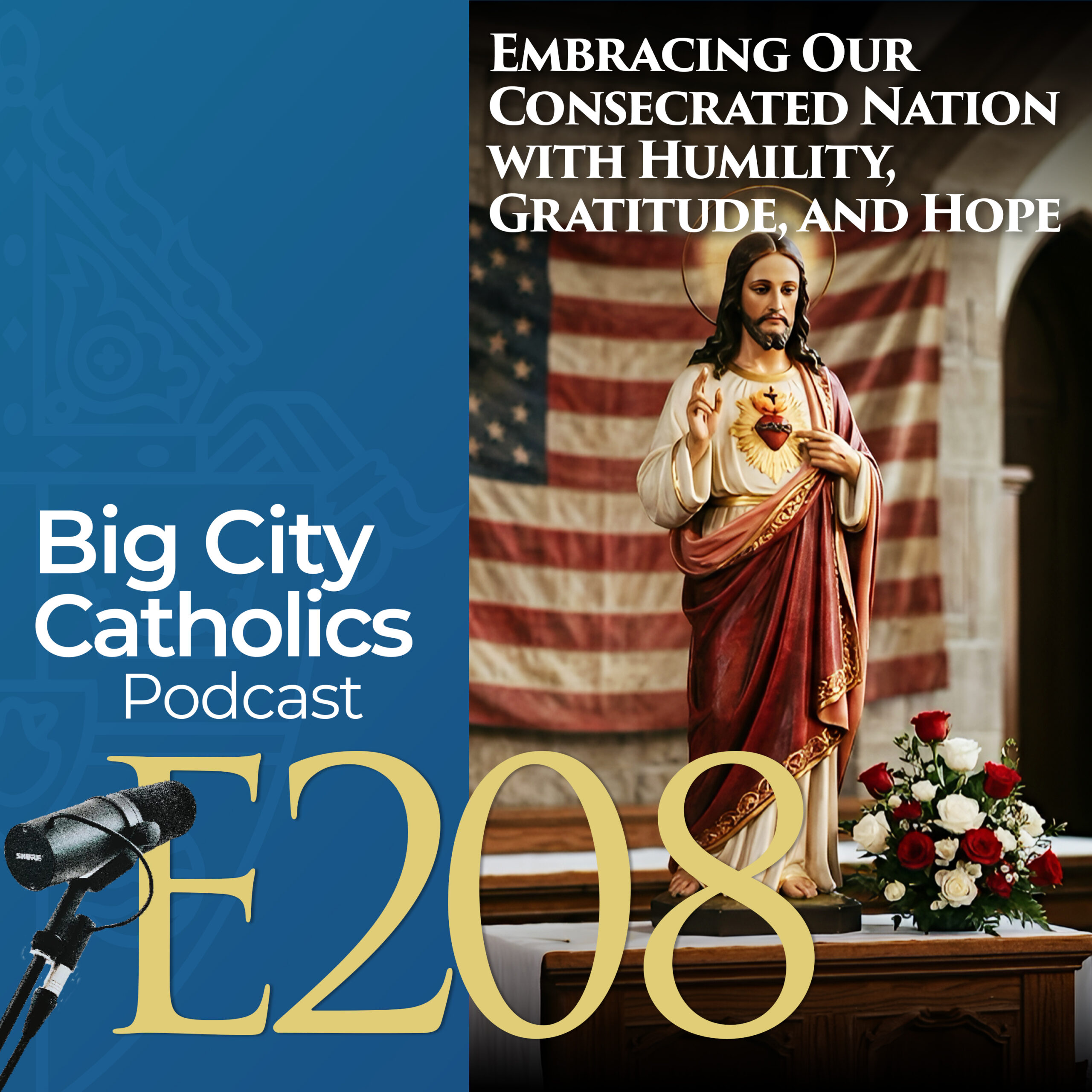
Recognizing last Friday, the solemnity of the Sacred Heart of Jesus was celebrated. We want to continue that momentum and offer the prayer that the bishops prayed consecrating the United States of America to the Sacred Heart of Jesus.
So we begin in the name of the Father, Son and Holy Spirit. Amen.
[00:00:43] Speaker B: Almost.
[00:00:43] Speaker A: Sacred Heart of Jesus, you know the longings of our hearts and you desire that we enjoy friendship with you. From your pierced side you have poured out the wellspring of life for which we thirst. Your heart burns with a love for all people to return to a right relationship with you. We celebrate the abundant gifts you have given this nation founded on the self evident truths that our Creator has endowed all people with the right to life, liberty and the pursuit of happiness.
We make reparation for the offenses against you and against human dignity that have taken place in this nation.
May our hearts be united to yours so that our families and communities enjoy peace and happiness.
May broken relationships be reconciled, injustices repaired and the wounds of our land be healed. May your Holy Catholic Church serve as a sign pointing all people to your infinite love. O desire of nations and center of history. We ask you to bless these United States of America.
Live and reign with God the Father in the unity of the Holy Spirit, God forever and ever. Amen. Most Sacred Heart of Jesus, have mercy on us. Immaculate Heart of Mary, pray for us in the name of the Father, Son, Holy Spirit.
[00:01:57] Speaker B: Amen.
[00:01:58] Speaker A: Bishop, we're happy to be back again with you.
[00:02:00] Speaker B: I feel like such a stranger. It's coming up on it's two weeks that I've been gone all on USCCB business. First our meeting and then now a pastoral visit to the migrant workers in South Carolina. The day that this releases, I'll be in the air on my way back to Brooklyn and Queens. So it's been a long time. I feel like a stranger, but it's good to connect this way.
[00:02:22] Speaker A: At least it is that we could continue the conversation. And I mentioned at the beginning, you know, the prayer that we used is that which you as the bishops gathered together in Florida for your meeting. That normally occurs at that point, but you chose at that meeting to consecrate the United States of America to the Sacred Heart of Jesus. It was a beautiful ceremony. I imagine of all the Meetings and all the things that were on the agenda. That was probably the highlight of it all.
[00:02:48] Speaker B: It absolutely was Thursday morning. We did a little bit of business and then we had three reflections, very powerful reflections from bishops, and all that was broadcast as part of the public meetings. But it's a real call to appreciate the love of God. That called ongoing call to conversion and transformation and also to be instruments of God's love and mercy. And then we made our way to the Shrine of Our lady of the Universe in Orlando, Florida. Beautiful sight. Time for prayer and adoration time. You stay in the church and pray before the Blessed Sacrament or to walk outside on the beautiful grounds. The Stations of the Cross, the Rosary, and then, of course, the Mass and the consecration. It really was a beautiful, beautiful occasion.
[00:03:34] Speaker A: Archbishop Laurie preached at that occasion.
[00:03:37] Speaker B: He did. And you know what the context of this all was? This was the vigil of the Feast of the Sacred Heart. But we did this really in the context of the celebration of our nation's history, 250 years, the Declaration of Independence and our claim as the beginning of a new nation. You know, Archbishop Laurie, in his homily, called us to a sense of gratitude, gratitude for that celebration, gratitude for our nation, for God's blessings, gratitude for the contributions that the United States has made in the world, but also gratitude with a sense of hope and humility. So it was really a very, very beautiful celebration and really, I think, set the right tone, at least for me, as we start to approach the national celebrations.
[00:04:21] Speaker A: Absolutely. I think even Bishop, as you kind of dissect the prayer, the beautiful prayer of this consecration, it doesn't hide anything. It recognizes we make reparation for the offenses against you and against human dignity that have taken place in this nation. I mean, that's a beautiful statement and a very humble and prayerful statement.
[00:04:42] Speaker B: Precisely. That's the humility that Bishop Laurie was calling for. And I often say this is a great occasion. We embrace our history. Now, what is embrace. Embrace our history mean? It doesn't mean that we erase it or, you know, pick out things that we like, but it's. It's not an unapologetic embrace. An embrace means accepting it lovingly as it is with gratitude. And so we acknowledge certainly the faults against human dignity, the reparations that need to be made. But by the same token, we don't reject it. We don't cancel it, saying, you know, well, as it's dark moment, so we just have to dismiss it. So I think that's really a good way to put it. To embrace it, embrace it with hope and humility.
[00:05:26] Speaker A: You mentioned too, that this podcast releases on June 19, Juneteenth, which is pretty appropriate in regards to this particular prayer, but also just on top of this
[00:05:35] Speaker B: topic, sure, many people are off today. Schools are closed. It's been brought into the heritage of our national federal holidays. It's a bittersweet kind of thing because it celebrates the end of slavery, but it has that deep shadow that slavery existed in our nation. It's very much part of the early years, the building up of our nation. And so, as the prayer says, we do need to make reparation. And so it's part of our history. And so it's something that we have to acknowledge and seek pardon, seek conversion, and recognize too that the evil of slavery that took place in that nation and really the forms of it that kind of exist in even the modern era. Pope Leo, in his recent encyclical about AI and human dignity, in paragraphs 175, 76, 77, he talks about the reality of slavery, not only in the United States, but in the world, and even the Church's failure to address it properly. And he apologizes with humility. It's a great, great moment and powerful witness on his part.
[00:06:46] Speaker A: It's true. I mean, in this particular encyclical, which we had the chance to invite Father Zwasta and Father Caroly to discuss it with us the week that it released, but there's so much in store within it. And of course, speaking of artificial intelligence, technology and the ways in which he calls it the chains of new forms of slavery through technology.
Yet quite beautifully, he does say, as you mentioned in that paragraph 176, it is impossible not to feel deep sorrow when contemplating the immense suffering and humiliation endured by so many, in stark contrast to their immeasurable dignity as persons infinitely loved by the Lord. For this, in the name of the Church, I sincerely ask for pardon. Again, beautifully humble, beautifully well said, well put. And acknowledging, not hiding, but acknowledging these stains of our past.
[00:07:41] Speaker B: And yet human dignity is still an issue that's really at the heart of the social teaching of the Church, human dignity. And we see all kinds of attacks. The Pope names some of the dangers in terms of AI, in terms of greed and corporations and governments and all of that. But let's think about human dignity under attack in our world and our society. The fact of abortion on demand, the human dignity is kind of cast away. We think of the care of the poor and the vulnerable. We think of the reality of human trafficking that's so, so prevalent in our world, which leads to actual slavery, People are kidnapped and child labor and all kinds of pornography, all the things that come out of that sense of human trafficking, the drug culture that exists, so much that eats away at human dignity.
And yet what the Holy Father is calling us to, what Catholic social teaching is calling us to, is to be awake and aware of these things, to be penitent, humble and penitent about the failures in our history, but also to be vigilant and to be prophetic in proclaiming the truth of the gospel to all.
[00:08:57] Speaker A: And you mentioned something which is so important, I think, is it kind of directs us forward, is hope even in the prayer, may your holy Catholic Church serve as a sign pointing all people to your infinite love, that our hope lie in the fact that we desire all people to move toward that love, toward that encounter, that relationship.
[00:09:18] Speaker B: Bishop Laurie was saying, our hope is rooted in the sense that the future belongs not to me or you, not to political movements, but to God.
Our hope lies in that our future belongs to God.
[00:09:33] Speaker A: Amen. That's the truth, truly. Bishop, as you mentioned, you know, part of this is in relation to the 250th anniversary of the founding of our country. And it's great that we are expecting to have on our show Father Michael Bruno of the Diocese of Brooklyn to talk a little bit about this topic, the role of Catholics in America, the role of the founding of our country. We hope to release that on July 3rd, that Friday prior to the July 4th weekend. That should be an exciting.
[00:10:02] Speaker B: It will be because Father Bruno is one of our priests. Of course, he's now the associate, but soon to be director of clergy personnel. But he's a church historian. He taught church history and particularly the church in the United States. So he'll have some good things to share with us about Catholic life in the United States. I'm looking forward to that. But, you know, on the consecration and on the celebration of the Feast of the Sacred Heart. So how did everything go back at home?
[00:10:26] Speaker A: So you were, of course, with the bishops, all the bishops of the country. And we here had numbers of celebrations, both locally and also the diocesan wide. So on the vigil as well, here at St. Joan of Arc, we decided to use that moment. There's already a scheduled Mass every Thursday evening. So we use that in the presence, in the context of adoration, to do the consecration to the Sacred Heart, both in English and in Spanish, which was quite beautiful. At the same time, on Friday, on the day of, we had the Mass from St. James Cathedral Basilica at noon celebrated by Monsignor Grimaldi, our Vicar General, which was broadcast, of course, on Net TV and was able to pray that consecration prayer. And then that evening, filling the co Cathedral of St Joseph, where the ladies the Cofradilla del Sagrado Corazon, which was quite a beautiful Mass.
[00:11:20] Speaker B: That's always really uplifting. It's a beautiful Mass. I've had the chance to celebrate it a couple of times.
[00:11:25] Speaker A: It's stunning. And this year, in the absence of yourself and usually Bishop Cisneros, who has some leadership within that group, Father Ernesto Alonso, a fairly newly ordained priest, I guess I can't say newly ordained anymore. I think he's four years ordained. A young priest in our diocese celebrated the Mass and preached and I had a chance to watch it afterwards. He did a fantastic job really addressing the community.
So it was quite beautiful. Again, just one last piece of this. Really beautiful, I think when all the local churches throughout our diocese, throughout the metropolitan and throughout the country are united in prayer for one particular purpose. And that's really beautiful. That's so beautiful. So it was nice to know that we were praying this in communion with so many others.
[00:12:13] Speaker B: That's great. That's great. Well, listen, I am looking forward to getting back to Brooklyn and Queens, but at the time of our recording, I've already begun some of the pastoral visit in South Carolina, visiting a couple of the farms and meeting some of the workers along the way, getting a sense of history.
It's fascinating. I'm looking forward to sharing that as well in a future podcast. But like I said, I'm on my way back.
[00:12:41] Speaker A: Please, God, and safe travels to you, Bishop.
[00:12:43] Speaker B: And I'll be back in time for Father's Day. Right. So I'll see my dad on Sunday and we'll pray in a very particular way for all the fathers in our Catholic family, asking God to bless them. The fathers, the grandfathers, spiritual fathers. And let's ask God's blessing upon all of us.
[00:13:01] Speaker A: The Lord be with you and with your spirit.
[00:13:04] Speaker B: Lord God, look upon us in your fatherly love.
Protect us and guide us.
Lead us.
We ask your blessings on all those who in your name protect, guide, lead and teach us. We give thanks for our fathers and for all of those who shape us and form us to know and to love you, O God. We ask your blessing upon them and we ask your blessing upon all of us.
In the name of the Father and of the Son and of the Holy Spirit. Amen.
[00:13:39] Speaker A: Amen. Thank you, Bishop. And to each and every one. Thank you for joining us once again in this week's podcast, Big City Catholics. We hope you'll join us again next week. God bless.
Sam.