Episode Transcript
[00:00:00] Speaker A: Foreign.
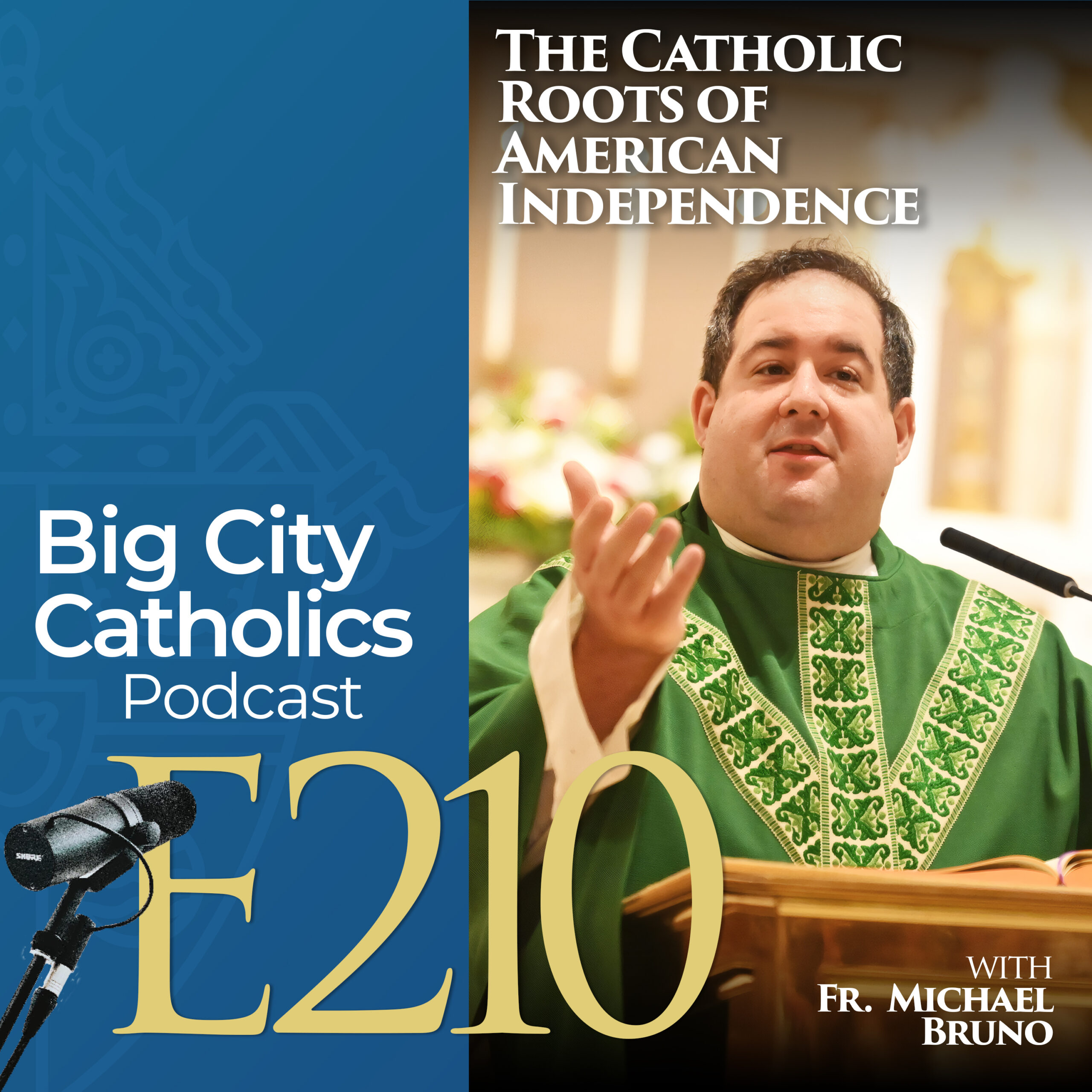
[00:00:10] Speaker B: A very happy July 4th weekend on this semi quincentennial of our country's founding, the 250th anniversary, as we record a special edition of our diocesan podcast, Big City Catholics, with Bishop Robert Brennan, the Diocesan Bishop of Brooklyn and Queensland, and myself, Father Christopher henyu. Here at St. Joan of Arc Parish today we're joined a special guest, Father Michael Bruno, vicar for clergy and consecrated life for the Diocese of Brooklyn, as well as the pastor of St. Vincent Farah in Brooklyn. It's his first time on the podcast. We're happy to have you on, Father Bruno, and we're talking about just that, this great day, this great celebration this weekend as we celebrate this anniversary of our country's founding and the role of Catholicism certainly in its founding. So before we begin our podcast, we start with prayer. And we'll begin with the prayer for our government written by Archbishop John Carroll. We pray in the name of the Father, Son and Holy Spirit. Amen.
[00:01:08] Speaker A: Amen.
[00:01:09] Speaker B: This is an excerpt from that beautiful prayer. We pray, Almighty God, who through Jesus Christ has revealed thy glory to all nations to preserve the works of your mercy, that your church, being spread through the whole world, may continue with unchanging faith in the confession of your name. We pray thee, who alone are good and holy, to endow with heavenly knowledge, sincere zeal and sanctity of life our chief bishop, the Pope, the Vicar of our Lord Jesus Christ in the government of his church, our own bishop, all other bishops, prelates and pastors of the church, and especially those who are appointed to exercise among us the functions of the holy ministry and and conduct your people into the ways of salvation.
We recommend likewise to your unbounded mercy, all our brethren and fellow citizens throughout the United States, that they may be blessed in the knowledge and sanctified in the observance of your most holy law, that they may be preserved in union and in that peace which the world cannot give, and after enjoying the blessings of this life, be admitted to those which are eternal.
In the name of the Father, Son and Holy Spirit.
[00:02:20] Speaker A: Amen.
[00:02:20] Speaker C: Hello, Father Christopher. It's good to be back with Big City Catholics. And a big welcome to you, Father Bruno. We're delighted to welcome you. You know, this is a big weekend. And so a special edition of Big City Catholics. We're going to be celebrating the 250th anniversary of the founding of our nation with the signing of the Declaration of independence on July 4, 1776. And Father Bruno, it's a great privilege to welcome you because you come not only with great experience as a priest and certainly as a formator, but you were a professor of history at the seminary at St. Joseph Seminary up in Dunwoody, and you taught something of the church in the United States. So I couldn't think of a better guest to have for our discussion. Welcome and thank you for joining us.
[00:03:06] Speaker A: Thank you, Bishop. Great to be with you. Thank you, Father Chris, for your kind welcome.
[00:03:10] Speaker C: While I love to usually chit chat a little bit, we have a full menu here, so I think we can get right into it. And why don't we start at the beginning? We think of those early days of the founding of our nation. We think about the role that Catholics played in the founding of our nation 250 years ago. We were a very small minority in this country, and yet we did have a part to play.
[00:03:34] Speaker A: No, absolutely, Bishop. You know, certainly July 4th brings us right back to Philadelphia. And, you know, we think of, for instance, the only Catholic signer and member of the First Continental Congress and signer of the Declaration, Charles Carroll of Carrollton, is in the room. And certainly this also reminds us of in the cause of American independence, Catholics play a very large role. And it's sort of a coming of age of Catholics who had faced a lot of discrimination and prejudice in the English colonies.
Much of the anti Catholicism of sort of that Elizabethan experience in England had seeped over into the English colonies, really outside of Maryland and Pennsylvania. And even there there were a lot of struggles. And so the American Revolution is, if you will, a coming of age, the first of, if you will, these coming of age moments of Catholics in the new republic. So right from Charles Carroll signing the Declaration, which, as we know, the signers are taking a great risk, right? Their risk of their life, their liberty.
Certainly they are now traitors to the Crown. But Catholics take up the revolutionary cause very quickly. And in the war itself, they step up. Certainly John Barry from County Wexford in Ireland is going to be the father of the American Navy. In fact, Commodore Barry is going to play a big role also for us here in Brooklyn in The War of 1812, when the British basically burned down much of Washington, Commodore Barry's going to lead the effort to build up the navy, and that will lead to the Navy yards, one of which it will be right here in Brooklyn, leading to a large Irish Catholic immigration into what was then the city of Brooklyn. So, Commodore, great connection for us in our own diocese as well.
[00:05:21] Speaker C: Actually, that's very close to the founding of our cathedral, the first parish on Long island in Brooklyn. And Queens. Third one, I think in New York State. All right. In that area near the Navy Yards.
[00:05:33] Speaker A: Exactly, exactly. Thomas Lloyd, you know, people take for granted that we have the words of Washington's inaugural, that we have sort of the discussions that were going on in the Continental Congress. That was because of the work of Thomas Lloyd, who's the founder of American shorthand, was the secretary of the first Continental Congress, was a Catholic and recorded much of Washington's certainly words as president and other important moments in the early republic. And one of the reasons we have many of those primary sources is because of Thomas Lloyd. For those of us in the New York area, we might encounter these other two names. I just think of other names we encounter on roadways. One is Pulaski. You could think of the Pulaski Skyway, which we hear a lot about. Well, Kashmir Pulaski of Warsaw was the founder of the American cavalry in the American Revolution, really basically built up the American cavalry in the army. And certainly another name you might hear, especially as we're driving over the bridge named after him is Thaddeus Kosciuszko, right, The Lithuanian born brigadier general of the Revolutionary army, by the way, in both communities still present in our diocese, right, of great pride, the Polish American community, the Lithuanian American community as well. And then obviously the French, right? The Americans don't come to victory at Yorktown without the French particularly. You could think of the Marquis de Lafayette, the Combo Chambeau. You could think of the French navy, which allows the siege at Yorktown to be a success, forcing Cornwallis to surrender to Washington. It's interesting because where I was on faculty and where I had served at the seminary, St. Joseph Seminary in Yonkers. Well, one of those, that property is one of the sites of Washington and the revolutionary forces in the New York, in the Hudson Valley, in the New York area. And we have evidence that most likely the first Mass, probably outside of Isaac Jogues, in the previous era of the French missions, probably the first masses being celebrated in the Hudson Valley are the chaplains to those French forces that had come to help reconnoiter New York, coming down from Westchester to reconnoiter. Because their basic conundrum was should we fight at the British in New York or should we go south? And they actually end up choosing south. They go to Virginia in Yorktown, because New York was such a stronghold for the British, especially on the Hudson, but certainly the French, many French troops and French sailors would be essential in the victory of the American Revolution. And we also know, however, that that coming of age, though, doesn't erase that anti Catholic presence and that anti Catholic fear. For instance, some of our American founders we could think of, for instance, Sam Adams, who goes on the record fearing the growth of popery in the new country. John Jay, the first Supreme Court chief justice, even questioned whether Catholics should be citizens. Are they subject to another, to another jurisdiction. And unfortunately, that's going to be a trope that will actually get repeated throughout
[00:08:40] Speaker C: American history, that allegiance to an outside leader. Yes, indeed. And it's interesting because our cathedral is located on J Street, right?
[00:08:49] Speaker A: Exactly, exactly.
[00:08:50] Speaker C: And that's, I think, actually somewhat symbolic because we live in the midst of this world, of this nation, we contribute to the life of this nation. But there's always that little bit of that tension. And some, like Thomas Jefferson, had a different view of religion altogether.
He wanted to use the words of Jesus, but really no sense of the Gospel itself, just the teachings.
[00:09:13] Speaker A: Sure, philosophical, moral system.
And it's interesting because Jefferson would have had, amongst the founding fathers, would have had probably one of the more wider exposures to Catholicism or at least the remnant of Catholicism before the French Revolution. Remember, he serves in France and as ambassador and so does have some contact there. When Jefferson's president, there's a great letter. The Ursuline Convent, New Orleans, basically writes to ask if they can continue in 1803 as now new Orleans and Louisiana Purchase has been completed. And Jefferson writes back and says, under our Constitution, sisters, there is no interference. You're certainly welcome to continue. And there's an interesting exchange there.
But in that new republic, I think, you know, we certainly could see Catholics entering the national discourse, admittedly in a limited way at first, and also sort of the exposure of some of that prejudice and anti Catholic sentiment. I always, when I taught US Church history, I always liked the quote of Jesuit Father James Hennessy, who was a very noted US Church historian and teacher of it. And he always says that in the US there's a conflict with Catholics between the dreams of homogeneity, he says, and the conflict reality of difference. There's a sense of we want to be the same as others, but also the reality that there is something unique and something different and that that sort of tension is something that's present right from the new republic. And in that Arab bishop, we have to talk about, about John Carroll, I mean, I think I'm so happy Father Chris chose that prayer of Archbishop Carroll, you know, really the church in the United States. He is the primary organizing force of the, of the church in the new Republic. Everything from education, Georgetown College in 1791, you know, St. Mary's Seminary, which is in the first seminary, basically on four acres that were bought by the Sulpicians from France. He calls the first synod in 1791. And. And Baltimore becomes the seat not just of the Church of the US but eventually its first archdiocese under Pius vii. And so, I mean, you have to. Carol has this just ingenious engagement with American culture. He has a sense of the desire and the need to engage the new republic. If you go down to Baltimore, the Cathedral of the Assumption, you know, that, that, that cathedral is intentionally built in that colonial, that colonial style. Right. Clear windows, sort of. It's built by Latrobe, you know, who builds, you know, builds the Capitol dome. So there's a clear desire and even in that cathedral, that first cathedral of the US to show this engagement with the new republic.
[00:11:55] Speaker C: Exactly. And, you know, I also think of Elizabeth Ann Seton, somebody who walked in the streets of New York City not as a Catholic, but who walked in the streets of New York City during that time. She was born just before the Revolution and through the founding of this new nation, but she was searching, finding her spiritual place, and made her way to the Catholic Church. So here in New York, had that experience and then went down to Baltimore, to Emmitsburg and worked very closely with Archbishop Carroll.
[00:12:29] Speaker A: Absolutely. And I, and I certainly have to say the role of women religious is essential, especially in that establishment of these institutions, these first institutions of the Catholic church in the U.S.
mother Seton, certainly the parochial school system. The first congregation of religious sisters founded in the US is her Sisters of Charity in 1809.
In addition, others too, Mother Duchenne out in St Louis, and other women religious come to the colonies from communities that had existed in Europe, whether it be the Daughters of Charity, the Sisters of Loretto, various Dominicans, Carmelites, the Visitandines which we had recently in the diocese. They were there from 1790 present in the new republic, building up schools, hospitals, starting those first, first moments, if you will, of Catholic institutional presence in the, in the US we think of later
[00:13:25] Speaker C: years, Mother Cabrini and the work she did, the immigrants, but, but again, finding these health systems and amazing, amazing things. Catholics themselves played a key role in the building up of this new nation. And that brings us to the 19th century with the first wave of Catholic immigration and with the Civil War.
[00:13:48] Speaker A: Yeah, Bishop, you know, we have to recognize we have been a country of immigrants. And this reality of Catholic immigration really explodes in the 19th century as we enter the age of the steamship. You Know people as we can go out in the New York area, go out to visit Ellis Island. You could see there's a great room at Ellis island which has many of the images, postcards of the steamships that were used throughout the late 19th and early 20th century. But beginning in 1819, the SS Savannah is that first steamship traveling across the Atlantic. And that opens up the possibility of immigration which is taken up for need because of necessity by Catholics in Europe, particularly in Ireland and Germany initially, certainly in 1845 as the Gorta more the great hunger leads to a massive loss of life in Ireland. There's also a million Irish immigrants who will come, many of whom to the shores of the United States elsewhere as well, but many to the United States.
In that period, you know, from 1845 to 1852, a quarter of Ireland's population is lost either to the famine itself or to immigration. Father Chris is the head of the Irish apostolate. I certainly defer. But it's a tremendous moment of importance in bringing many Irish Catholics to the United States.
[00:15:11] Speaker C: Indeed, in my own family, I would say one side of my family and my mother's side of the family are relatively recent immigrants. Her father and her grandparents were somewhat recent.
But on the Brennan side of the family, we've been generations of coal miners in Pennsylvania and trace back into the 1840s, 1850. So that would have been during that time of the great hunger.
[00:15:37] Speaker A: I think in my own family. Bishop, my great grandfather would have come on the SS Berliner, found out his ship, you know, and this. These immigrants especially. And in addition to the Irish, the Germans, certainly if we go to many of our churches built in the mid 19th century, not a surprise there's a large German Catholic community. Remember now they've come over 1848. Things are politically unstable and eventually there's going to be tremendous oppression of the church in the Prussian empire. And so you also see a large German immigration in this mid 19th century. Again, many of whom were Catholics, stopping first in New York. Many will also then move west to Pennsylvania, Ohio. But then, you know, we have the famous, what was called in the 19th century the German triangle. Milwaukee, St. Louis and Cincinnati. It was said that on the streets of Cincinnati and also streets also Milwaukee and parts of St. Louis, you would, you would hear German more than English. And the tremendous architectural legacy of. And we see it in our own diocese, in any of the German built churches, you know, we have a few,
[00:16:43] Speaker C: a number of German built churches and the communities. And really that German language stayed around until not too Long ago. So probably in this 21st century, we had the last of the German speaking masses. Right?
[00:16:57] Speaker A: Right, Absolutely.
Yo, absolutely. And so, you know, you have Irish Catholics and German Catholics and then you have the Italians. The first wave of Italian immigration comes really in 1847-49, in that period where you do have the beginning of revolution and unification efforts in Italy, which does cause the displacement, especially of sharecroppers, many Italians who lived in farming and rural areas. And we find an immigration beginning in that period and again, many of whom are now Catholics and therefore also desiring to bring with them their faith, their devotion, and for all these communities, a commonality certainly amongst these waves of immigration. And this, we'll see this also in the early 20th century in the Hispanic immigration. A commonality is always that their fate becomes a lifeline, if you will, a bridge to what they've left behind. And therefore also a new, you know, a support, a sustenance for them in this new frontier that they've entered in the United States. And pastorally, it opens up a new challenge as well that the church has to meet these needs. And that's where, as we said, you know, women religious, men religious, the, the, the, the, the growth of parishes and of dioceses. You know, we go from Simply the first five diocese now to an increase of dioceses in the 19th century. So this is going to happen especially as these immigrants both arrive and also move westward. You know. And so you'll see, in addition to those first diocese, you know, remember those first diocese of Baltimore, Boston, New York, Philly and Bardstown in Kentucky, which becomes Louisville now you see the opening up of the, for instance, Detroit, you know, Chicago and Milwaukee. St. Louis, which had been established already, now becomes an archdiocese in 1847. So you see, you know, there's this growth and development with this new wave of immigration, but just like the Revolutionary age, with this growth of the church in this period is also that sort of presence of increased prejudice and again, worry, concern about these Catholics and, and how they're gonna relate to the American experience and to the republic. And it becomes an age of tremendous discrimination and nativism against Catholics throughout the country, including violence. And this is gonna be a reality.
1834, there's sort of one of these moments in US church history.
It's the burning down of the Ursuline Convent in Charlestown, Massachusetts. And it becomes a sort of rallying cry, if you will, a moment of great concern for Catholics. We see the future Archbishop John Hughes, as a priest in Philadelphia, is going to decry this moment. Right. And especially other riots that's going to occur in 1844 in Philadelphia itself, riots that target Catholics. Louisville, Kentucky, on August 6, 1855. Bloody Monday it was called. It's an election day in Louisville. And so what happens? But Protestant nativists, many of them from the Know Nothing Party, go into Catholic neighborhoods and basically stage a mob. A mob stages an attack on the Irish and Germans to prevent them from voting in Louisville on that day. And this is, you know, this is one of those realities that's also faced as you have these new waves of immigrants. And I think for us, certainly here in Diocese of Brooklyn. Right. It's always a reminder, I always think, of the line of the Old Testament. Right. You, too, were strangers in a foreign land. That we have, as Catholics, a very. A great love and passion for welcoming the immigrant, precisely because as Catholics in the United States, we know what it means to both suffer for our faith, but also to enter into a foreign and sometimes even a more hostile environment.
[00:20:48] Speaker C: Some of that nativism and the Know Nothing Party, we get reminders of it even today. So I remember a story about the Washington Monument, that the stone, I think, was coming from Italy, from Catholic Italy, and thrown into the Potomac River. And so you see two different colors of stone because the project had to be abandoned and then rebuilt. But that was largely out of this nativist attack on Catholic immigration here in New York. You mentioned Archbishop Hughes. He was a great one fighting for the immigrants, the Irish immigrants in New York. And it was shortly after that, we have the founding of our own diocese right here in Brooklyn, so in 1853. Right, right.
[00:21:36] Speaker A: And Hughes is going to send, you know, we recall, we have that. That famous letter from Peter Turner and. And the other lay Catholics who are in Brooklyn, Irish Catholics working in the. Many of them in the Navy Yard. And they send a request, you know, to Archbishop Hughes at the time that we. We desire, you know, especially a priest to minister to us, catechesis for our children and a place to be buried in reverence in holy ground. Those were the three requests really given over. And previously, you know, we have the priests of Barclay Street, St Peter's coming over by ferry with women religious, catechizing and teaching children by ferry, going back and forth. However, you know, there's a desire for stability. And so eventually that first Parish is established, St. James, and then also other parishes following it. We certainly could think of probably Mount Carmel and Astoria. St. Mary's St. Patrick's in Bay Ridge is still founded under the archdiocese, and
[00:22:33] Speaker C: that was founded as Really, a chaplaincy to Fort Hamilton, right?
[00:22:37] Speaker A: Absolutely. Which was defending. Which was defending the Narrows, you know, especially at the entrance to the harbor. So Archbishop Hughes, though, eventually will send and with his support, will establish the Diocese of Brooklyn with his vicar, his Vicar general for Irish affairs, Bishop John Lachlan, who was a right hand to him, certainly in New York.
[00:22:58] Speaker C: Let's talk a little bit about the Civil War itself.
[00:23:01] Speaker A: Yeah. This is a moment where we also, as Catholics, I think, at this anniversary, have to confront, you know, some a legacy, too, of inequality and certainly racial injustice that had occurred. And I think it's an important thing about history to tell the truth, that we learn from it and grow from it. And certainly we confront the fact, and we have to recognize that Catholics were split on the issue of slavery and split during the war, and that this is also a legacy that we confront. Certainly 1785, you know, 20% of Maryland's Catholics were enslaved, you know, in 1857, when Dred Scott. The Dred Scott decision, which basically says that slaves are legally held by their masters, even if they're taken out of slave states, that decision was penned by a Catholic, the Maryland Catholic, Chief Justice Roger Taney.
And there were prophetic voices, you know, we could think of Orestes Brownson, Jeremiah Cummings. Father Jeremiah Cummings is another one. Archbishop Purcell of Cincinnati was a champion of emancipation, but, you know, they suffered for it. Archbishop Purcell is going to get reported to Rome for his stance in support of emancipation.
And so that. That continued need for conversion and growth, you know, that we recognize, you know, as the Civil War was about to start in 1861, Archbishop Alemany of San Francisco, he has a great quote. He says, you know, we're about to witness this. The most disastrous divorce that can beset the most noblest family and the most calamitous conflict ever witnessed between brothers.
And he's very prophetic. You know, we might forget, you know, we're removed from history, that the Civil War claims 620,000 lives, 1.1 million casualties, roughly right in this conflict. And Catholics are on both sides of the war.
We have Catholics, certainly in the south, fighting for the Confederacy. Catholics in the north, certainly here in New York, famously, the Irish brigade, the fighting 69th, for instance. Father Corby, if you go to Gettysburg, you could see that famous statue of Father Corby, a holy cross. Father, who eventually becomes president of Notre Dame.
Father Corby is giving general absolution to the fighting 69th and to all those troops going into battle at Gettysburg. And so it becomes a moment of reckoning, but also one in which I think we have to confront that there wasn't the outreach at times that we needed. Certainly even after the war, you know, Archbishop McCloskey of New York had proposed a missionary effort. There were nearly 4 million free blacks. I really do prophetically thank the many of the religious orders who will take up that effort, the Josephite Fathers, the Mill Hill Fathers, other missionary orders, the Divine Word missionaries who are going to come in and take up that effort, certainly after the war, in Reconstruction, to ministering to black Catholics in the United States, many of whom now are moving, and especially moving to different parts of the country.
But many are also going to leave the church. And that's something that I think we're continually conscious of and reckoning. And certainly I know the US Bishops have made several beautiful statements, one of them, one of them a pastoral letter, and even recently on Juneteenth, which actually comes from this period of two years after emancipation of Union troops, telling the slaves being held in Galveston that they are from freed. Certainly, I think that that impetus to both recognize the history and grow and learn from it and with greater sensitive and openness is one that is incumbent upon us, certainly as Catholics in the Republic.
[00:26:47] Speaker C: In that consecration that we had to the Sacred Heart a couple of weeks ago, Archbishop Laurie, and even the prayer of consecration reminds us a time of tremendous gratitude, but also a time of humility and a time to seek forgiveness. Pope Leo, we spoke about this last week on the podcast, offered that apology for slavery and for where the church failed to respond or to act or actually participated in the institution of slavery. So this time for us is a time of great reflection, again, profound gratitude, great recognition of some of the prophetic voices along the way and the role that Catholics played in the foundation of our nation, but also for that, that sense of humility, what Pope Francis would call compunction.
[00:27:34] Speaker A: Yeah, absolutely. Absolutely. And growth from it. I mean, we learn, right?
[00:27:39] Speaker C: Exactly.
[00:27:39] Speaker A: And learning. And it informs our actions, our pastoral efforts today. It informs our, you know, our work, certainly in the diocese, you know, in our. In our diocese, which is so diverse and representative of the universal church. Right. It's, It's, It's a lesson for us. And things get a little sticky, too, for the church after the Civil War, because also the assassination of Lincoln, which we have to say, implicated several Catholics. Mary Seurat, you know, the first woman executed, but, you know, and implicated Dr. Mudd, who sets John Wilkes Booth legs. These are Maryland Catholics, in fact, you know, John Surratt Mary Seurat's son flees to the, to the papal army after the, after the assassination of Lincoln under an alias, until he's finally found out. And so that also created a really sort of hostile moment, a crisis moment, which the bishops had to navigate. In fact, President Andrew Johnson, in a moment, if you will, of some healing, President Andrew Johnson is going to come to the second plenary of Baltimore, the second Plenary Council, and be present for the last session.
Sort of the first moment of its kind, especially for an American president. And the Church is going to see the need after the Civil War, you know, industrial schools, orphanages, protectories, for now, many orphan children. Right. And this is going to be a response of the Church in response to the calamity of the Civil War. And certainly also, I have to mention, for a really momentous occasion, the United States was the first black Catholic priest ordained for the United States. His father, Augustus Tolton, whose cause is on the way. He's ordained in 1886.
He's ordained in Rome. He comes back and works in Chicago until his death, an untimely death at 43 in Chicago in 1897. And again it shows a step forward. Now, Augustus Tolden suffered and suffered greatly and especially, you know, has to be said, was a. Was really a pioneer and a model of holiness. And certainly we're praying for his cause because he.
Yeah, especially as a priestly witness facing, you know, discrimination, but also on his way home, it's interesting. He does stop. We know he stops in Hoboken. He celebrates Mass in Hoboken for the Franciscan sisters. So he has a spot connected to us, at least in the tri State.
[00:29:58] Speaker C: Isn't that interesting? So now we find ourselves in the 20th century, two world wars, but in a sense also coming of age of Catholicism, new waves of immigration. You know, I was pastor at St. Mary of the Island, Long beach, and I lived in a house that was built by Cardinal Mundelein. He was a Brooklyn priest. He built a church shortly after, in 1915, and then a year later was the bishop in Chicago. And it seems like a small thing, but it turns out, of course, to be a major C in the United States. But he was one who would be proudly of German stock, but very clearly an American. He wanted to make that identity as American citizens, in a sense that Catholics have a place in the United States, have something to contribute to the United States.
And he was very strong on that.
And also in terms of social programs,
[00:30:54] Speaker A: Bishop, he's a perfect portrait to bring us in the 20th century right his, he's of German stock, but his grandfather, he has a grandfather who's killed in the Civil War.
And he's a champion of Catholic immigration, but also Catholic youth, making sure that youth are now especially young people getting into positions of influence and government. And he does that here in Brooklyn, in New York City, influencing, you know, we, the Cathedral Club. It's just his foundation to get Catholics connected into areas of government and certainly how many lawyers, judges that are influenced by him. But I also, Bishop, I would highlight 1925, right. Underlying this is a major moment, that International Eucharistic Congress that he holds in Chicago.
And we again, this is one of those events that maybe is not as looked at in history now that we have time has passed. But you know, this is a major moment of Catholics saying we are here.
They bring in higher up members of the hierarchy from all over the world. In fact, there's a red train, famously that's coming from New York out to Chicago to have the cardinals who are visiting. And you know, you have 50,000 people gathered for the initial benediction on the campus of Mundelein. The estimates are a half a million Catholics are kneeling for the benediction in this moment in Chicago in 1925. It's a landmark event. And Brooklyn born Cardinal Mundelein really does that and also shows it, especially in his vision for Mundelein even becoming a pontifical faculty, establishing a pontifical faculty in the Midwest that, you know, that this should be a place of connection to Rome. And also Mother Cabrini, we have to mention Mother Cabrini going from New York all the way to California.
But also she'll die in, she'll, she'll die in Chicago. But connecting this outreach to new immigrants, you know, education, social services. One of the beneficiaries, although he doesn't finish school because his father dies young, Governor Al Smith here in New York had been in a parochial school. The family couldn't continue because his father dies young. He starts to work in the Fulton fish market and here in New York becomes governor. 1918, runs for president, 1928. And again, this is a landmark moment and certainly connects us to. You could think of John F. Kennedy, 1960, so that by 1960 you have a Catholic president, United States, which really you think of it happens. The Al Smith campaign of 1928 really sets the stage for President Kennedy in 1960, that the idea of Catholics now are on the national stage running for the highest office. And even during the two world wars, Catholic participation, the bishop's efforts in both wars, the first World War in supporting the troops. The Knights of Columbus are in France. Right. With troops setting up, you know, support services in Second World War. Right. Catholics play a tremendous role. Many of them immigrated themselves and Certainly in the 20th century, I just have to mention we have the rise of Hispanic immigration. Nearly 600,000 Mexican, Mexican families will immigrate in between 1910 and 1925, opening up another wave of immigration that's going to help continue the growth of the Catholic Church in the US and that new
[00:34:12] Speaker C: wave really defines a lot of our diocese here in Brooklyn and Queens.
[00:34:16] Speaker A: Absolutely. You know, and so you see both Mexican immigrants, Puerto Rican immigration, north here to New York, certainly between 1930 and 40, and then obviously, immigrants from the Dominican Republic and throughout Latin America are going to add another wave of immigration that helps the church to expand and grow and pastorally, again, having to respond to as well. I think in the 20th century, I mean, I think it leads us to, you know, so what does this mean for us? Because it's, you know, to tell the history, certainly I love talking about it, but, you know, what does it mean? And I think for us, I mean, I think we could say there's some themes that come across Right. In every of these, in all of these periods we've talked about, you know, obviously, diversity. The Catholic Church in the US Is representative of the country, and we're a diversity of rights, of peoples, of cultures, of languages.
And that mosaic that forms the church in the United States, I think is such a beautiful reflection of our Catholicism in that truest sense of the word, of its universality. And I think in the United States, embracing that. And I think also that brings us to that other key point of immigration. The church in the United States has flourished and grown because of wave after wave of immigrants who have come over the four centuries to North America and then certainly to the republic. And I think for us, embracing that reality of being an immigrant church, but also being a church that flourishes in its diversity is so important and for us pastorally. Right. Sets. Sets the tone for a lot of what we do.
And then that that other reality of learning from, learning from the challenges and also the injustices and the inequality that was present in the republic, you know, and learning from, on this anniversary from those moments and allowing us, therefore, to be particularly conscious and solicitous of those that are marginalized, those that are more vulnerable, those that are are, you know, that. That are certainly among us, that we have as Catholics and a demand towards the corporal and spiritual works of mercy and of standing for the dignity of human life and of every human person. That cause for us is very dear because of we know the history, we know where we've come from, and certainly the saints that have come from our land, whether it be St Elizabeth Ann Seton, St Francis Cabrini, St John North, Mother Duchenne and her work with Native Americans, you know, they bear the witness and testimony to that compassion and to that concern that we certainly have as Catholics in the United States.
[00:36:51] Speaker C: We have so much to be grateful for, so much to be proud of. And again we still, we learn from our history. And thank you, Father Bruno, for this enlightening conversation. I think we scratched the surface of many things we can come back to and then coming year, but I really enjoy being able to talk about it. And friends, I wish all of you a very happy Fourth of July weekend, a big celebration. And no matter where your political leanings are, we as Catholics are first and foremost called to remember we're children of God, witnesses to Jesus Christ, living in a particular land and shining forth that example that witness to Christ. So happy Fourth of July weekend. God bless you your families. We ask God's blessing on our city and on our nation.
And I'll close with the prayer of the consecration to the Sacred Heart which the Bishops used a couple of weeks ago.
Let us pray.
Almost. Sacred Heart of Jesus, you know the longing of our hearts and you desire that we enjoy friendship with you.
From your pierced side you have poured out the wellspring of life for which we thirst.
Your heart burns with the love for all people to return to a right relationship with you.
We celebrate the abundant gifts you have given this nation founded on the self evident truths that our Creator has endowed all people with the right to life, liberty and the pursuit of happiness.
We make reparation for the offenses against you and against human dignity that have taken place in this nation.
May our hearts be united to yours so that our families and communities enjoy peace and happiness.
May broken relationships be reconciled, injustice is repaired and the wounds of our land be healed. May your Holy Catholic Church serve as a sign pointing all people to your infinite love. O desire of nations and center of history.
We ask you to bless these United States of America who live and reign with God the Father in the unity of the Holy Spirit, God forever and ever. Amen.
[00:39:20] Speaker B: Amen.
[00:39:21] Speaker C: And may the blessing of Almighty God, the Father, the Son and the Holy Spirit come upon you these days and remain with you forever and ever. Amen.
[00:39:29] Speaker A: Amen.
[00:39:30] Speaker B: Thank you, Bishop. And certainly thank you, Father Bruno, for joining us on this week's edition of Big City Catholics, a blessed July 4th. And we hope that you'll join us again next week. God bless.