Episode Transcript
[00:00:00] Speaker A: Foreign.
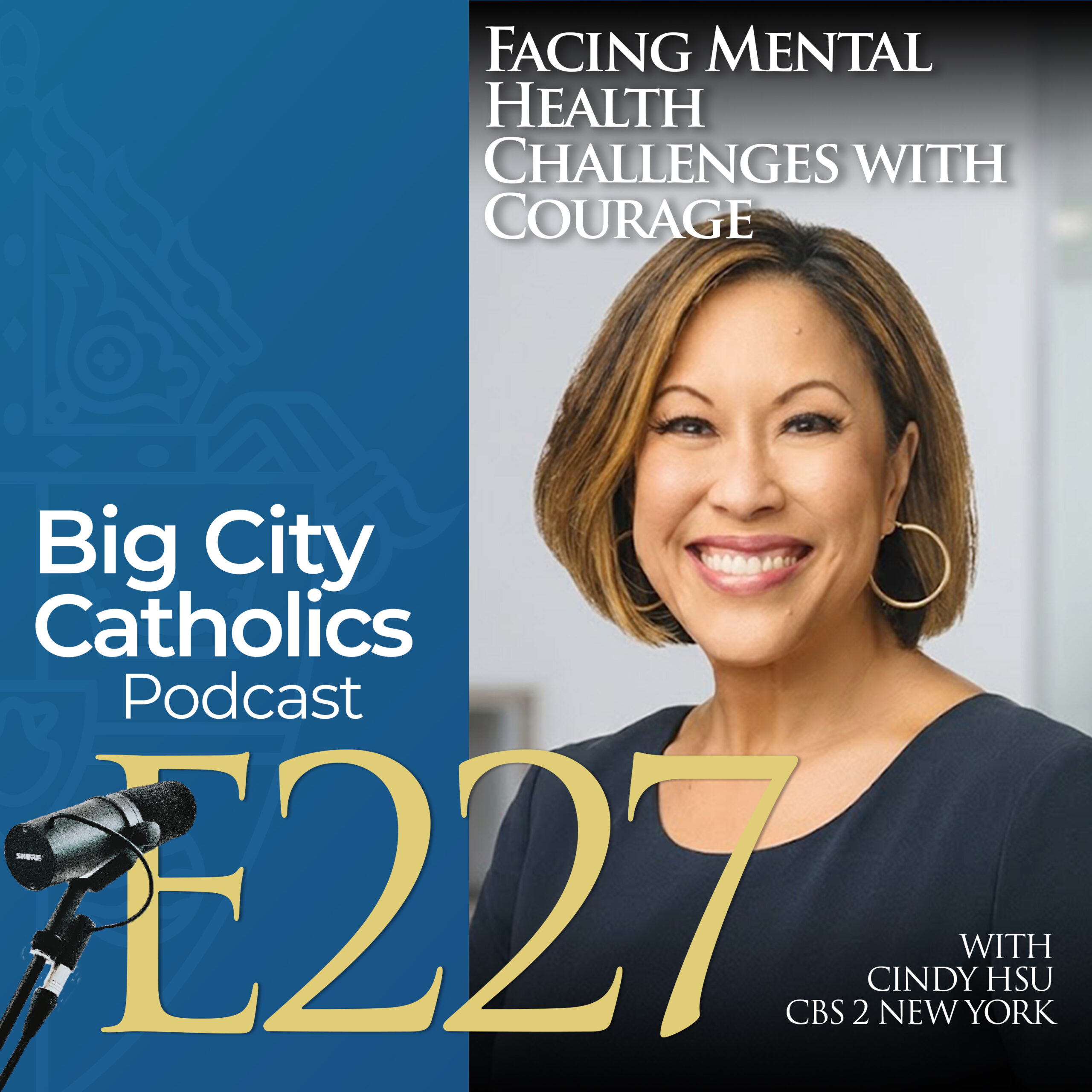
Welcome to a new edition of our diocesan podcast, Big City Catholics, with Bishop Robert Brennan, the Diocesan Bishop of Brooklyn, serving in Brooklyn and Queens, myself, Father Christopher Henry. Here at St. Joan of Arc Parish in Jackson Heights today, we're delighted to welcome Cindy Hsu, an Emmy award winning journalist and longtime anchor and reporter for the CBS News. Born in Honolulu, Lulu, Hawaii, to Chinese immigrant parents, Cindy grew up moving around the country as a daughter of a United States Coast Guard pilot. A graduate of Virginia Tech, she began her journalism career in Richmond, Virginia, before working in Steubenville, Ohio, and Green Bay, Wisconsin. But in 1993, Cindy joined CBS New York, where she has spent more than 33 years reporting on some of the most important stories affecting New Yorkers.
Throughout her distinguished career, she's received multiple Emmy awards and recognition for her reporting on families, education, adoption and community life. Beyond her work in journalism, Cindy has become a passionate advocate for mental health awareness and suicide prevention. In 2021, Cindy courageously shared her personal experience with severe depression and her journey toward recovery. Through her Breaking the Stigma reporting and her involvement with the American foundation for Suicide Prevention, she continues to encourage honest conversations about mental health and remind others that help and hope are available today. We're grateful to welcome Cindy Hsu to Big City Catholics to discuss her career, her journey, the importance of compassion, faith and hope in confronting mental health challenges. Cindy, welcome to Big City Catholics.
[00:01:52] Speaker B: Father Chris, thank you so much.
[00:01:53] Speaker A: Before we begin, Cindy, we'll begin in prayer. There's a beautiful prayer offered to the intercession of Saint Dymphna, who in the Catholic Church is a patroness for mental health awareness and for those suffering with mental health. We pray in the name of the Father, Son and Holy Spirit. Amen.
Good Saint Dymphna, great wonder worker in every affliction of mind and body. We humbly implore your powerful intercession with Jesus through Mary for the health of the sick saint, infinite patroness of persons with mental health conditions. Always look out for those men and women for their healing and recovery and for an end to stigma and indifference in society.
Amen. In the name of the Father, Son and Holy Spirit. Amen.
[00:02:41] Speaker C: Thank you, Father Henyu. And thank you, Cindy, for joining us today. Your journey is an incredible journey and you are a great advocate for mental health and for those who are suffering. We're glad you're with us today. Could you share a little bit on a personal side of why this is so important?
[00:02:58] Speaker B: Yes. Bishop Brennan, thank you so much. In 2015, I had been at Channel 2 for many many years as a journalist, and I started to feel like I couldn't do stories as quickly as I used to. And I started getting brain fog, and I started getting very stressed from many things.
And all of this led to a suicide attempt.
And I needed to go to the emergency room. I needed to go to a psychiatric hospital.
I was so blessed to have survived.
And it was because of this experience that I am now a mental health advocate. Took me many years. It took me, let's see, from 2015. I didn't tell anyone at work until 2021.
[00:03:46] Speaker A: Wow.
[00:03:46] Speaker B: Yeah. So they knew I was gone for months, but I just would say I had a medical issue, and I kind of shut it down. But in 2021, as you were mentioning Covid, everyone, I think, was feeling mentally challenged at that time, with so much isolation, that that's when I decided to do an interview with Dana Tyler and come out with my story, because I felt like people really needed it at that time.
[00:04:12] Speaker C: That was a great service to our community, because when somebody does courageously stand forward, first of all, I think there's a sense of identification. You say, okay, I'm not alone in this. And then secondly, maybe the courage it inspires, the courage that's needed to be able to talk about it.
[00:04:29] Speaker B: That is so true. I mean, I was very fearful of how people would react.
I was also fearful of, would I lose my job? Not that work can cut you off, but you know what I mean, if there's. If all the viewers suddenly think badly of you and don't respect you, that was a fear. And the opposite happened. I had so many people and people who were in my office who I had no idea they had different paths with mental illness. And there are so many different kinds, from depression to bipolar, all sorts of things. And that's also what I. What I found from the viewers is so many of them will just come up to me and hug me and say, I'm so glad you did that story. I was able to talk to this family member, that family member, and three, they understood. And so I really feel like that's why I'm so glad that you're doing this subject on your podcast, because we need to talk about it, we need to hear it, and we need to hear it from people like you.
[00:05:23] Speaker A: In previous episodes of our podcast, we were highlighting through this month of October, a month of respect Life in the church. We celebrate that here, but it's also Mental Health Awareness Month. And there's such a beautiful connection, I think, between respecting life means we Respect the dignity, the value of all life. And that means we walk with people, with compassion, with kindness, with love. It's rooted in the Gospels. It's rooted in the messages of our scriptural readings. Even this week is walking with compassion, with kindness, with love. I really do appreciate as well, I echo the words of Bishop, you know, for. For bringing this to such light and in your work in advocating for awareness and. And removing the stigma, what seems to be a common concern or stumbling block for people as they. As they move forward in this awareness and in seeking help?
[00:06:16] Speaker B: Well, I think there's the fear factor that I was talking about of how are people going to react? And especially in communities, immigrant communities, communities of color, it is especially difficult because many of us are brought up. I can talk about my Asian experience, to not be a burden, to not complain, and it would put shame on my family. That's how I thought it was going to be. And incredibly, it wasn't that way. And no history of issues in my family. And yet I think my mother is such a strong faith is so important to her, and I think that really, really helped her because she is the one who found me in my attempt. And you can't, you know, that has to be so traumatic. But she never came out in anger.
She never, you know, people lash out. And when. When something like this happens, it affects the whole family. It affects everybody.
So the church was very important.
[00:07:17] Speaker A: You mentioned culturally and Bishop, we often talk about how, you know, you're the bishop, the diocesan bishop of the Diocese of Immigrants. There's so many cultures. Bishop and I share an Irish heritage, and I speak on that Irish theme, that there's a stigma. There is certainly a stigma that is present within the community, and there's other, sadly less productive ways of dealing with one's issues that sometimes leads to addictions, addictions of alcohol or drugs, and we see that. And, Bishop, in your work, how do you experience this stigma or even how do you experience the cultural concerns with mental health awareness?
[00:07:58] Speaker C: Well, I think there are other concerns as well. I think that's a very important one. But when you look about the community, like Brooklyn or Queens, you raise questions about access, access to mental health, language abilities, the support of a larger network, and really some of the experiences right now. So, you know, right now I'm very concerned about children in some of our communities. We talk about it a lot in the Haitian world, with the whole tps we're talking about, what is this effect on children?
There's something else that I think I've seen in the years that I've been a bishop, not only here, but in Columbus, Ohio and on Long Island.
And that is that we're facing it at younger and younger ages that so many children are filled with anxiety and feel sort of like they're outcasts on the fringe. So those issues of mental illness are really far reaching among the young.
[00:08:53] Speaker B: That is so true. I don't have them on the top of my head, but the statistics of how young people are suffering from mental illness are devastating. I talked to a lot of doctors, as you said, Father Chris. I do Breaking the Stigma for Channel two. So I focus on mental health and a lot of it is children. The American foundation for Suicide Prevention is actually going to merge with the Jed foundation, which focuses on young people. I also feel like, you know, we were talking about languages. It's important for these different resources to have it in different languages. We have a program at AFSP called Talk Saves Lives and it's now in many different languages in Spanish. And also the other thing is we go into churches and talk to pastors and religious leaders because we do know that so many people, that's where they go for help.
[00:09:48] Speaker C: That's true. And the other thing too is I think parents, in the case of children, families in general really struggle because it's not just stigmas, but the idea, what am I doing wrong?
[00:10:00] Speaker B: How
[00:10:00] Speaker C: have I failed? Do you sense that as an issue in the community?
[00:10:05] Speaker B: I do. I really do. There's a lot of blame and shame and guilt around this. And that's one of my message is there shouldn't be.
Mental health is just as important as physical health. And people don't, you know, get angry if you get diabetes or cancer or different physical issues. But mental health, nobody can see the scars.
But it's the same. It's so many different. There's never one cause of something, but it can be a chemical imbalance.
It can be so many things.
[00:10:37] Speaker A: To use such a platform for good is such a beautiful gift. And I'd say too that at times, again, our news sources are generally highlighting the negative things that's happening in the world. You know, violence and crime and. And so to use that platform to say to people who are worried or concerned or just kind of sitting, maybe even homebound or just watching and saying, oh my goodness, everything is, seems to be burning around us. And to provide a sense of and hope, you mentioned your mom and the role of faith and you mentioned even going and visiting churches. There is a. As we started our podcast of St. DYMPHNA who is the patroness of those who suffer with mental health concerns and issues.
But more than that, I think faith gives people a sense of community, and community gives them a sense of support and warmth. Our young people are on Instagram, they're on Snapchat, they're on their phones, they're on TikTok. And there's an isolation that comes with that. Are there ways that we can combat this, the secular kind of approach, other than, you know, it's hard to just say, get off Instagram, get off TikTok. How could a parent see these signs, perhaps in their children?
[00:11:50] Speaker B: Well, I think it's important, as you know, Bishop Brennan was saying, it starts so young these days, and I think you need to have these frank conversations starting when they're young. Don't be afraid to talk about things that parents may think are scary, even the word suicide. Their AFSP did research, and saying that word will not compel somebody to go that way.
Yeah, it's just so important to talk about it early. Don't show judgment. You know, that's the other thing. If you think somebody is having an issue and maybe a child is not to try to fix it right away, you want to listen to what they're feeling, not why are you complaining. You have this and you have that and everything else, and that's just not the way to do it. It's probably similar to the way you listen to people.
[00:12:40] Speaker A: And it is. And, and, you know, for those who, you know, in a busy parish, such as St. Joan of Arc and a priest and as counselors, I often think of Henri Nouwen's the Wounded Healer. I think of that. It's sort of in our brokenness that we can help those who are also broken and to share in those, those common, that common ground. What might you recommend for priests even, who are helping people in need, or even priests who may seek that sense of help as well?
[00:13:09] Speaker B: I'm so glad you brought that up, because I always try to make a point that self care is so important, especially in what both of you do. I mean, you hear so much pain that people come to you with and that you need your own outlet, you need your own folks that you can talk to and let it out. So, yeah, that is really important and to take the time and to know that, you know, I use the example of, you know, the, the airline, the oxygen masks, you know, before you can help someone else, like, let's say a child, you have to put it on yourself or else you're no help at all. So that's a good thing to remember
[00:13:48] Speaker C: as priests, we have to recognize our own limits. So. So we're not counselors in that sense. We're not, you know, there's certain. Some priests are that by training, but it's that careful, attentive listening. You know, there is something in the psyche that it wants to be the fixer.
[00:14:05] Speaker B: You want
[00:14:06] Speaker C: to be able to. You'd love to sit with somebody and have them feel much better when they walk out of the office. You want to be able to give the answer. And that's where you get things like, you have so much to be grateful for, you know. But I think that for us universally, the approach is prayer and solidarity.
You know, that you can't discount those two things, prayer and solidarity, that you're not alone. And, you know, maybe, like, how can we help find the resources? So for us, we, you know, we try to tap into resources like Catholic Charities so that we can make recommendations for counseling where it might be helpful, but for ourselves, too, to be able to make use of the resources available to us so as priests. Spiritual directions an important tool for priests. It's a very important tool. And especially these days, you know, when I was growing up and there were more priests in parishes, you would be in a household with three, four, maybe five priests.
And now more and more guys are doing it alone and covering multitude of parishes, two or three parishes alone. And so it's very, very important for us as priests to be able to have friends that will be honest with us, to kind of hold ourselves accountable to a certain extent where somebody can say something's not right, something's not right. You know, it doesn't mean you're bad or you're failing,
[00:15:30] Speaker B: but
[00:15:30] Speaker C: something's not right. And then, of course, spiritual direction, which is an internal kind of a forum, and to be able to bring everything that's going on inside, because sometimes it's just you need an outlet for daily frustrations.
[00:15:45] Speaker B: No, that's very true. And I like what you're saying about the importance of community and, you know, talking amongst people that you trust. Because isolation is one of the biggest signs of depression, you know, And I know when I was going through depression, I would not respond to text messages or phone messages and all these different things I used to do. And you were talking to about, you know, how can parents recognize things, you know, if. If your young person is suddenly not finding joy in life or joy in things they used to love. Let's say they used to love soccer, and suddenly they never want to go. And, and they used to love, you know, playing with their pet and now they don't want to do it. And then they lock themselves in their room. So they're a lot of different signs and you have to have that conversation.
You know, people are so nervous to have that conversation. But I think that is the key is communication and community.
[00:16:39] Speaker A: Cindy, you've. You've had the chance to visit college campuses, you're speaking publicly. Has there been any experience in that work that has really stood out to you and just said, wow, your message is a message of hope. It's a message that changes lives.
But have you received particularly any examples that just stay with you and say, thank goodness, you know, that I've been able to bring this message something specific,
[00:17:06] Speaker B: a letter I will never forget because there was such a deluge of mail when I first did the story in 2021. And I remember a parent writing and saying that she watched the special with her daughter, who I think was about 11 years old, something like that.
And after watching the daughter said to the parent, I was feeling the same way.
And the parent was saying that watching that and opening the conversation saved her daughter's life.
And anytime I go out, you know, the other day I was at the American foundation for Suicide Prevention, out of the darkness walk and you walk around the crowd and everyone comes up and hugs me because they were suffering alone. And then when you make it public like this on podcasts and television and the Internet, it lets people know that, like you said, they are not alone. And there are so many people suffering and there are so many resources out there. My daughter is, she's now a first year veterinary student, but through undergrad, I really wanted her to see a therapist because she was getting very stressed out by the academic overload and all of the students feel, feel that way. And I knew that my therapy had really helped and she had never, you know, gone to anything like that. So I really had to convince her and it's really helped. Then she, you know, she could talk to this person for a few years. She did that.
And I think it's really important that you have those conversations with your kids and you get them the help they need, whether it's medication, therapy, all sorts of different resources, get them the help they need.
[00:18:48] Speaker A: Teaching and helping our young people to learn, you know, proper coping skills, healthy coping skills. I find a great responsibility to be the pastor of a parish with the school. Here in our diocese, Cindy, we have a program that is available to our school age children Called pdhp. It's a program for the development of human potential. And we have a counselor here in our school, and every school has access to a counselor. And when I was in my first parish of Holy Child Jesus, that's where the headquarters for pdhp, one of the headquarters was.
And the director was always so grateful. He said, you know, we've never had a pastor send so many people to us. I said, well, you're here, you're in our backyard. It's such a great gift. And it was free, and it was a service provided for them by the Catholic Church. And so it's a great gift to be able to instruct our young people, you know, proper coping skills, never.
Don't be afraid to seek help, to ask, ask for help. It's very moving and very rewarding to be able to lead that. I'm sure you feel the same way when you visit those college campuses and when you see even your daughter responding to that invitation.
[00:19:58] Speaker B: I just. I always tell people that asking for help takes courage.
It is not a weakness.
It's one of the bravest things you can do. And I think we have to. We have to recognize that it's almost the same when you have physical ailments.
You need to go to the doctor. You need to get it taken care of. If you let it go, it doesn't get better by itself. Very often
[00:20:21] Speaker A: there's a gospel passage, Cindy, of a woman who suffers with hemorrhages for multiple years, and she sees Jesus in the crowd, and she comes and she says to herself, if I could but just touch the tassel on his cloak, I will be healed. I've used that gospel a number of times with young people asking them just to seek the Lord for help. I never realized just how much courage it took for her to think that, to seek that and to reach out and touch the Lord and to touch that tassel. So we have to be there to support. We have to be there
[00:20:53] Speaker C: and encourage and encourage. I mean, you know, that was really what Pope Leo took as his prayer intention for the month of October. This was so important to him. He made it his prayer intention. A genuine prayer. There's actually a video of it. A genuine prayer for those who are suffering, for those who are facing challeng, carrying tremendous burdens, praying that the church can be this welcoming place and praying that we can be signs of hope to one another.
[00:21:21] Speaker A: Cindy, as we conclude this podcast, can you direct our listeners, those who need more information? Where might they go? For. For more info regarding the resources that are available to them.
[00:21:33] Speaker B: The American foundation for Suicide Prevention is amazing. When I went through my depression, I actually immediately went on the Internet to try to find out information. I'm a reporter, right. And they had so much just on their website. Ways to have conversations with your teen if you think there's trouble signs to look for. They also have all sorts of programs all year for different groups. You know, suicide loss survivors, people who have lost people. They come together in certain times. Also, the national alliance on Mental Illness, NAMI is wonderful. If you go to their website, they have so many free workshops. You can do it over zoom. You don't have to even give your real name or anything like that. And they're very specific. It could be for Asian parents or African American groups or, you know, whatever it is, you will find it there. And then finally, the suicide crisis and lifeline 988.
If you are with somebody who's an emergency situation, you can call that number for them because you will be put in touch with a counselor and therapist 24 7.
[00:22:43] Speaker A: Wow, that's beautiful. I really appreciate you sharing those resources. I appreciate your taking the time to join us in this edition of Big City Catholics. Bishop, as we conclude, perhaps you could offer a prayer and a blessing.
[00:22:56] Speaker C: Sure. In the name of the Father and of the Son and of the Holy Spirit. Amen.
Lord our God, may this conversation help us to grow deeper in our care for one another, in our listening skills, and make of us instruments of your peace, instruments of hope, true hope in a world that sometimes grows very dark.
And may the Lord bless all those who are listening this day. May the Lord bless you and keep you. May his face shine upon you and be gracious to you. May he look upon you with kindness, kindness. And grant you his peace. And may the blessing of almighty God, the Father and the Son and the Holy Spirit descend upon you and remain with you forever and ever. Amen.
[00:23:38] Speaker A: Amen.
Thank you, Bishop. Thank you, Cindy. Thank you, Cindy.
[00:23:42] Speaker C: Wow, what a
[00:23:43] Speaker B: great
[00:23:43] Speaker C: conversation.