Episode Transcript
[00:00:10] Speaker A: Welcome, everyone, to a special edition of Big City Catholics from the U.S. bishops Conference in Baltimore. I'm Monsignor Jim Vlon, the president and CEO of the Catholic Faith Network. But I'm joined here today by the great host of this podcast and show, Bishop Robert Brennan, the bishop of the Diocese of Brooklyn. Bishop, thanks for being with us and letting us do this today.
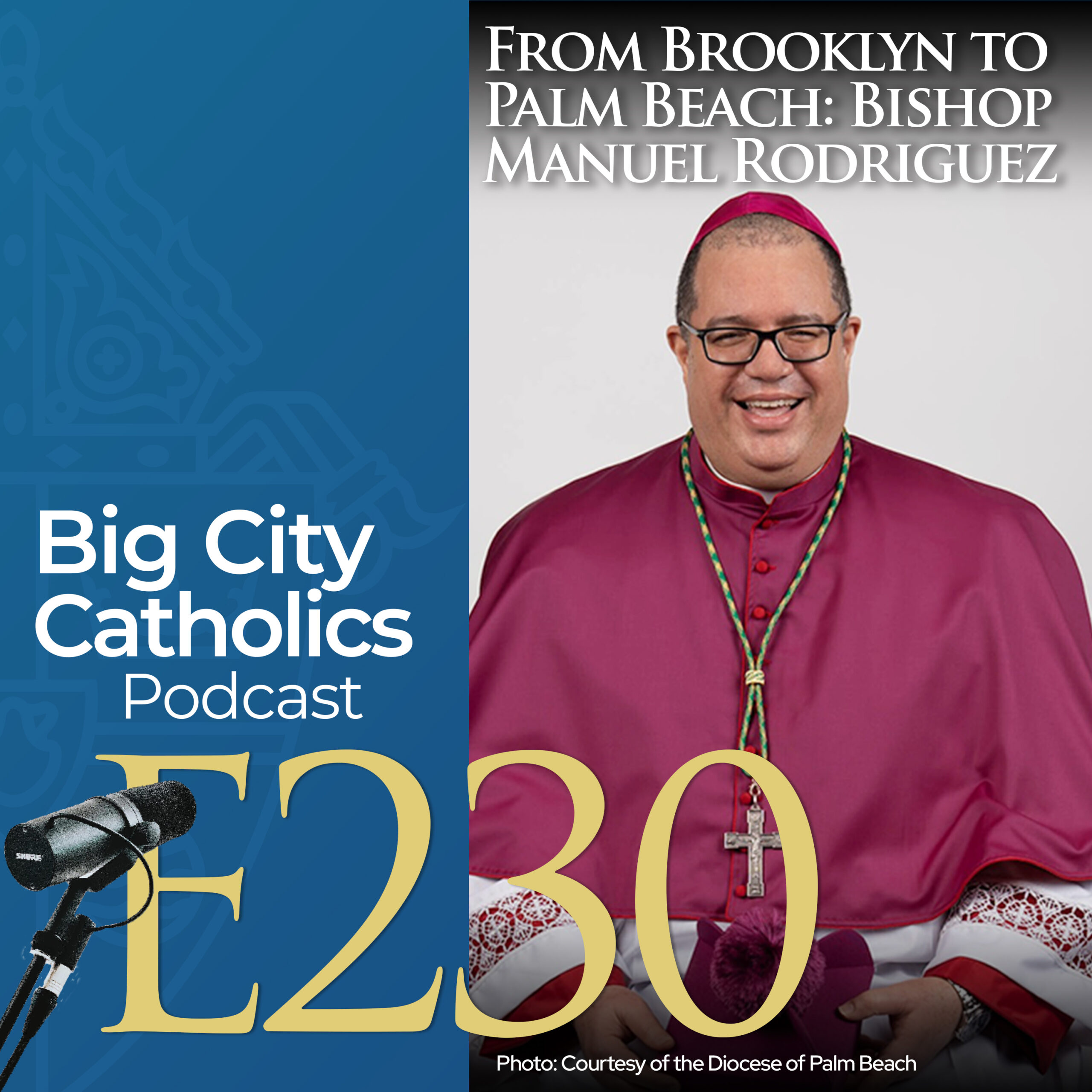
[00:00:27] Speaker B: It's great once again to be with you. In a sense, all my worlds collide here when we come together in Brooklyn, people I've known from the past, from Michael Santa. We're going to be welcoming Bishop my mom, Rodriguez, who was a priest of Brooklyn and is now serving in Palm Beach. We go back to high school. This is always a good experience.
[00:00:45] Speaker A: It's nice. And I find the same thing. This is our 18th year here. It's a long time you were with us.
[00:00:50] Speaker B: I was there in the first one, and I'm just looking around at all the equipment. Remember the things you used to have to rent a truck to bring everything down
[00:00:56] Speaker A: back in the old days, everything was giant. And we used to have a truck outside
[00:01:00] Speaker B: with
[00:01:00] Speaker A: a big satellite on it, shooting up to the sk.
[00:01:02] Speaker B: I remember.
[00:01:02] Speaker A: And now, you know, it's a bunch of iPhones and a couple of people. You know, it's amazing how things get easier, right? So it's nice. But a lot of old friends, too, which is nice, you know, and this is a nice meeting this week because it's a time for you all to pray together and spend some time together and discern
[00:01:16] Speaker B: one of the things the new format is about. We speak in with prayer.
[00:01:19] Speaker A: Yeah, I like that.
[00:01:20] Speaker B: Right. It really does set a tone for the rest of the week. We begin with prayer.
[00:01:24] Speaker A: I love that. So now Bishop Manuel is a guest today, and I would say this is how I know him, because I watched his farewell mass, and I can say one thing. My God, was he beloved?
[00:01:34] Speaker B: So welcome, Bishop Manuel Rodriguez.
[00:01:36] Speaker A: Glad you're here.
[00:01:36] Speaker B: Welcome back to Brooklyn, because this is a Brooklyn podcast and we've been missing you. We've been missing you a lot in Brooklyn, but we know you're doing great work in Palm Beach. Tell us, how is it going in Palm Beach?
[00:01:48] Speaker C: Thank you so much, dear Bishop. Thank you, Monsignor Jim, for the opportunity and the great chance to be here, part of this show. I am very happy also to catch up and to get together. I am absolutely been missing Brooklyn a lot and missing you a lot.
It's been quite a new experience, but I have to say, it's been also a blessing and a Grace, for me to get to know a new diocese, a new presbyterate, a new set of challenges. Palm beach, the Diocese of Palm beach and its five counties. Because Palm beach county is just one of five of the counties included in the diocese, which also. The diocese also covers Martin County, Okeechobee County, St. Lucie county and Indian River.
It's really a very extended area. You know, right now we are getting ready for a major moment in our diocesan life, which is we're going to have a diocesan sina with the help of the Catholic Leadership Institute.
Okay,
[00:02:55] Speaker B: good.
[00:02:55] Speaker A: Yeah, great.
[00:02:55] Speaker C: You know, in order to start taking the steps towards the final goal would be to put together a ten year plan, pastoral plan for the diocese. So we're working on. It's going to take like about 18 months. We're very excited about it and we are getting ready, as you are, for the world. You think?
[00:03:12] Speaker B: Yes,
[00:03:13] Speaker C: I
[00:03:13] Speaker B: think they may have competition. We have about 500, just shy of 500. We had to stop the registration because of hotel rooms at about 500. Yeah.
[00:03:23] Speaker A: Wow.
[00:03:24] Speaker B: And then we'll have another couple of hundreds through the neocatechumen away. But you are up to
[00:03:29] Speaker C: 700.
[00:03:31] Speaker B: He only started working on this in February. Wow. He got down there, he said, we're going to start the. We're going to World Youth Day.
[00:03:37] Speaker A: Wow.
[00:03:38] Speaker B: Sounds like another bishop I know came in and started rolling and opened a whole new world to us. Absolutely. Murphy did that. We were so
[00:03:45] Speaker A: blessed to have him with us
[00:03:46] Speaker B: blazing, saying, we're going to World Youth Day. We're doing this, we're doing that.
[00:03:49] Speaker A: That's funny because West Palm does that. Doesn't ring the bell for me. For a lot of young people, I don't know why. I think like older folks, retired folks, but not really. Huh.
[00:03:58] Speaker C: Well, Monsignor, we have a very, I have to say this a beloved elderly population. And we love them a lot. And they come from. Mostly from the Northeast.
Yeah,
[00:04:11] Speaker A: right.
[00:04:11] Speaker C: To retire in the diocese. But we also have a growing population of young people. As a matter of fact, right now we have 20 Catholic schools, 17 elementary schools and three high schools. But we are now slowly thinking, started thinking in opening new schools because of the numbers and the growth of some of our towns. For example, like West Palm, Wellington, Jupiter, Port St. Lucie, for example, Port St. Lucie is one of the five top growing cities in the United States.
You know, it's a. Yeah,
[00:04:50] Speaker B: I didn't know that. That's
[00:04:50] Speaker C: true. Oh, yeah, yeah, yeah. The Mets have a stadium there. Yes. So, yeah. So, you know, the Word you think will be an opportunity for our young people to start coming more, being more of the center of our pastoral planning and focus. And also it's an opportunity for our youth ministry to get reinvigorated. And that's what is happening right now.
[00:05:12] Speaker B: And you know what else you talk about that young and old difference. One of the great things that the bishop did is he invited some of the parishes with the older folks to sponsor some of the struggles. What a great idea. With the younger folks. What a great idea.
So there's an intergenerational side to this whole thing.
[00:05:29] Speaker C: Oh, yeah. We have, for example, parishes such as the one that, you know, St. Edward's which is in the island of Palm beach near Mar a Lago. They're sponsoring some of the other parishes located in areas a little bit more challenged. We also have a wonderful group of families that are traveling together to the world today. It's been really an amazing experience. And the youth. Yeah, Palm beach is a place of tremendous hope for the church. The number of young families that you can find that you have there, the number of young people themselves. We actually getting people from all over moving into the diocese, into the area, into the five counties. So, yeah, it's going home. And then the other major intention for this effort with the World Youth Day is vocation. I was going to say vocational
[00:06:25] Speaker B: vocabulary. One of the places where
[00:06:26] Speaker A: you see a dividend. Right.
[00:06:27] Speaker C: That is one of our most important challenges right now. We only have eight seminarians in a very difficult situation, vocation wise. So we desperately need to get better. The World Youth Day is one of the strategies that we are implementing.
[00:06:42] Speaker A: I love that. That's fantastic.
[00:06:44] Speaker C: Yeah.
[00:06:44] Speaker A: And do you have a seminary, too?
[00:06:46] Speaker C: Yeah, we have. The dioceses in Florida with respect to seminaries are blessed because we have two major seminaries that we share. One is the one in Boynton Beach, St. Vincent de Paul Regional Seminary, which is shared by the dioceses in Florida and all the dioceses in the Carolinas and nearby dioceses. And then we have also we take advantage of St. John Vianney Seminary, which is owned by the Achios of Miami, which is a college seminary undergraduate. So we have those two. Recently, we opened a house of discernment in Palm beach to keep boosting the numbers, keep promoting vocations.
So. Yeah, but the word Youth Day will be a major moment in vocational promotion. Yeah,
[00:07:30] Speaker A: you're right.
[00:07:30] Speaker C: What
[00:07:31] Speaker A: about the young adult crowd? You know, in New York, we hear about it, they're always talking about these parishes. One, St. Joseph's down in the village you know, 500 young adults every week they're coming to Mass. Do you see that happening too? I think this is happening nationally.
[00:07:43] Speaker C: Yeah. Well, I am copying two things from Brooklyn, among others.
No, no, but in particular regarding the youth ministry, something that is still taking place in Brooklyn, but that, in my opinion was a very important.
Was to come up with these grants for the parishes to hire a full time youth minister. Okay. That really made the difference and is still making the difference, you know, in Brooklyn. And I am now, I already started through a committee putting together that initiative of getting the funding needed in order for us to offer that to our parishes.
Yeah.
In order for the parishes to have full time, well trained youth minister, which.
[00:08:31] Speaker B: And that comes with a certain amount of accountability. Yes,
[00:08:33] Speaker C: yes, exactly.
[00:08:35] Speaker B: Do things. It's not just sit back and have pizza. You have to have approved programs and you have to participate in diocesan events and things like that.
[00:08:43] Speaker C: It's something that still needs to be more promoted in that part of the country.
There's a lot of enthusiasm about it. So our parishes are packed with young people. Well, these numbers, this response to the world, you think in itself can speak volumes
[00:09:03] Speaker B: about
[00:09:03] Speaker C: that. You know,
[00:09:04] Speaker B: they're not going across state lines. They're really crossing the world. Yeah.
[00:09:08] Speaker A: Think
[00:09:08] Speaker B: about it. Right? Yeah. It's a real
[00:09:09] Speaker C: trip. It's a big
[00:09:10] Speaker A: trip.
[00:09:10] Speaker B: Yeah.
And you know, Bishop Manuel had some pretty big experience before going down there. So he was in a parish where they had 13 masses on a weekend. A place with great life and great energy. And now you. But you, you have a whole panola of language and culture in Palm beach as well.
[00:09:28] Speaker C: In Palm Beach? Yeah, Palm Beach. The diocese in general is mostly Caucasian. We English speakers mostly from. Many are snowbirds, as you mentioned, but we have many natives. Most of them are natives, but we also have many Haitians.
[00:09:43] Speaker B: Yes,
[00:09:44] Speaker C: pretty much in most of time. We are exaggeration. Over 60% of the parishes have important Haitian component among them. And then we have over 17 Haitian priests serving in a diocese that has around 110 priests. That's a good number available. You know, of course, of. Well,
[00:10:05] Speaker B: we'll be talking a little bit about immigration and about the multicultural thing.
[00:10:09] Speaker C: We also have a very, very important, as you know, Hispanic population, among which we have to mention the Cubans.
We have a good, important number of Cuban families, either descendants of Cubans born here, but of Cuban background, or Cuban immigrants. And there's also Mexican central. We have a very important Guatemalan population.
Very important, very important. Especially in the area near Lake Worth. And then we have Dominicans. We have also Venezuelans a little bit, but in general. Yeah. And then we have Asians, like Vietnamese.
It's a nice. What I call a walking Vietnamese parish that they gather every month and they have the mass in Vietnamese and they have their own dun. Yeah, It's a large community, Filipinos and Indians as well. It's a beautiful, diverse community.
Absolutely. It's
[00:11:08] Speaker A: great. So, bishops, I had heard some of the agenda for this meeting, and one of the agenda items is about immigration. We've talked about it. I mean,
[00:11:16] Speaker B: it's something that's going to be part of our conversation now until whenever. I mean, to me, one of the sad things is that when you look at the political parties, there seems to be a preference for keeping a problem that you can use for political purposes than really to solve it. We were talking about all of the multicultural richness of our churches in Machtel center, in Brooklyn, in Palm Beach. But the issue of immigration has really been concerning us. And it has for years and years and years calling for comprehensive immigration reform. But one of my questions is now, given the election results and all of the different things going on, in some ways you might say we're more divided than ever. But I have to ask the question, is there some group in the middle? Is there some coalition that can be built of people in elected office who really would be interested in tackling the problems? There's a group, I think,
[00:12:15] Speaker C: of
[00:12:16] Speaker B: where the majority of people come somewhere in the middle who recognize that, wow, borders had to be secured. The situation we were seeing in Brooklyn and Queens in the last. Every. Everywhere.
[00:12:29] Speaker A: Everywhere,
[00:12:31] Speaker C: everywhere. Yeah,
[00:12:32] Speaker B: people were living in tents in the middle of the winter. Floyd Bennett Field at
[00:12:36] Speaker C: Creedmoor,
[00:12:36] Speaker B: that's not sustainable. You know, entire populations were just dropped in on areas that didn't have the infrastructure to take care of people. So there was a certain overreach there. And that was in reaction to sort of the immigration approach before.
And now you have people saying, okay, yeah, it's good we're controlling the borders. Yeah, it's good we're dealing with some of the criminal elements. One of the things I heard in Corona was people say, yeah, thank God some of the. We reclaimed our streets,
[00:13:08] Speaker C: yes.
[00:13:08] Speaker A: But
[00:13:09] Speaker B: on the flip side, the same people would say, those things are good. Accomplishments of this administration
[00:13:15] Speaker C: are
[00:13:16] Speaker B: saying, but there's a certain cruelty,
[00:13:19] Speaker C: and
[00:13:19] Speaker B: that's something we just can't stop.
[00:13:20] Speaker A: See, we had politicians that could work together, right?
Kennedy and McCain and Bob Dole.
They were people who could reach across the aisle.
[00:13:28] Speaker B: Reagan and Tip o'. Neill. Yeah,
[00:13:30] Speaker A: Reagan and Tip o' Neill was a great one.
[00:13:32] Speaker B: Yeah. Moynihan,
[00:13:34] Speaker C: I think that this is a good time after the midterm elections. This is a good time, especially for people of faith and those who are listening us. I invite you to also consider this. People of faith. We are called to intervene and to promote reconciliation and to promote unity, because it is in no one's interest that this country keeps divided.
So one of the things that we need to stop immediately is to demonize the other, Demonize any kind of opposition, demonizing people. That's not gonna work because the truth is always in the middle.
The truth is not on the left or on the right. It's in the middle.
So we need to start looking for ideas that can work. For example, I found. With all due respect, I found very important the intervention that President Trump did in Venezuela.
You know, I understand the concerns, but that was really going to the roots of the problem, because what happened in this country, what was happening in this country immediately after the pandemic was, you know, was simply a disaster. With all this avalanche of people from Venezuela, especially in New York, we had a lot of that. So that was an important step.
But at the same time, those caravans that were coming through all Central America.
No. So that is something that no one in his or her senses will accept, something that should be allowed. So we need to start being smart. One of the most important, I think, contributions in this area has been achieved by President Reagan.
[00:15:24] Speaker B: You
[00:15:24] Speaker C: know, President Reagan understood the immigration problem and wasn't afraid to think out of the box. You know, in his
[00:15:33] Speaker B: time. That's what we need. Think out of the box, but with common sense, you know.
[00:15:37] Speaker C: Common sense,
[00:15:37] Speaker A: yeah.
[00:15:38] Speaker C: You know, and he came up with this idea, giving people that were undocumented papers so they can pay taxes. You know, that was something that was good.
[00:15:46] Speaker B: And you say, okay, good, we sealed the border. Now we can start to regularize people.
[00:15:50] Speaker A: Exactly right. That's the way to go.
[00:15:52] Speaker B: I'm glad you mentioned Venezuela. We look at Haiti and we look at
[00:15:55] Speaker C: the
[00:15:55] Speaker B: situation.
It is not. It is so sad. And
[00:15:58] Speaker A: we have. People have to go back and people
[00:16:00] Speaker B: going back. People have
[00:16:01] Speaker A: lost
[00:16:01] Speaker B: their jobs, and there's just such uncertainty.
But if you go, take the Venezuela as an example, it's not as simple in Haiti, but what can we do to help Haiti? We've got to get there to change that situation.
[00:16:16] Speaker C: For example, when it comes to the Haitians, the tps.
[00:16:20] Speaker B: Yeah.
[00:16:20] Speaker C: Someone that has been working in this country for the last 15, 20 years has been paying taxes, has worked permit. Why do we need to deprive that person from his or her legal migration status? You know, find ways to keep them here, but to keep them visible and legal.
So that was something that was, in my opinion, unnecessary, that deprivation of the TPS status. And also, for example, on the other hand, you have the situation of. Of those who are the deportations.
So you have a family with five kids born in this country, all five. And then you have the mother and the father undocumented. If you arrest the father and deport him, don't deport the mother as well, because you need to think about. So what about the kids?
That becomes an issue.
[00:17:16] Speaker A: I know, Bishop, in our parish we have 5,000 children who carry little cards that if they go home and their parents are gone, they have the name and address and the phone number of the family will take them in. And there are many people who have had to take advantage of that already because they've lost their mothers and fathers,
[00:17:32] Speaker C: you know, so
[00:17:33] Speaker B: just the fact of. Can you imagine the trauma of walking around.
[00:17:37] Speaker C: Yeah.
[00:17:38] Speaker A: A little kid, a grammar school kid, they shouldn't have to worry about things like that, really. Right,
[00:17:43] Speaker B: exactly.
[00:17:43] Speaker C: Yeah, yeah. And I do believe that right now we have the possibility of engaging in dialogue and discerning. Discerning, because it is in no one's interest that we go back to the disaster that was happening in 2021, 22. In no one's interest. So we need to fight to be smart enough to find new solutions.
[00:18:05] Speaker B: And unfortunately, the loudest voices are on the extremes
[00:18:08] Speaker A: always. Yeah,
[00:18:09] Speaker B: a lot of voices are on the streets. But I think if some of the leaders now who've been re elected is a chance to build coalitions. You know, like you said, we reconciliation, don't demonize. Where is that common ground, that sense of goodwill and working for the common good? You know, the vocabulary of the Catholic Church is common good and human dignity.
So how do you. How do you foster solutions that are rooted in human dignity? And one thing is, I say with a certain amount of pride, as Americans, we know how to solve problems.
[00:18:46] Speaker C: Yes. So
[00:18:46] Speaker B: we need to do that here.
[00:18:48] Speaker C: It's
[00:18:48] Speaker A: very true,
[00:18:49] Speaker B: you know, Right. We look to things and when we stick our minds to it, we can solve problems.
[00:18:53] Speaker A: Can you both admit though, that your people, Hispanic people, run to the church in these kinds of moments, moments of anxiety, moments of worry, they run to the church, they run to us for support, for prayer, and also I think, for a sense of kind of home, a sense of belonging.
[00:19:10] Speaker B: We had in Brooklyn, a beautiful, beautiful expression. And this came from the Haitian community. We used Stations of the Cross for migrants and refugees. It was done in three different languages. We began at St. Jerome's Church in Flatbush. We began with Mass, and then we walked to St. Therese Little Flower Church and to St. Vincent Farah,
[00:19:34] Speaker C: and
[00:19:34] Speaker B: we did the stations across along the way.
It was beautiful, people coming together to pray.
And because of the element of fear, the people who came were largely documented, but they were praying for their brothers and sisters
[00:19:50] Speaker C: who
[00:19:50] Speaker B: couldn't be there. And that sense of solidarity, yeah, they come running to the church, but they come running to the church together.
[00:19:56] Speaker A: And
[00:19:56] Speaker B: we stand in solidarity with each other. It is a beautiful thing to see,
[00:19:59] Speaker C: and
[00:20:00] Speaker A: it's almost like natural, which I love.
[00:20:02] Speaker B: Again, you think of what this country's been through and how by running to the church, we've solved a lot of problems.
We've borne a lot of difficult times. But with the grace of God, literally with the grace of God, we can get up again and we can keep building, keep going forward, keep providing a future for our children, our families keep being beacons of hope.
[00:20:26] Speaker C: And I have to say that, and I don't think this is an exaggeration, the church, the Catholic Church throughout this entire crisis, has been the safest place for the people, for those who felt persecuted or in danger. Somehow. That's why we haven't. And it didn't happen in Brooklyn. It hasn't happened in Palm Beach. And I'm positive that perhaps this is the average for the country. That's why we didn't have a massive, like, decrease in Mass attendance by the Hispanics, because they still feel very safe in their churches.
Yes, yes, yes.
[00:21:06] Speaker B: Like you say, in some ways, coming more.
[00:21:09] Speaker C: Yes. Bishop,
[00:21:10] Speaker A: we gotta go already.
[00:21:11] Speaker B: You see that? What? It goes so fast. It
[00:21:13] Speaker A: really does. Yeah. Great conversation.
[00:21:14] Speaker B: It's good to be together again.
[00:21:15] Speaker C: Thank you for the invitation.
[00:21:17] Speaker B: Oh, I'm glad. And
[00:21:17] Speaker C: please consider doing one of these shows in Palm Beach.
[00:21:22] Speaker B: We'll get this on your website. Okay. That we will do.
[00:21:24] Speaker C: Yeah.
[00:21:25] Speaker B: Thank you for joining us for this week's edition of Big City Catholics. I'm going to close with prayer. The Lord be with you.
May the Lord bless you and keep you. May his face shine upon you and be gracious to you. May look upon kindness and may he grant you his peace. In the name of the Father and of the Son and of the Holy Spirit. Amen.
[00:21:43] Speaker A: God bless everybody. See you soon.