Episode Transcript
[00:00:00] Speaker A: Foreign.
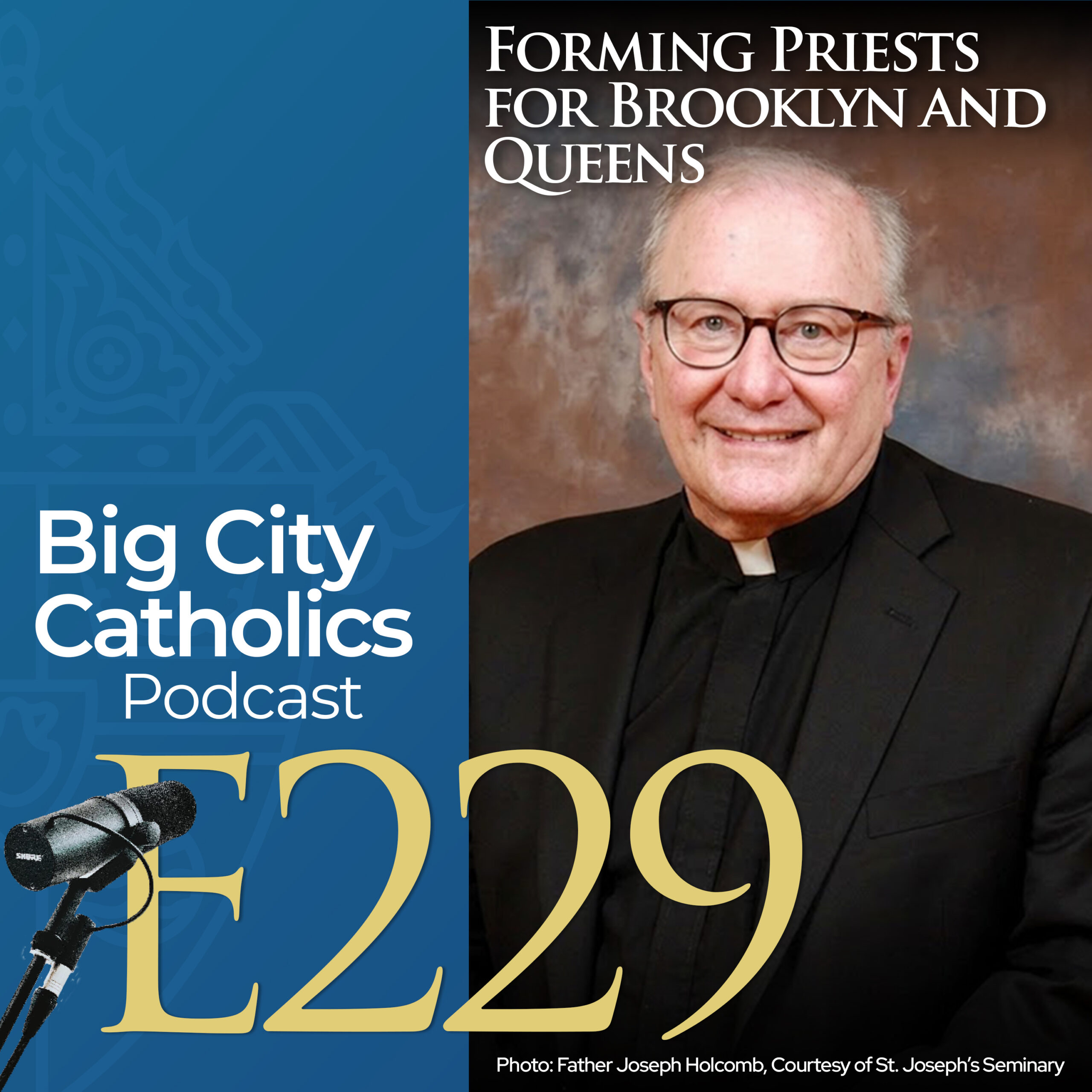
Hello and welcome to this week's edition of Big City Catholics. I'm your host, Bishop Robert Brennan, Bishop of Brooklyn, serving in Brooklyn and Queens. And this week I am recording from the seminary from St. Joseph Seminary in Dunwoody, where a good number of our men are being formed to become priests. And I'll be speaking with Father Joseph Holcomb, who is the director of seminarians for the diocese, but also the director of the propag year. Father Joe, welcome.
[00:00:41] Speaker B: Good morning, Bishop. Yeah, thank you. Thank you for having me. Oh,
[00:00:44] Speaker A: I appreciate it. Great
[00:00:45] Speaker B: opportunity. Yeah.
[00:00:46] Speaker A: I'm going to. We'll start with prayer as we normally do, but I'll ask you if you would lead us in prayer.
[00:00:50] Speaker B: Sure. In the name of the Father and of the Son and of the Holy Spirit. Dear Lord, we pray that you will create among us Catholic leaders individuals made in your image who will apply your teachings in their lives and positively impact our families, our workplaces, our communities and our church.
Help us to inspire those with whom we come in contact to share their God given talents, to do your will and to find a place in your kingdom where their deepest joys and the world's deepest hungers meet and cry for their special qualities and abilities.
Make us leaders, Lord, leaders with strength and courage to follow you. Leaders who make your love visible to the world in all of our words and actions.
Amen.
In the name of the Father and of the Son and of the Holy Spirit.
[00:01:46] Speaker A: You know that prayer comes from. I came across it in Ibriviary, but it's written by young adults as part of the Millennial Celebration 2000.
And you know, that was 26 years ago. But a prayer written by young adults for young adults and really fits what we're going to be talking about, the forming of leaders in the church right here at the seminary. But just to introduce you a little bit, you've had a rich experience in Brooklyn and in Queens. But I'm going to point to two things not associated with the seminary or parish. When I first came, you were the chaplain for the New York Mets.
[00:02:23] Speaker B: I was, I was. And it was a great experience. I would go to Citi Field for home games and things, and it was very interesting. We were trying to get footing into the new stadium and we had a couple of different places to worship. But now I understand Monsignor Mahalski has an auditorium and he's celebrating Mass there, which
[00:02:43] Speaker A: is great. It's pretty steady and it's pretty useful. And you mentioned that it's Mansino Mahalski, because now, now you're not in Queens anymore. You're in Dunwoody. But you took advantage of that to get where your heart really lies in baseball.
[00:02:56] Speaker B: Yankee Stadium.
Yeah. Thanks be to God. It's been a. It's been a wonderful ride. For the past two years, we've been celebrating Mass at Yankee Stadium. It wasn't easy to get a footing there as well, but with the help of Austin Wells, who is their catcher, a wonderful, wonderful Catholic young man, we were able to establish Mass there whenever they're home, whenever they're for a home game.
[00:03:20] Speaker A: Great service. It is. It's wonderful. And it's a service certainly for the players, but also for vendors, for employees.
[00:03:28] Speaker B: Exactly.
[00:03:29] Speaker A: When my brother was stationed near Shea Stadium, and often at the games, they would. The police officers used to take part in the Mass. So I remember that's what that was, my first recollection of it. But now you've been director of seminarians for a number of years now.
[00:03:45] Speaker B: Five years at the time.
[00:03:46] Speaker A: Five years. Okay. So coincided my own term, you just came in and you were doing that as rector at the cathedral residence of the Immaculate Conception. And then we kind of shifted things around and moved things just as we were beginning the propa dutic year.
So why don't we talk a little bit about that experience? A lot of people would find that a new concept, the idea of a propadutic year.
[00:04:11] Speaker B: Yeah. Ever since 2023, when the American bishops, they promulgated the. The new PPF, the Program for Priestly Formation, the sixth edition, which when the more you read more, you see the wisdom of our Holy Father, Pope Francis, who initiated the whole process, and the bishops of the Church, how important the propadutic year is. I've often said to the men in the past four years who have been part of it, how I wish I could have had a propadetic year myself. And the reason being is because guys coming into the seminary now, they have a great heart. They have a wonderful, wonderful desire to serve the church and to be ministers. The problem is that they're coming from a culture that's very different than when I was growing up, which was a long time ago, we'll
[00:05:07] Speaker A: say.
[00:05:09] Speaker B: So with that, they have to learn more things about the church that we took for granted. And that's why I think the pragmatic year has been so wonderful.
There's a wisdom in what the Church did, in having the young men really begin to learn the basics of the faith. You know, some guys are coming in with a lot of different experience that's number one at times, family of origin issues, you know, that they're working out in their life, a sense of, you know, what our culture thinks is appropriate and good.
When we look at it, we say to ourselves, God, that's not the way we want our young people to be living or to be growing.
An opportunity for them to detach from the experience of the world to a certain extent.
[00:05:59] Speaker A: And there's the media fest. Right,
[00:06:01] Speaker B: exactly, exactly. Where they do not have their cell phones or computers for a week at a time. We collect them Sunday evening after dinner, and then they get them back on Saturday morning after Mass.
All of that, as well as great, great presentations in their. In spiritual formation formation and priestly formation. They get the basics of the faith.
[00:06:27] Speaker A: Right? Exactly. And here at St. Joseph's there are different models of the propateutic year, but here we meet the requirements of the program for priestly formation with a separate program. But they're in the midst of a seminary environment. So there's something that's supportive that they witness around them.
[00:06:47] Speaker B: Exactly. They're able to see what they're ultimately working for, which is a very positive thing. We have a distinct horarium, which means that we're not with the rest of the house for a good portion of the time. However, there are times in which we do gather together. For example, on Wednesday mornings, we celebrate mass with the rest of the house. The second is Sunday, which is community day for the entire house. We celebrate morning prayer and mass together and then the opportunity for sports events outside or whatever. And then we have a very large community meal where everybody gathers together.
[00:07:25] Speaker A: The Sunday family gathering.
[00:07:26] Speaker B: That's right. Exactly.
[00:07:27] Speaker A: Good.
[00:07:28] Speaker B: Exactly.
[00:07:28] Speaker A: Basically, that's that first stage and that's the newest part of it. And we used to speak in terms of, you know, first philosophy, second philosophy, first theology, second theology. We speak about the different stages. The late Pope Francis gave us a different way of talking about it. He speaks of stages, not of years, because basically it meets the fellow as he's ready to take that next step. And so the after propradeutic stage, one moves into.
[00:07:58] Speaker B: One moves into discipleship, which would normally be pre theology, where they study philosophy. The interesting thing about both the propag year as well as the discipleship stage, which is two years, they're both times for discernment. The first one, very, very basic discernment, is God calling me to this vocation. And once they move from the prakadudicya, they're in to discipleship stage, which is much more serious in a sense. Because they've started their academic preparation for the priesthood, but they still have the opportunity to grow in their own discernment to get things a little bit clearer.
Bringing them to configuration. Now, the interesting thing about the configuration stage is that usually the first step in configuration, first configuration, is candidacy. It was interesting. One of the bishops, in trying to describe what candidacy really is, is now that they've had three years to discern, they're engaged to the church. And so candidacy is almost like an engagement. Not saying that engagements can't be broken in the midst of configuration, but that they're on a serious track to study theology as well as move on to holy orders.
[00:09:19] Speaker A: It's one of those crossroads where you have to make a clear decision and say, yes, I am moving on to this next step. Configuration is what in my time would have been called theology. And it would have been the four years of studying theology. We would have, in my day, had a pastoral year in that time. We do a lot of that work, that human formation earlier on in the propag stage. So this is really more of an academic, has a pastoral dimension to
[00:09:50] Speaker B: it.
[00:09:51] Speaker A: But that's like when you're really talking about seminary. Right,
[00:09:54] Speaker B: right. It's very interesting about that pastoral year. I never experienced the pastoral year. We had it during our diaconate. And the interesting thing is that now configuration or theology is three and a half years, which it was for me. We received diaconate, but we did a year to 18 months in a parish. And it's interesting that when it all happened, the old became new again.
[00:10:19] Speaker A: Isn't it something in the new
[00:10:21] Speaker B: ppf?
[00:10:21] Speaker A: Exactly. Exactly.
What used to be is.
[00:10:26] Speaker B: Yeah,
[00:10:27] Speaker A: it's very funny how the church goes that way sometimes. I mean, the truths of the faith are solid, rock solid. We can count on those. We can count on Jesus Christ. But sometimes the way we approach things. I remember there was a time when people said, oh, we had to be stronger in academics. And then there was a time that says, well, maybe we're too academic and we had to be a little more balanced. Here we strike that balance. But yeah, I guess my experience pastoral year was partly that human formation which you get in the propa duodic and partly that on the job training kind of thing, internship. And that's what that diaconate semester is really all about.
[00:11:04] Speaker B: And that's the big difference. The propag year is that year where we pray and we hope and we work with the men, that their discernment is rock solid in a sense, you know, that they're moving towards making a clear decision. I would say in the past three years since we've had the program here at St. Joseph's the discernment has been very clear for many.
And I would say some of our successes are the young men who have decided that this is not what their vocation is, that God is not calling them. And not that there were many, but they were very solid discernment ability, you know, to say, yes, Lord, I think you're calling me, or no, Lord, I think
[00:11:46] Speaker A: you're
[00:11:46] Speaker B: calling me somewhere else.
[00:11:48] Speaker A: Which I think when we're talking about vocations is something that should be comforting and maybe give a little bit of confidence in giving it a shot, you know?
[00:11:59] Speaker B: Exactly.
[00:11:59] Speaker A: If you really think God might be calling you, but it's just too confusing, I really can't sort it out. You talk to the vocation director. A vocation director and a spiritual director can help you in that initial phase to figure out if there might be a call.
[00:12:13] Speaker B: Sure,
[00:12:14] Speaker A: but it's in that prabhadic stage. It's giving God the chance to speak to you.
[00:12:19] Speaker B: Exactly, exactly. I say to the guys every time they walk into the doors of the seminary, God has given you a year, a year that you'll never have ever again to think seriously about a vocation, to disengage from, in a sense, the craziness that surrounds us in the culture and the world we live in.
An opportunity to deepen your relationship with the Lord and.
And to try to maybe discern what it is he's calling you to.
They're never going to get this kind of an experience again, you know, and it's such a gift, it's such a grace to be a part of this year.
[00:13:01] Speaker A: And then in that last stage in the diaconate year,
[00:13:05] Speaker B: the vocational synthesis stage.
[00:13:08] Speaker A: So that's the vocational synthesis stage. And in that stage, it's not a discernment like the pastor really was for
[00:13:17] Speaker B: us.
[00:13:17] Speaker A: It really is. Get to work, start putting what you learned into action and ease yourself in. Sort of like that on ramp to the expressway.
[00:13:26] Speaker B: Yeah. And the beauty is that it's not completely unknown to them because throughout the year and the summers that they're here, they're in pastoral situations. But now they can give all of their talents to the work of the church, you know, as a deacon.
[00:13:43] Speaker A: And so we're moving toward that. We haven't quite achieved that because you base these stages build on each other. So in a sense, we had a start with the propertutic and those who did the propertudic year, they're moving up along the way, so we'll be seeing that.
[00:13:58] Speaker B: And so here at St. Joseph's the men who started the program with the propa duodic year are now in first configuration. After this year, they'll have two and a half more years before they're ordained to the diaconate. Yeah.
[00:14:12] Speaker A: So let's talk about the seminary. How's life here at St. Joseph these days? How many do we have studying here?
[00:14:17] Speaker B: Okay.
We have a combination of the Redemptris Mater or the Neocatechumenate Way, as well as our seminarians for Brooklyn who are coming directly from the diocese. We have a total of 42 that are here. The neocat acumen at Way Fellows, they live in a separate seminary in Queens. Our guys live on campus, and it's just a wonderful place to be. The sense, the atmosphere is always so up and very positive. You know, guys, I struggle every once in a while, but it doesn't affect the entire community. The food is good.
The atmosphere is good. The community life is very solid. I'm amazed because we have so many different dioceses represented, aside from the Diocese of New York, Brooklyn and Rockville Center. We have Bridgeport, Connecticut. We have diocese from New Jersey. We have as far as Des Moines, Iowa, who. You know, we have seminarians from them as well. And so it's a great mix.
[00:15:19] Speaker A: And we pick up a few from other countries. Right. That they're being formed for their country.
[00:15:24] Speaker B: Exactly.
We have guys from Palestine, from Jordan. They're actually studying for Jerusalem. The
[00:15:30] Speaker A: Latin.
[00:15:31] Speaker B: The Latin Patriarch in Jerusalem. We have guys. We have one person from Germany. Germany. We have two guys from Uganda. So we have.
[00:15:39] Speaker A: It's an international. It's
[00:15:41] Speaker B: very international.
[00:15:42] Speaker A: It's international in the sense that, like, Brooklyn and Queens, people are coming from all over. But it's another set of international because we are bringing people forth to be formed here and go back to.
We
[00:15:54] Speaker B: also have Carmelites that are brand new, that are in the.
[00:15:57] Speaker A: I did notice the scapulas today. That's
[00:15:59] Speaker B: right,
[00:15:59] Speaker A: yes. Yeah. Okay.
[00:16:00] Speaker B: We have about four Carmelites. We have the CFRs. We're studying. And they've been kind of like a standard here for. For many years, but it's
[00:16:09] Speaker A: always great. The
[00:16:10] Speaker B: Identity Missionaries. Yeah, yeah. And we also have the Oratorians. The
[00:16:15] Speaker A: Oratorians. As a matter of fact, last week we had four men ordained for the Diocese of Brooklyn as deacons.
Please God, I'll be ordaining them in June.
[00:16:30] Speaker B: Correct? Yeah.
[00:16:30] Speaker A: The service in our parishes. And that's exciting for but there is a fifth man who is from the Brooklyn Oratory who was ordained a deacon as well.
[00:16:41] Speaker B: Sure.
[00:16:41] Speaker A: Who will be ordained, but serving in Brooklyn because the oratory is in Brooklyn. So life is pretty full here at St. Joseph Seminary. And at this point, all of our major seminarians are being formed right here.
[00:16:53] Speaker B: Correct.
[00:16:54] Speaker A: We've used other seminaries in the past, for example, Pope St. John XXIII for older men. We just don't have people in that category right now. We've used Rome.
One of our seminarians of old is now a priest finishing up his studies in Rome. We have other priests studying in Rome, but your job is the director of seminarians. So you're following our seminarians wherever they are. You happen to be also doing the propratutic year, but your role with the diocese is to work with all of our seminarians,
[00:17:26] Speaker B: correct? Bishop yeah, we have guys in college. So as we had a college residence seminary in Douglaston since we closed that, we've sent our guys to two different places. A Lady of Providence up at Providence, Rhode island, and then from there they go to Providence College. They live in a house of formation, as we had at Douglaston, and with guys from primarily New England, and they go to Providence College. And then we also have seminarians that are in St. Andrews hall, which is connected to Seton Hall University.
So they, they live in that house of formation with guys primarily from the New Jersey area, but also the Archdiocese of New York sends college seminarians there as well. And then they go to Seton Hall University in the midst of both Seton hall and Our lady of Providence and St. Andrew's hall, they do a propaeutic program.
Now, is it a propag year? It is, but it really isn't because the young men are actually in school, so they're kind of occupied by their studies. But it's kind of like a toss up as to whether or not they should do another propa dutic year, like once they arrive here.
But that is, I think that depends on the person and the maturity and, you know, the growth that the person experienced, you know, over the course of their four years.
[00:18:51] Speaker A: These are certainly things that we're going to have to discern, you see.
[00:18:54] Speaker B: Absolutely.
[00:18:54] Speaker A: To use the analogy of the plane, we're building the plane. We're flying the plane as we build it.
[00:18:59] Speaker B: As we're building it. Exactly, exactly. And. And I think each individual case is very, very unique. You know, some guys mature quicker than others. You know, they become a little bit more savvy, and certainly, you know, they get to know themselves better, and their spiritual life is much more grounded. Other guys, it takes a little bit more time. And that's really what I think the beauty of seminary formation at this point is, is that, you know, every young man is at a different stage in their life. And we can't, like, lump everybody together and say, well, you know, this is, you know, where they are. So it's a question of making, you know, talking to the young men, and that's the beauty of my job, is that I get the opportunity to speak with them, to kind of work with their formators, to understand how they're doing, you know, while they're in the college seminary situation, as well as other seminaries as well. Because I've had the privilege of visiting our man in Rome. I had the privilege of going up to Pope St. John XXIII, you know, to speak with those guys.
And, you know, you get an insight as to where they are.
[00:20:11] Speaker A: And you work with their seminary formation faculty.
[00:20:15] Speaker B: Exactly.
[00:20:15] Speaker A: With the rectors and with the formation faculty, so that we can see how they're doing. And also see, is the particular program fitting and is it what we need for the men who are there now and for Brooklyn and Queens?
[00:20:31] Speaker B: Sure.
[00:20:32] Speaker A: You know, one of the nice problems that we're going to be facing is that the horizon for college students is looking somewhat promising and we could have a number of guys next year. It's true for us, but it's true for others. So what we're finding is that we may need to branch out in terms of the seminaries that we have. And then I
[00:20:51] Speaker B: gotta say, I'm gonna give him a little bit of a plug. That's the great work of Father Chris Betche, who's been doing so well as vocation director. And really, you know, he has an ability to really kind of connect with young people on a. On a very, very good, positive level. They respond not just to him, but to his vocation, you
[00:21:11] Speaker A: know,
[00:21:11] Speaker B: because his priesthood is really out there. It
[00:21:14] Speaker A: is. And he gets out to the parishes he's working with, many, many retreats, all kinds of offerings at Project Andrews. So I think every other month or so, there's a gathering of people who. It's not that you're going to this to be a priest, you're going to this to learn what priesthood is about.
[00:21:32] Speaker B: Exactly. Yeah.
[00:21:33] Speaker A: And they're invited by their pastors, and they're in different deaneries. So we get around the diocese. We have retreats for those in high school.
He puts together the bishop's retreat that I'll always lead in the spring and March. But many, many opportunities for us to delve into that vocational question.
[00:21:51] Speaker B: Plus the Jeremiah Project, many of them have occurred here, which is kind of a good thing because they get the chance to meet some of our seminarians. Yeah, it's a great opportunity for those young men on the Jeremiah Project to meet seminarians, to have meals together, to celebrate the liturgy together. It's just good mix. It's a good opportunity for them to see how life in the seminary truly is.
[00:22:15] Speaker A: Right. I'm really impressed. And he's on the faculty of Cathedral Prep, which is another place where a high school student can discern.
It's not doesn't mean you're going to be a priest if you go there, but at least the opportunity is there to talk about it. And there's daily Mass and regular prayer. He's getting more involved, too, in our university apostolates and visiting in other high schools. So I'm really, really happy and proud of the work that he's doing. And like you say, it's bearing fruit.
[00:22:45] Speaker B: Absolutely.
[00:22:47] Speaker A: Well, thank you for your great service as the director of seminarians. Ask all of you please pray for vocations. Pray that in a world that's filled with an awful lot of noise, our young people can hear God's call. God is doing amazing things in Brooklyn and Queens. I say it all the time, calling young people people to holy marriage, calling young people to service of faith, calling young people to religious life and calling young people to priesthood, religious or diocese. I'm telling you, I am really proud of our young people because we're seeing more and more young people really interested in knowing where God is calling and generously, courageously stepping forward. So we pray for them. And if you are interested in being a priest, a young man who's interested in being a priest, I encourage you, even if you're not sure. Start a conversation, perhaps with your parish priest, Father Chris Betche. You can find the Office of Vocations on the diocesan webpage. One of the first steps, One of the best first steps is to talk, of course, to pray, but also to talk so that you're not praying in an echo chamber that you can help to hear God's voice and not just your own. Thank you, Father Holcomb, for joining us this week.
[00:24:06] Speaker B: Thank you, Bishop,
[00:24:07] Speaker A: and thank you for listening in this week. Please join us again next week for another edition of Big City Catholics. In the meantime, let's pray and ask God for his blessings. The Lord be with you
[00:24:18] Speaker B: and with your Spirit.
[00:24:19] Speaker A: May the Lord bless you and keep you. May his face shine upon you and be gracious to you. May he look upon you with kindness and grant you his peace. And may the blessing of Almighty God, the Father and the Son and the Holy Spirit. Amen.
[00:24:31] Speaker B: Amen.
[00:24:32] Speaker A: So please join us, us next week for another edition of Big City Catholics. I'll be down in Baltimore, and we'll record from Baltimore with the meeting of bishops. So a special edition of Big City Catholics. And by the way, let me ask your prayers for the bishops as we gather this week.