Episode Transcript
[00:00:00] Speaker A: Foreign.
Welcome, my friends, to the newest edition of Big City Catholics, Bishop Brennan's podcast. And I'm Deacon Kevin McCormick, Superintendent of Schools for Brooklyn and Queens, and I'm very excited to be this week's co host. I also love the fact that I get to open with a prayer. And if it's all right with everybody, I'm gonna. I'm actually gonna dig way back to the 16th century and get a prayer from Francis Drake. In the name of the Father, the Son, the Holy Spirit. Amen. Disturb us, Lord, when we're too pleased with ourselves, when our dreams have come true because we've dreamed too little, when we've arrived safely because we sailed way too close to the shore.
Disturb us, Lord, when with the abundance of things we possess, we've lost the thirst for the waters of life, have fallen in love with life and ceased to dream of eternity.
In our efforts to build a new earth, we've allowed our vision of the new heaven to dim.
Oh, Lord, disturb us to dare more boldly, to venture more wide seeds where storms will show your majesty, where loss of the sight of land will help us find the stars.
We ask you to push back those horizons of our hope and to push back the future in strength, courage, hope, and love. We ask this in the name of our captain, who is the Lord Jesus Christ.
Amen. It's always great to be in the seat. I'm very excited about that. We also are really excited to have with us an extremely special guest, the head of Futures in Education, John Notaro. John Notaro and Futures in Education are the flip side of the school's office. And together, John and his team raise about $10 million to help our students and their families. And today, we're eventually going to be talking about the federal scholarship tax credit, which is a huge deal. And John is our quarterback, steering us through our captain, if you will, using our prayer to get us through this. So just before we get to the heavy stuff, and, John, thank you for being with us. Bishop, what's it like to be the ordinary of Brooklyn and Queens on Halloween?
[00:02:07] Speaker B: Well, this year it was very different for me. I. I don't know if it was because it was on a Saturday, but it was a real community weekend. I had confirmation In Ridgewood, in St. Bridget's I told the kids that nearly 80 years ago, my dad sat right where they were for confirmation. He grew up there.
We went to kind of like the Cobble Hill section for. For dinner. Driving through all the different neighborhoods, I don't remember seeing that many Families, young families outside walking around with kids in costume. It reminded me a little bit of what I used to think Halloween was. It was sort of like an innocent day for the children and we dressed up as silly little things. It kind of went off on this morosa macabre kind of thing. And then all some of the occult and that's actually incred, but it was just nice to see some of the innocence of it all.
[00:03:01] Speaker A: John, you have three young kids. What was it like?
[00:03:03] Speaker C: I do. So I have an 8 year old girl, a 10 and 12 year old boys, and my daughter and my middle guy were still into the trick or treating and so we were out. We were in Middle Village, Queens and just very similar to Bishop's experience, just hundreds of kids out on the block going around everyone in their costume.
A little heartbreaking that my 12 year old was kind of over it. He didn't want to do the trick or treating in the end. He was, you know, digging through his siblings stats
[00:03:35] Speaker B: not too sophisticated for that,
[00:03:37] Speaker C: you know, but it's always a fun day.
[00:03:39] Speaker B: The other thing I think that contributed was a beautiful day. Wasn't it a beautiful day?
[00:03:43] Speaker C: Beautiful day, yeah,
[00:03:44] Speaker B: it is, absolutely. It was really good to steal a term from you, Deacon Kevin. It was good in a sense to recapture it, you know, for the innocence part. And of course, Halloween is really at its root, Feast of All Hallows, the Saints. And a lot of our parishes had kids dressing up as the saints for Sunday Mass. That was another treat to have All Saints Day on a Sunday.
[00:04:06] Speaker A: Obviously Easter and Christmas are the two most important holidays, but in my opinion, All Saints and All Souls. All Saints is a holy day. All Souls is a commemoration. If you could do anything about that. Bishop, I really think it should be a feast day, but the Pope hasn't asked my opinion on that. But this is where we kind of connect with our ancestors, the people who didn't make it to the front page, but are definitely part of the choir of the heavenly host now and people we can look up to and people who don't give up. In my reflection, I was talking about Venerable Bruno. The idea of like, we always can start again. The saint is not the one who failed a million times. The saint is the one who got up a million and one times. And so I always love these days and they're very prayerful days for us to remember family and friends. But I think we had like a jackpot and we had the marathon, which in Brooklyn and Queens. The majority of the race is in Brooklyn and Queens and it's just a cool weekend. And we were very lucky.
[00:04:57] Speaker B: It really was. You know, I always try to get out of town on the marathon weekend.
I always try to get out of town because if you have to go anywhere, you've got to be there already. Well, now that I've seen it, I. I'm not so sure I want to get out of town. It was, again, another sense of community. I said Mass for All Saints in the Church of Queen of All Saints.
[00:05:18] Speaker A: I got married there. Gina and I. Gina. I were married.
[00:05:21] Speaker B: Oh, really? Ah, very good. Beautiful church, isn't it? Just a beautiful
[00:05:25] Speaker A: church.
[00:05:26] Speaker B: Father Siriello, who's talking about, again, what we're seeing in so many places, like an uptick in numbers in young people and families. Even with the marathon, a couple of people said, don't judge us by today. But I'll tell you, even with the marathon, even though it was hard to get there, there was a good crowd at both the 8:30. I arrived in time for the end of the 8:30 mass and then the 10:30 mass, which I celebrated. But it was great after the mess to go outside on the steps and watch all the waves of the runners coming by. And it was the excitement. One of the things I've always wanted to see, and I saw it. Bishop Lachlan High School, they have a great music program over there.
[00:06:05] Speaker A: Yes, they do. Yes.
[00:06:06] Speaker B: Fantastic music program. Kids come in not knowing an instrument. They start teaching them, and by the time they're in their later years, and I say years because it's not just like the final day, they're playing sophisticated music in their band. And so the band is out on Lafayette Street. They play a lot of the theme from Rocky, but they were doing other things as well. And you can see it's just this big celebration as the runners are going by, and you can see that they appreciate the support of the crowd.
[00:06:38] Speaker A: Yeah, brother Dennis and Mr. Bolan do great work over there. And Lachlan is one of the real treasures of our diocese, there's no doubt about it. Speaking of treasures in our diocese, or at least creating treasures in our diocese, John, we have a commitment of our governor, Governor Hochul, that she is going to opt in to the federal scholarship tax credit.
And you and I had the privilege to be down in Washington, D.C. last week to talk about it. John. This is something that can really be a game changer for Catholic education in the Northeast, especially in Brooklyn and Queens, New York in general, the New York State in general. Why don't you give us a Cliff note version of where we're at on this whole experience.
[00:07:16] Speaker C: Thanks, Deacon Kevin. Yeah, I'll start just on the conference. So last week we were with intelligent, talented, really phenomenal leaders from across the country who all had a singular focus.
What can we do to create the best educational opportunity for every child in our country?
And it was so inspiring to be a part of it. We're going to go into a couple of details in a second about the tax credit. But what grounded, I think, Kevin, both of us felt this way. What grounded us was that despite all the details and the things we learned and the work that we're going to need to do to make this successful, the overarching theme was providing support to the kids.
It is about the kids.
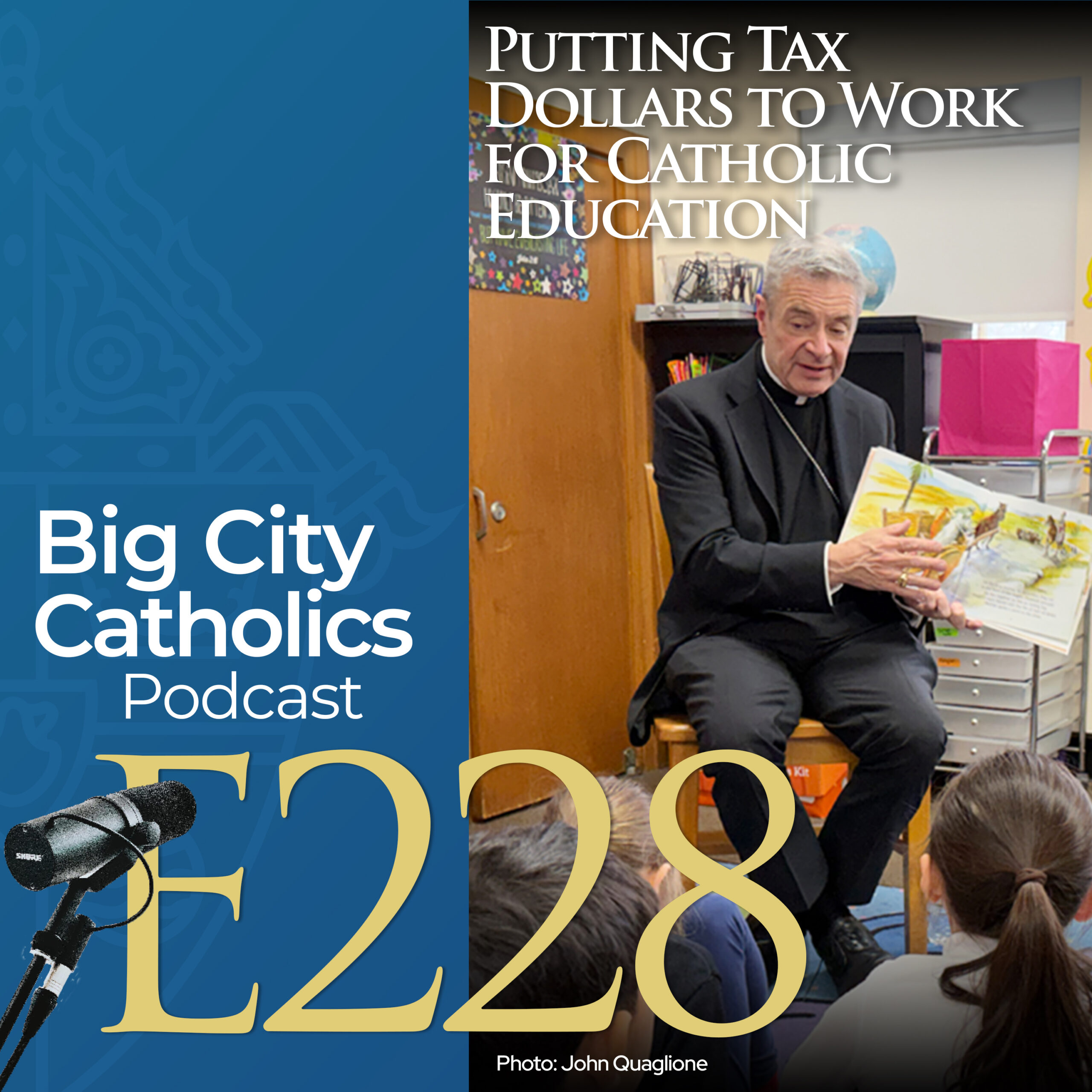
And what is this opportunity for the kids? Starting on January 1st, our donors to a scholarship granting organization can make a gift. Individuals up to $1700, married couples filing jointly up to $3400 that can. Those gifts can be applied for tuition assistance and other educational costs to help students in private schools, including Catholic schools. Futures in Education, which serves the Diocese of Brooklyn Schools, is a qualified scholarship granting organization.
So we would be a beneficiary of these donations.
And these donations would then be passed on to the children in our Brooklyn and Queens Catholic schools, both elementary and high school. And the too good to be true part of it is that the tax credit that comes with this gift is dollar for dollar 100.
So when a donor makes that seventeen hundred dollar gift, it is at no cost to them how they can redirect monies that they owe to the federal government. And when I talk about this, the first question I ask people is, are you a taxpayer? We all are. Right? Like that's the. Yep, of course I am. So if you pay taxes, you can redirect $1700 of those taxes that you pay to support children in our Brooklyn and Queens Catholic schools. So it allows you to make a gift at no cost to you. It is what we believe will be a transformational once in a generation opportunity for our schools and really has the potential to change the trajectory of Catholic education across the country and in our own diocese.
[00:10:25] Speaker B: Yes. So let's get into that. So one of the mistaken ideas is that this is a tax deduction and it's not. It's even more than that. If you make a gift. So you have to make the gift. If you make a gift of $1700, then $1700 comes off your tax bill, not your reported income. Correct?
[00:10:48] Speaker C: Correct.
[00:10:50] Speaker B: And so as you say, Dollar for dollar, it's a big chunk of change. Essentially, it comes back to you.
What you're doing is you're sort of in the driver's seat for directing where your tax dollars go.
[00:11:01] Speaker C: Yeah, 100%. You hit the nail on the head, Bishop. This is a rare opportunity to actually decide on an individual basis where to spend your dollars. So if you owe $10 in federal taxes and you decide to participate in this and you give a $1700 gift to a scholarship granting organization, your tax bill will be reduced by $1700. So you're paying that same 10,000 no matter what. But now you get to slice off a piece of that to help our Catholic school children. It's such an incredible opportunity just to kind of create a sense of what the magnitude can be from this. If we think who attend Mass weekly, who go to Sunday Mass in our parishes in Brooklyn and Queens, if we were able to get just 5% of all of our parishioners to participate in this program, it would generate an additional $12 million in revenue for our schools and for our students.
So the potential is enormous.
And, you know, we have a lot of work to do because we need people to be aware that this exists.
Know that. Yeah, it sounds like it's too good to be true, but it really is, you know, almost too good to be true. This is an opportunity for folks to be a part of supporting Catholic education without any financial impact to them.
[00:12:36] Speaker A: John, can I look? So I don't have any kids in grammar school anymore or in high school. My kids are all adults. Can I give?
[00:12:42] Speaker C: Absolutely. So it's a federal program, so anyone who pays federal taxes can be a donor to this program.
And because it's federal, it's across states.
So you live in New York, but if you were grandparents who lived in a different state, you could still support futures in education and the schools in New York. There's no limitation on who can donate, where you could donate to. So if you pay taxes, you are eligible to be a donor to this program.
[00:13:17] Speaker A: John, can I give to my. Can I give to my grandkids? Could I make my money? I say I want to go to these three kids. Can I do that?
[00:13:24] Speaker C: But through this program? No. There's already laws that exist that have existed for a long time, and because of the tuition aspect of private schools, a donor cannot give.
Think of a scenario of a parent making a donation to which they can get some kind of deduction or now credit for. For. And they're really paying their tuition. Right. So that, that Setup is not allowed. So a parent or grandparent, etc. Can make a donation. They cannot select the student that it goes to.
But I want to just expand on on your question a little bit. What you can do is select the school that you wish to support.
So if you wish for your donation to support the school where your kids go, then you would be able to make that restriction.
And we believe that that's going to be one of the primary motivating factors that are going to inspire people to give to this. So if you are a parent and your child is in a specific school, you are a parishioner of a parish that hosts a school, or your parish is aligned to a specific school, we believe that your motivation will be to support that school. And this program does allow for that.
So what about your grandkids? What about them getting the help? They will be allowed to apply for the funding that gets raised. And the great thing about this bill and why we're so excited about this at Futures in Education, is that it expands the level of support to more of our middle class families. Futures core mission has always been to help our poor, poorest families have that opportunity to, yes, the families pay into the tuition, but then we give them that extra boost that helps them keep their kids in those seats. So we're not abandoning that core mission. That's still going to be at the heart of everything that we do. But now with this tax credit program, we could get more assistance to those families and help more families. So today in our programs, families who earn less than four times the poverty level are eligible to participate in tomorrow's world. Through the tax credit program, families that earn up to three times the area median income will qualify for support.
What does that mean? About 90% or more of our families that are in our schools right now will qualify for support.
So just looking at that from a kindergarten to 8th grade perspective, today we help about 4,000 students.
As of January 1st, we'll have more than 10,000 students at K8 that are eligible for some kind of support. So it's an enormous expansion of where we are today.
[00:16:26] Speaker A: So let me ask you another question. So January 1st we can start to put these allocations in for the 27th tax year. But I may not have $1,700 to lay out right away. Am I out of luck? Then?
[00:16:37] Speaker C: Another great question. We are trying to come up with several different options to allow people to participate. For some folks, they may be in a position where they can, in effect, lay out the 1700 and then file their tax returns and receive that 1700 back. For other families, donors who are on a very limited budget, there are other opportunities. We are going to have monthly payment options, biweekly payment options. But we're also working on a structure which is allowed under this new legislation where donors can participate through their payroll.
So think about it today, most likely, the way you have your payroll set up today, there are deductions that are made from. You have your gross pay, and then there are deductions that are made for federal and state taxes, and then you have your net pay. That's what all of our paychecks look like. So in this new setup, you would be able to direct some of the deduction from the federal government taxes that, that you owe to a scholarship renting organization. What does that mean? In actuality, as a donor, you could still receive your same exact paycheck, same exact net pay, and be donating into this program. So it's a phenomenal way to participate without having any effect, effect on, on your own budget. So we're excited about that being an available option to increase participation for many of our families who may struggle to, you know, if you're in a limited budget, seventeen hundred dollars is still a lot of money. And this would be an easier way to make it happen. And we'll be sharing the ways that that could get done.
[00:18:27] Speaker B: That sounds exciting. And, you know, I'll tell you, there were two things I'd point out. One is, I think this is an opportunity for people who've always admired the work of something like Futures, but, you know, like the angel program, even something like the Angel Pokemon was out of reach, you know, because you're dealing with other expenditures, the tuition and college tuition. So you're saying stuff, oh, man, I'd love to give, but I just don't have that disposable income. And now all of a sudden, a whole new people are able to help Futures who haven't been able to do that, who believe in the mission. This invites people in. A lot of people in my own circle of friends, you know, who say, oh, I wish I could, but it's just out of hand. And now, yeah, this is something I can do. And it's. And you're part of the mission. It widens that sense of being part of the mission.
I think that's a key, key thing.
But you said something else that I think is very, very important.
You spoke about the mission of Futures. And we're not going to abandon what we're all about. And fortunately for many Years. And this is one of the great things I inherited here in the Diocese of Brooklyn. Here in Brooklyn and Queens, we have some phenomenally generous benefactors. And you have an extraordinary team and a board who are so committed. And we're raising an opportunity, an awful lot of money that goes into scholarships. We still rely on that. Like, this widens what we can do. But we are as committed as ever to making Catholic education available, and we really rely on our donors. Would you want to say something more about that?
[00:20:17] Speaker C: Yeah, Bishop, thank you for raising that. And I just want a second phrase for the donor base that supports futures in Education today, too. When you want to talk about commitment to the mission, you know, we have angels, angel donors today who are supporting 100 kids. You know, there. There are so many committed donors, and some have one student of two students. So, you know, we have a whole gamut, you know, of folks who are involved in this, but they are so brought in. And our angel program, you know, directly connects that donor's gift to the student who's receiving that support.
And the questions that we get, you know, like, oh, what's happening with my donation? What's. No, those aren't the questions we're getting.
Hey, I noticed that, you know, student A's grades went down this month.
Is everything okay with the family? Can you reach out to the school and see what's going on? Do they need some kind of extra support from us? Where is that 8th grader going to high school? We really want to stay connected to them. So this is what we continue to see.
Their buy into the mission. Their dedication to the children who are getting to that support is so inspiring.
Our message to them is, please, please continue to do it. What you're doing. This is not going to replace that work. And in fact, for our core donors, we are going to be asking them to do this tax credit gift in addition to what they are already doing. We need that to happen. We need to be able to get that support to our poorest families while we grow this new program. And, you know, we need both to truly have successful schools, keep access open to our families, and stick to, you know, I think, you know, I'm going to go back to that D.C. conference that we were at last week, and what you heard from so many of the presenters, and so much of it is related to Catholic schools. But at the core of the school choice movement, which really drove so much of this legislation, is where a family lives.
What their zip code is, what their economic situation is, should not dictate the educational opportunity for that child.
And we believe that strongly. And that is why that part of our mission is so important.
And we have that extra piece of passing on the Catholic faith through the work that we do, and that's what makes that work so important.
And hopefully those efforts get complimented by all of these new people now learning more about what futures is all about.
[00:23:09] Speaker A: So, John, we have a situation here where we have about 1.45 million Catholics in Brooklyn and Queens right now, and a lot of them pay taxes. If we had about 800 people per school, that would cover most of the budget.
800 people making this donation at 1700 a pop. You do the numbers. I think it's like $1.7 million. That sounds outrageous, but in our neighborhoods alone, we have 800 people on our block. You know what I mean? Like, if we're living in a neighborhood where there's apartments or where there's tight houses together, there's a lot of people out there. And again, there's going to be a lot of things we're going to. We have to talk to the Knights of Columbus. We need to talk to our accountants. We need to talk about our. Our labor unions. We need to talk about folks who may not think that they're involved in education, but now they have this opportunity. It's so exciting. John, really,
[00:23:58] Speaker C: you're hitting on a really important point from the perspective of the awareness. We've held a couple of informational webinars and presentations so far on this, this. And I've never been a part of anything where there are so many questions. Well, I. I don't itemize my deductions. Can I still do this? The answer is yes. You know, I get a refund. I don't get a refund. You know, and so the questions go on and on that you can really get lost in the details on all of this. But. But our job, and it's not going to be an easy one, is to get the awareness out there as much as possible, because once people do really understand it, they understand the potential magnitude. They understand that they can do this. There's no strings attached, and it is going to really make a difference. That's what's going to make this successful. I'm so grateful for this opportunity to be on this podcast today, because what we're. The conversation we're having right now needs to be had over and over and over again until this becomes second nature to everyone who cares about Catholic education.
[00:25:09] Speaker B: And I'd like to go to another point, because we started Off. There's a good segue here. But we started off talking about what this will do for our schools.
John, would you explain? Because it is a help to our schools, because of volumes. But the real point is this is going directly to families to help them with their tuition.
[00:25:28] Speaker C: The point of this whole program is increasing access for families. So the monies that get raised, that come into futures go back out to our schools. So the schools are the beneficiaries of the money, but it is for the families that apply. What we're seeing in the opportunity are two things.
Number one, first and foremost, is relief for our families, as you very clearly articulated. But there is a secondary benefit to our schools today. I don't know of any other business models where the premium, top price that we charge to our customers is in some cases almost, you know, only a little more than half of the actual cost.
So our schools today are providing a deep discount to families to attend those schools. So there is a gap between the tuition that gets charged and the actual cost to educate.
So where we are going to now be in a position to provide relief, extend access.
We also have this unique opportunity for our schools to move their tuition models more towards the actual cost to educate, so we could close that gap. So we are looking at school sustainability, enrollment, access.
All of that is on the table if we do this the right way.
[00:26:58] Speaker A: John, right now we have schools that have to find 50% of that cost for their children. They have a tuition of about 6,000, which is about average, a little higher than average for our schools, and it's costing about 12,000 per kid. Now, on top of that, we have faculties that are being paid at a discount. That sounds. Discount is a very neutral word. Our faculty are sacrificing to be in our school schools. This gives us the ability to raise all the ships in there. It gives us the ability for us to be competitive and allow people to. To. To have an education that they want. We're not in competition. I mean, I guess we are in certain levels with the public school, the charter schools or whatever. But when. When you look at states, Bishop Ohio is a great example of this. So is Florida, where there is an open competition, if we can be. Use those words here, competition. Actually, everybody does better. The Catholic system does better. The charter system does better. The public system does better. There are some naysayers right now. Some of our people here might hear that the teachers unions are up in arms about this State senators in Queens is. But I don't think it's fair because what they do is they take money that that's not New York State money, it's federal money. And I think this is what Governor Hochul decided on on this level, is that there is potentially millions and billions of dollars that could be coming into New York State for the kids. It's all about the kids.
[00:28:18] Speaker B: And to that point, John, this is something that can benefit all children because. Or has the ability to benefit all children because it can go and be directed toward public schools or charter schools. As long as there's a scholarship granting organization, correct?
[00:28:36] Speaker C: Yes. And what we already know, even scholarship granting organizations that we work with today are looking to create a public school program as part of what they're doing. So for our Catholic schools, tuition obviously is the, is the biggest factor and the piece that we need to keep focus on. But as the rules of this program get finalized, they're going to be a list of educational expenses that can be covered by this program.
And among those, as a very simple example, would be tutoring. So, for example, a scholarship granting organization that will also assist public school students can raise money for those children to receive tutoring services. So if there's a child who needs extra assistance, they could apply to that SGO and they can receive funding for that tutor. And what's interesting about that is that will wind up being a way for teachers, you know, whether they're in our Catholic schools or in our public school, to also be able to receive more.
[00:29:37] Speaker B: Darn a little extra
[00:29:39] Speaker C: for the work that they're doing in, you know, and now being able to, you know, more readily help those kids.
[00:29:45] Speaker B: Exactly. Again, it's the rising tide that's raising all the ships. You know, of course we're partial.
We want to do the best that we can in our own schools. But really, this is about the message, as you said last last week at the conference, parents, it's about giving the children the best opportunity for education wherever they might be. It's a great, great gift. You know, I have to say I'm speaking before the election, but we're broadcasting after the election. I am very grateful to everyone on the federal side and President Trump and to the administration and all the people who worked on making this available to everybody, everyone in the United States. And I'm very grateful that Governor Hochul elected with a good deal of resistance to opt in. So to everybody, this is one of those bipartisan kudos to everybody. Great, great job. Thank you one and all. And to all of you who are listening, it's going to take a little bit of Work, it's not just write the check in. It's all taken care of. There's a little bit of work that needs to be done, but we are ready to help you do that. John, as we kind of take this out, would you tell people how they can get more information, especially when we get toward the end of the year, because that's when it starts, like in January, you can make your donation, right?
[00:31:05] Speaker C: Yeah, exactly. Bishop
[00:31:06] Speaker B: so this is the time for education, but how can we get more information?
[00:31:10] Speaker C: Yeah. Bishop what I would encourage people to do for those who are listening, visit our website. If you go online and look for futures in education, as soon as you get to our homepage, you'll be able to navigate to get more information about the program. Things are evolving very quickly, so as we get new information, we'll make it available. There are details that are being worked out, but we. We're working on a structure. So on day one, January 1, people will be able to go to our website and make their tax credit gift, and the full instructions on how to do that will be there. But for now, we encourage you to learn more about it. And one of the best ways you could do that is by going over to our site.
[00:31:49] Speaker B: Thank you, John, for being with us. Thank you, Deacon Kevin, for co hosting today. Thanks for both of you for taking part in this conference and for all the work you've been doing in the last year or so on this particular issue, but all the work you do all the time on behalf of our young people. One of my expressions, I guess I have a few taglines, and one of them is God's doing amazing things in Brooklyn and Queens. And I thank you for. For being part of God's great work here.
[00:32:16] Speaker C: Thank you.
[00:32:17] Speaker B: Thank you for joining us this week. Please join us again next Friday for a new edition of Big City Catholics. In the meantime, let's just ask God's continued help and blessing. The Lord be with you
[00:32:29] Speaker A: and
[00:32:29] Speaker B: with
[00:32:30] Speaker A: your spirit.
[00:32:30] Speaker B: May the Lord bless you and keep you. May his face shine upon you and be gracious to you. May he look upon the kindness and grant you his peace. And may the blessing of Almighty God, the Father and the Son and the Holy Spirit descend upon you and remain with you forever and ever. Amen.
[00:32:43] Speaker C: Amen.