Episode Transcript
[00:00:10] Speaker A: Welcome, everyone, to Big City Catholics. I'm Monsignor Jim Vlon. I'm the president and CEO of the Catholic Faith Network. And I'm joined here today by the host of Big City Catholics, Bishop Robert Brennan, the Bishop of the Diocese of Brooklyn, along with Archbishop Nelson Perez, who's the Archbishop of Philadelphia. Welcome to the show, and it's good to be with you both again on television and on radio.
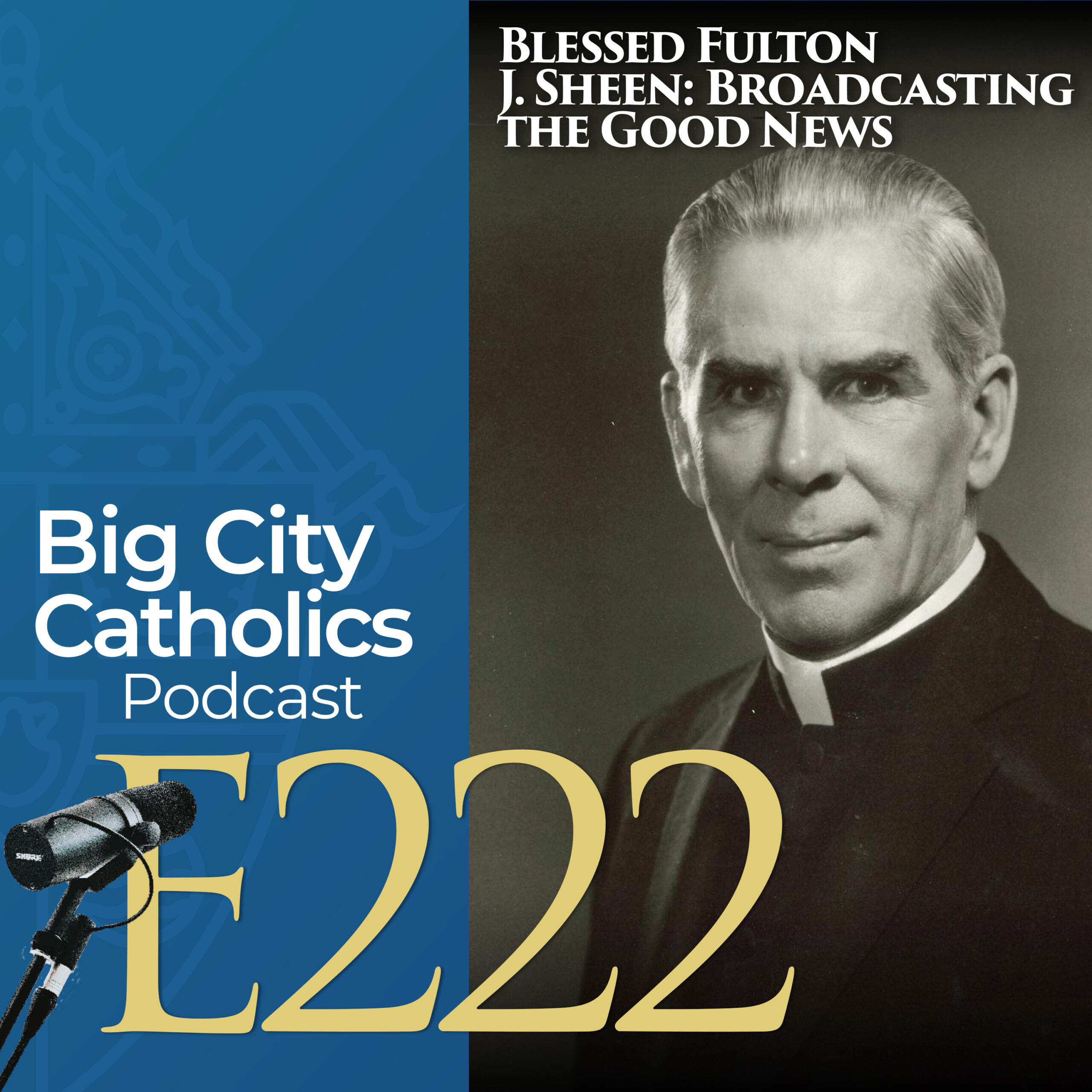
[00:00:30] Speaker B: And thank Senior Vlon. You know, this is the crossover edition, so Catholic Faith Network, Net tv, and of course, Big City Catholics, the podcast. And we're doing a special program in anticipation or if this will air the day after the beatification of Archbishop Fulton Sheen. We're looking forward to that celebration. A big moment for the church in the United States. Also a big moment in terms of media and evangelization. Archbishop Perez, the Archbishop of Philadelphia, Monsignor Di Graco and I used to do a program on Catholic Faith Network. And of course, Monsignor, you were always a big part of that in the. In the production and getting us all set going with the team at Catholic Faith Network. So I was hoping for a little bit of a insight reunion. That was the name of the program. We're going to do that again. We will get these insight reunions when the three of us can work out our calendars. But today we're going to do some memories, some of our memories when we were young in the early days of TV and of Archbishop Fulton Sheen, and really talk about some of its implications for evangelization today. But as always, why don't we begin with a prayer in the name of the Father and of the Son and of the Holy Spirit. Amen. Lord God, we remember those words of the psalm, go out to all the world and tell the good news.
Indeed, we are thrilled to be part of your mission of proclaiming the good news in the world.
This week, we give thanks for the beatification of one of our local priests and bishops, Archbishop Fulton Sheen. We give thanks for his life, for his holiness, his sanctity.
We give thanks because we know him as a bishop like ourselves, doing the best that he could with what he had. But, boy, he had a way of bringing joy and hope to people. We ask you, Lord, to help us to be true messengers of your word and to bring the good news of salvation to all whom we meet through Jesus Christ our Lord. Amen.
[00:02:36] Speaker A: Amen.
[00:02:36] Speaker B: In the name of the Father, Son and the Holy Spirit. Amen. So, Monsignor Vlon, we kind of grew up in, I would say, the golden age of tv, right. I remember the black and white set. I remember when we got our first color set. I don't know if that's your experience. I remember the Saturday morning program, the times that we would gather as a family to watch tv because a show was on once.
[00:02:57] Speaker A: Yeah, right.
[00:02:58] Speaker B: And that was it.
[00:02:58] Speaker C: Yeah.
[00:02:59] Speaker B: Maybe you would get the reruns six months later, but that was about it. But television at that time was sort of a bonding experience.
We deal with different kinds of media today, but remember those days?
[00:03:10] Speaker A: Well, you know, what was great about those days too is television was much simpler then. And Archbishop Perez, you'll probably speak to this too, because you're a product of this exact same era. Archbishop Sheen, really, it was a one camera shoot, which meant he was staring at the camera the whole time looking at you, and you felt like he was speaking right to you directly. I remember sitting on the couch in my house looking at this black and white television and there he is with a piece of chalk in his hand talking to us and making story kind of connect with us, with what the point of the scriptures or theology that he was trying to get across. It was very, very effective television back in the day that, you know, was being discovered at that very same time. Three camera sitcoms. Think about I Love Lucy. Think about, you know, the early ones, Hazel. Like those kinds of shows, there was three cameras and they bounced around a lot. But with Archbishop Sheen, it was one camera and boy, they were on it. And that, I think, was a very different way of doing television. Even though it was an old fashioned way, it was something we were not used to seeing. Like when you're watching, well, cartoons, forget it. But if you're watching something like I Love Lucy, you know, bounced around and you had different sets. This was a blackboard, the archbishop, a piece of chalk and you. And it kind of. It drilled right into you. I thought it was. I thought it was fascinating. You have any experience of him early on, Archbishop Perez?
[00:04:29] Speaker C: Only in what I've seen after the fact, you know, and your words are.
Are spot on. He was effective. He was intense.
Yeah, he was intense.
And it captured really the imagination of the people of his time, as he was, in so many ways, way ahead of his time.
Way ahead of his time when, like, he started in a lot of ways, using technology and using television to advance the gospel and the message of the church hadn't been done before and became a household name for Catholics and non Catholics alike. So in a lot of ways he laid down the groundwork for what we do now today. What CFN does today.
It's amazing that probably without even knowing it, he was a visionary and he was starting a vision for the future that now has become our daily bread is the way we function.
[00:05:33] Speaker B: Yeah. You know, the other thing I think that was somewhat innovative for the time is that he was doing this on network tv.
Now, this is. The field has changed with cable. But remember when we were kids, they had the closed circuit tv. We get it in the schools. Davey and Goliath and things of that nature. Right.
[00:05:55] Speaker C: And TV was like, you know, nine channels.
[00:05:58] Speaker A: Yeah, yeah.
[00:05:59] Speaker B: And so the fact that he was on network tv, that's a big deal.
[00:06:03] Speaker A: It was unheard of. And that was groundbreaking. And he became so hot, if you could use that word, I'll go back to another show. So, you know, I'm a big fan of Jackie Gleason. The Jackie Gleason show did a special when it was Jackie Gleason's birthday and they had all these different stars come on and wish him a happy birthday. Gene Kelly, you know, John Wayne and Lucille Ball, the last guest on his birthday show. And somebody introduced it as a surprise guest for Jackie, who was a Catholic. Right. And a devout Catholic, as a matter of fact, was Archbishop Sheen. And he walked across that stage and embraced Jackie Gleason for his birthday as a special gift to him. And Jackie's crying on the stage and the Archbishop's holding him. And that's how that show ended. I remember it was like it was yesterday. It was such a moving thing to see. He had an effect on other celebrities. So sometimes he would receive a little heat, you know. You know, for hanging around with celebrities. But celebrities were looking to him for grounding, for faith. And he was a great source of faith, almost like a chaplain to a. To a celebrity community, you know, in
[00:07:08] Speaker B: the early days, showing that something can be done, that this media can really make a difference and that we also have a standing in that world. We have a standing in the world. We have something to say to the world, a message of hope.
[00:07:22] Speaker A: I agree with you.
[00:07:22] Speaker C: And that's what's special about the Archbishop, is that he didn't play the role of a star.
[00:07:29] Speaker A: No.
[00:07:30] Speaker C: He very much was a priest of the church, a bishop of the church, and presented himself in that way, even in his manner of dress. Right. He was always dressed the part. Dressed the part, not of a TV star, but dressed the part of a shepherd of the church. And he approached what he did in that manner. Really unprecedented, as you say, Bishop Brennan, on network television. I don't know of anybody that occupies a space like that right now.
[00:08:00] Speaker A: No, you're absolutely right. A lot of people try, but nobody does. And back in the day, it was truly revolutionary to the medium of television. Right. To actually have a priest, a bishop, speaking to the people of America. It was millions and millions of viewers back in those days. Now, you know, audiences are proliferated. Right. So it's not the same. But then it was millions and millions of people, over 10 million people watching him. That's a lot of people to affect in a half hour show.
[00:08:28] Speaker B: I loved his teaching style. I love the way the chalkboard and the angel whispering in his ear, as he would say. But like you say, Monsignor Fluent, he's looking right at you. And basically, it was the catechism, in a sense. He was just. It wasn't about politics. It wasn't about the world. It was the catechism.
[00:08:52] Speaker A: Yeah. And the way he.
Exactly right. Yeah, exactly right.
I remember a couple of years ago, I was asked by Cardinal Dolan to offer the Seven Last Words of Christ on Good Friday at St. Patrick's Cathedral. And I was scared to death. And what I was scared of was not speaking at St Patrick's it was not Cardinal Dolan sitting there, you know, waiting for me to make a mess of myself up there. It was standing in the place where the archbishop, Archbishop Sheen himself offered those seven last words that are remembered to this very day, not only in the book that came from that, but in that moment where he presented that literally. I think that kind of changed the church in America, you know.
[00:09:29] Speaker B: Absolutely. You know, we talk about some of those personal connections. I was just thinking of some of those.
We had two parishes here in Brooklyn. One of them is Lady Queen of Modest in Forest Hills, and the other is Our lady of Angels. And Archbishop Sheen used to preach Lenten missions. And then he would do those last words until he began doing them at St Agnes and then at St Patrick's in the city in New York, he would do them in these churches. So there are communities here in Brooklyn and Queens that feel a connection to him more by history than by anything else. But it's still a connection. So I'll be offering Mass on Saturday at Our Lady Queen of Martyrs just to make that connection with his preaching and his connection to the parish.
[00:10:16] Speaker A: That's great. I remember when I went to the seminary, we had to read two books. We had to read the Seven Story Mountain by Thomas Merton, of course, and we had to read Treasure and Clay by Archbishop Fulton J. Sheen. I can remember sitting on the beach at Jones beach here in New York, reading that book on the beach as I was preparing to enter the seminary. And I've always been struck, both of those men writing about the frailty of humanity and the grace of the spirit and those things, like I found as a great encouragement in the early days and even now, you know, in my own vocation.
[00:10:48] Speaker C: Absolutely. At the end. Why is Fulton Sheen being beatified? He's not being beatified by the Church because he had a TV program.
Right. He's not being beatified because he was popular in his time and impacted people.
Ultimately, he's being beatified because the Church recognizes that in all of that, he lived a life of heroic virtue that is to be placed before the world as an example of the Christian life to live. His beatification is not calling us to be a TV star or have a TV program. It's calling us to strive and the challenge of living a holy life, whether it's on television or in the midst of our home or as a priest and bishop. What the Church is saying about Archbishop Fulton Sheen is way beyond what the world around him at his time is saying. Yes, he was that presence on network television and said great things and taught the catechism and the faith of the Church with great clarity. And those in and of themselves are wonderful things.
But the Church is recognizing that in the midst of that, he did it in a holy way, in a holy way that was heroic in nature, that his virtue was heroic. So much so that he's now being beatified and placed before us as one to imitate.
[00:12:20] Speaker A: Yeah, I agree with you completely. One of the things I wanted to mention is that, so 1979, you know, I'm in the seminary. I'm in my first year in the seminary. Bishop Brennan, you were like a year behind me, Right? So were you.
[00:12:32] Speaker B: Right. So I was in high school. I would have been a senior in high school.
[00:12:35] Speaker A: You were a senior at St. John's I had just graduated from St. John's High School, so I'm a freshman. And we have this. They announced this at lunch. Anybody who would like to go to Archbishop Sheen's funeral is not only excuse from school, but there is a bus that's going to be taking us there. And we all jumped on the opportunity to go to the funeral Mass at St. Patrick's Cathedral. So I went, of course, to his mass. And this is the actual prayer card they gave out. And I was sort of laughing with the two of you before we started. Like most of my Life has been destroyed since then. I don't have a lot of these things. I'm not. I wasn't a keeper of things. But I put this in my Bible as, like, kind of a bookmark, and it stayed in there ever since 1979, incredibly. But this is the prayer card that they gave to people who attended his funeral Mass, and. And we did file pass his body and say a prayer, I would say. One of the things that I found interesting about that is that his funeral attracted. I remember this part every single walk of life you could imagine. You know, the great and the mighty, political leaders, homeless folks, everyday people, children, school children. The cathedral had every kind of mix of person there, which I found very, very inspiring, really, because that's, I think, who he basically appealed to. He didn't appeal to any one particular kind of person. I think he appealed in his Yemeni to lots and lots of people.
[00:13:54] Speaker B: Exactly. He really did. And I guess if he appealed, had a certain appeal, we would feel it with a connection here in New York that at that point in his life, he was a real New Yorker.
[00:14:04] Speaker A: Absolutely right.
Can you remember the embrace with Pope John Paul II at the cathedral? Remember, that photo is a great picture of them hugging each other. Right. And he's. And Fulton Sheen is an older man, and he's getting ready to go home to God, but he's being embraced by the Holy Father in the sanctuary of St. Patrick's Cathedral. Right.
[00:14:25] Speaker B: Beautiful moment.
[00:14:26] Speaker C: They're embracing now.
[00:14:28] Speaker A: Yeah, it's. Right. It's just something. Right. It's just something else. It's really beautiful. Bishop Brennan, a couple of other themes of his life that you want to touch upon today. Of course, the missionary component of his life, that was a big part of his entire vocational, if you will, career. His mission was missions, right?
[00:14:45] Speaker B: Absolutely. Calling people to that awareness of the missions. You know, the world is bigger than ourselves. And the Pontifical Mission society is celebrating 100 years, the propagation of faith and this reaching out to the world. And so he didn't only reach out to us to teach the faith, but he called on us to support missions, to be aware of those who are out in the mission fields bringing the word to other people.
[00:15:10] Speaker A: I love that. And the other thing I was thinking about, too, is he wrote a book called Marriage Takes Three, which I think is interesting. It's the man, the woman, and also the Lord. And I was thinking about you, Archbishop Perez, with the great renewal work you're doing in the archdiocese, which I'm hoping and praying, I'm not kidding, that that becomes a proof text for dioceses across the country, because I think you're heading in that direction. Are you involved with that rebirth and that kind of firing up marriage and the beauty of the sacrament of marriage in this, too?
[00:15:38] Speaker C: Absolutely. Because, you know, in the last decade or two, we all seen as priests that that marriage as an institution has lost a lot of oomph, so to speak. Right. People living together or not getting married in the church.
And I in particular want to make sure that we make the beauty and the gift of the sacrament of marriage accessible to our young people, to our young adults. And we're seeing a beginning of a resurgence of that, especially being back in Philadelphia. I have altar servers when I was a priest now asking me to marry them. There's a desire, I think, to include God in their relationship. And we certainly see in our young adults in New York and Philly this searching, this thirst for the transcendent God in their lives. They realize that something has been missing, which Archbishop Bolton Sheen, that's what he talked about, right? That God has to be really at the center of our own hearts in family, church and society.
[00:16:45] Speaker B: I was with a couple of bishops recently and, you know, all these studies and the reports of young people coming to Mass in great numbers, and yes, we're seeing a good deal of that. And one bishop said, you know, part of it is holding on to values and very important. But he said another part is they're looking for people to marry. And that sounds worse than it's meant to be, that people are looking for others who share those values and really do want to enter into marriage as a lifelong commitment joined together by God. And I think there's something to that.
[00:17:23] Speaker A: Yeah, I think you're right. And I think it kind of folds into yet another thing that he once said. He said if you don't. If you don't worship God, you're going to worship something and most likely it will be yourself. And it's kind of an interesting thing when you look at this culture and particularly the young people that are kind of coming out of that now. It really was a culture of self worship and sort of people not even entering into relationships because it really is just all about me, wouldn't you say?
[00:17:51] Speaker C: Me doesn't do it. I think they're also beginning to realize that me doesn't do it. The only one that ultimately does it is to have a heart rooted in the lord is what St. Augustine spoke about, right. The human heart was made for God and it will be restless until it finds its Rest in God. And there is a restlessness in the world today. I've also been asked what is the reason behind this resurgence, especially with young people, to come into the church or revert to the church, as they now call it. You could give a lot of sociological reasons for that, but at the end, I think it's a work of grace, yes, the work of the Holy Spirit that continues to work, you know, even despite us at times. It's a wonderful and beautiful thing to see. And Archbishop Fulton Sheen captured that mystical, grace filled life that the Lord offers us. He captured that. And that, I believe, is why he really captured the hearts and the imagination of a nation and really of a world.
[00:18:56] Speaker A: He said, if you don't live what you believe, you're going to believe what you live. And I think that's sort of what we're talking about here. You know, that's the kind of thing like where we get this whole, it's me, me, me, and it's not you, and I don't really care about you. Go live your life. Where now I think we're seeing a little bit of a different world now where if we don't hang on to one another, not only will the world be lost. I don't want to talk in these big sweeping terms, but like, our neighborhoods are lost and our families are lost and our parishes are lost, our vocations are lost, and we need to be connected. I think that's an important part of that.
[00:19:26] Speaker B: So important on that theme of being connected, I think one of the things that Houghton Sheen did is he became the model for us, the flagship, you might say, of Catholic media, the church in the media. Look at the advances, look at your own experience. Monsignor Jim, in terms of radio and Catholic Faith Network, this podcast, the many different Catholic influences, with all the new medium, we still go back to that founding example.
[00:19:56] Speaker A: Yes, Believe it or not, around here we have the rights to 12 of his programs. I don't think they know we have them, but we actually have the rights to them. And we still air them and they still get a very high viewership because, you know, certain concepts like love, forgiveness, mercy, they don't get old. You know, they're forever. And they're rooted in the Beatitudes. They're rooted in the preaching and the life of Christ. They work. And even his shows, we find they still work. I still have the rights to Davey and Goliath, and we air that like once a month, maybe might air a deviant life. And that doesn't get many Viewers, that's sort of a nostalgic thing, maybe just for me. But the Archbishop Sheen's life is worth living.
My God does that. That really still draws viewers because it's timeless.
[00:20:41] Speaker B: Do you ever come across some of the old programs?
[00:20:44] Speaker C: Archbishop oh, absolutely. Yeah, absolutely.
And again, I was always struck by the intensity of his word. And as Monsignor Vlan spoke about how he was intense in looking at that camera because he was speaking through the hearts of people. He knew that at the other side of that camera was a world of human beings that were starving for God, and he wanted to give them the best that he could.
[00:21:09] Speaker A: One of the things he said is about sometimes how the Lord breaks into our hearts is with a broken heart, which is kind of interesting. And when he was interviewed a number of times, he did a lot of work with priests since priest spirituality. He has two books about priest spirituality. And when they asked him, like, what would he consider the cross of the priesthood? Believe it or not, of everything. It was clerical envy. It was a very interesting thing. Like, you wouldn't think of this, you know, clerical envy, being envied by others and having to bear the cross of being envied by others. Now, you could easily translate this and say, well, envy in this world destroys relationships, Right? It destroys family, it destroys friendships. That's such a. For me, such an insightful thing to be able to be aware of and to be able to kind of pray about and look to Sheen for some direction and help because he really processed a lot of that pain in his own priesthood, you know.
[00:22:03] Speaker B: No, that's a real cross. That's a weakness that we all face along the way.
[00:22:08] Speaker C: We're always looking over to somebody else and comparing what they have or don't have, rather than approaching life with a grateful heart.
A grateful heart of what we do have.
[00:22:19] Speaker A: Exactly. We used to live across.
[00:22:20] Speaker B: Didn't we have that in the gospel? Just last week, the tenants in the field, the guys who were chosen at the beginning of the day, thought they got a great deal, and then at the end, they were cheated. What changed? Well, somebody got a better deal. Yeah, right, right.
[00:22:34] Speaker C: And Jesus in that, you know, that parable is like, what are you complaining about? I was true to the arrangement. You know, I made an arrangement with that first guy. What are you complaining about? And I'm not taking anything from you either. This is what I arrange. But we're always looking to see what's on the next person's plate.
[00:22:54] Speaker A: The buffet. Spirituality, the story of my life. I agree with you.
[00:22:58] Speaker C: I told the story last week on this Gospel. When I was a kid, my mom used to say that I would eat with my eyes.
And even to this day, if I go to a restaurant and the person next to me orders the exact same thing that I did, but then I look at their plate and I think, well, they got a little bit more pasta than I got. Why did that happen?
[00:23:17] Speaker A: It's also the size of a slice of pizza. Who's got the biggest piece?
[00:23:20] Speaker C: You know, it's such a human reality that the Lord wants to, I think, purify us from.
[00:23:29] Speaker A: Absolutely. Bishop Brennan, we're already wrapping this all up, believe it or not, and it's a privilege to do this. It's great to be with the two of you again today.
It's a privilege to be back together, too, on TV and on the podcast together. I'm happy to be able to do this. Why don't you? Richard Perez, we want to ask you if you would offer us a final blessing today.
[00:23:45] Speaker C: Sure. Well, we ask the Lord to bless all those who are listening to us today.
And we thank the Lord for the gift of Archbishop Fulton Sheen, who by the time this airs will be beatified already.
What a gift to the church. What a gift to the world for being a trailblazer and using the medium of television to proclaim the gospel and to teach the faith that we so much need to embrace each day of our lives. And we ask the Lord to bless us in Christ's name. Amen.
[00:24:21] Speaker A: Amen.
[00:24:21] Speaker B: Amen.
[00:24:21] Speaker A: Bishop BRENDAN how can we find this if people want to see a second or send it to somebody?
[00:24:25] Speaker B: Well, our diocesan website, the Diocese of Brooklyn can help direct you or on places where podcasts are offered. They're all different platforms. We're on a good number of them. And just search Big City Catholics. Catholics has an S at the end because I think without an S is already trademark. So we have Big City Catholics. Join us next week for another edition of Big City Catholics, where we're going to be reflecting on the life and the death of Saint Francis of Assisi.
[00:24:56] Speaker A: Beautiful. We thank you for joining us on this special edition of Big City Catholics. For Bishop Robert Brennan and for Archbishop Nelson Perez, I'm Monsignor Jim Vlon. God bless. We'll see you soon.
Sam.