Episode Transcript
[00:00:00] Speaker A: Foreign.
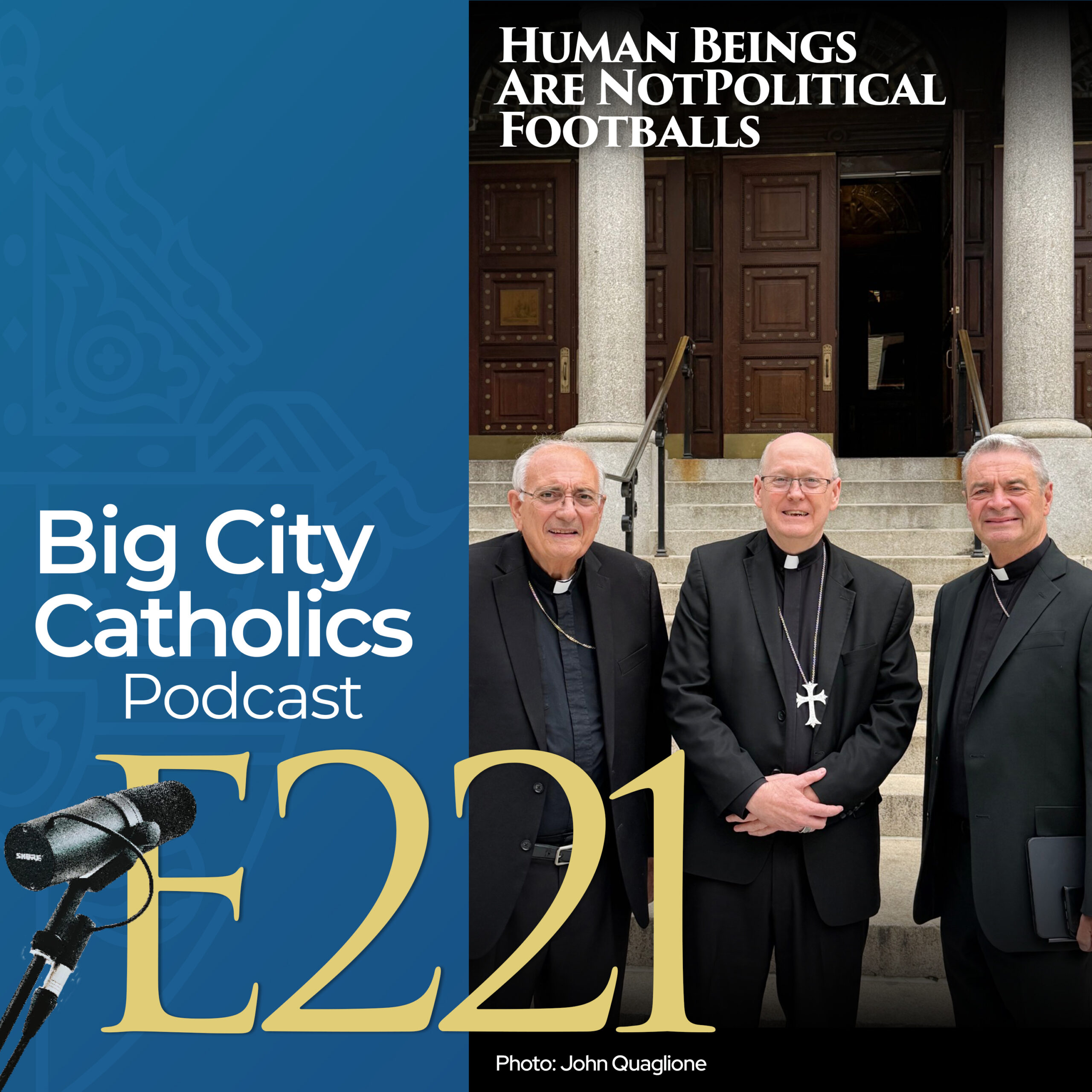
[00:00:10] Speaker B: Hello, and welcome to this week's edition of Big City Catholics. Actually, a very special edition of Big City Catholics. I'm Bishop Robert Brennan, Bishop of Brooklyn, serving in Brooklyn and Queens. And I am joined this week. What a blessing this is by two other bishops, two brother bishops. Bishop Nicholas DiMasio, my predecessor, who is still very active our diocese, and Bishop Brendan Cahill of the Diocese of Victoria, Bishop of Victoria, Texas. We'll be talking today about migration and particularly some of the effects of things that are taking place right here. Very important to people here in Brooklyn and Queens. Of course. We begin always with prayer. In the name of the Father and of the Son and of the Holy Spirit.
[00:00:53] Speaker C: Amen.
[00:00:55] Speaker B: Lord Jesus, when you multiplied the loaves and the fishes, you provided more than
[00:00:59] Speaker D: food for the body.
You offered us the gift of yourself, the gift which satisfies every hunger and quenches every thirst.
Your disciples were filled with fear and doubt, but you poured out your love and compassion on the migrant crowd, welcoming them as brothers and sisters.
Lord Jesus, today you call us to welcome the members of God's family who come to our land to escape oppression, poverty, persecution, violence and war.
Like your disciples, we too are filled with fear and doubt and even suspicion. We build barriers into our hearts and in our minds.
Lord Jesus, help us by your grace to banish fear from our hearts that we may embrace each of your children as our own brother and sister.
To welcome migrants and refugees with joy and generosity while responding to their many needs.
To realize that you call a people to your holy mountain. To learn the ways of peace and justice, to share our abundance as you have spread a banquet before us to give witness to your love for all peoples as we celebrate the many gifts they bring. We praise you and we give you thanks for the family you have called together from so many peoples.
We see in this human family a reflection of the divine unity of the one most holy Trinity in whom we make our prayer. Father and Son and Holy Spirit. Amen. In the name of the Father, the Son, Holy Spirit.
[00:02:32] Speaker B: Amen. So, Bishop Dimasio, welcome to Big City Catholics.
The ultimate big city Catholic from Camden to Brooklyn, and of course, Bishop Brendan Cahill. Bishop Cahill is the chair of the USCCB Migration Committee. He is an old friend of us. We go back to when we were both fairly new bishops and we met at the Gathering of the Bishops in Orlando, Florida. He served me on the Cultural Diversity Committee and now he's the chair of the Migration Committee. Bishop Kahl reached out to me not too long ago about a week or two ago and said I'd love to come to Brooklyn. Something was canceled and I'd like to have this chance to accompany especially the Haitian people during this crisis with the removal of, of the temporary protective status. And it just turned out to be a great, great pastoral visit of accompaniment, of listening, of learning. But Bishop Cahill, you are no stranger
[00:03:34] Speaker D: to Brooklyn, are you?
[00:03:35] Speaker C: No, I'm not. I actually used to come to Brooklyn each summer for two or three weeks to stay at my grandparents house. So my mom and dad are both Brooklynites. My mom was From Little Flower, St. Therese of the Sioux and, and grew up on Clarendon Road. And that's where we spent time with summers visiting there. And my dad's from St. Teresa of Avila and grew up there and he went to St. John's High School, mom St. Brendan's and so parents are both proud Brooklynites. My dad's deceased, my mom's still living. So I feel very connected to Brooklyn. Even though I speak like I do, I speak, this is, this obviously fools people, my southern Texas accent. But I have always kept Brooklyn in our heart from our youthfulness. And so that was recently. That's why I was struggling with working with migration and immigrants and issues on migration and with the situation, trying to advocate for an extension of what's called temporary protected status. And actually Bishop DiMarzio has a history of immigration advocacy.
He knows more about this than I do and he serves on the committee him to continue serving to be advisor, you know, help me as we consider how to best respond and how to advocate. And so with this, the temporary protective status was very particular that going back to an earthquake in 2010 in Haiti, that the United States said we can receive some people from Haiti to give relief to help them, but also to help Haiti, you know, by receiving people here. And, and the understanding is that it's temporary. It is temporary, but when it's safe to go back, that they will return or can return.
And so that's what my concern with this was, that the government's deciding that it's safe to return to Haiti. And I think it's obviously a lot of Catholics on the ground and we know the reality and it just doesn't seem to be a good judgment right now.
[00:05:43] Speaker B: It's clearly not safe.
[00:05:44] Speaker C: It would be on one hand for people who are here, it gives an uncertainty about the future because you don't know what's going to happen.
And there could be a better way, humanly speaking in our country that we could say more clearly have an Extension for a year or two or something. Just have an extension. And so we were advocating for that, and the government decided to know that they were going to end the temporary protective status and begin deporting people to Haiti against their will. Right. So if people don't want to go, they would take back to Haiti. And so that was a concern, humanly speaking, that I had.
[00:06:26] Speaker B: And, you know, Bishop wanted to come here to Brooklyn because Brooklyn is one of the larger concentrations of Haitian people.
[00:06:35] Speaker A: Yes.
Basically, Miami would be the largest, and then Brooklyn, then Boston. Those are the three big, you know, places where we find Haitians. Our Haitian community is very active right now trying to be advocates for the extension of the TPS or other things that can be done to allow people to stay until it's a safer situation. Unfortunately, Haiti still is in suspension in a certain sense, because the government.
The other day I saw this thing. The president of El Salvador was here advocating in Washington that day. We're recording somebody put down and the Haitian government should do the same thing on the board. There's no government.
So I mean, this is the part of the problem, so you can't make comparisons. There's a big difference of the situation, Haiti, where you have the UN Peacekeepers being there, trying to do something with all these gangs that are really running everything.
So it is a terrible situation, and something could be done to extend the time for these people to be here. The whole deportation problem is another question, because in effect, my opinion, certainly it's unnecessary.
Most of these people are working.
You're not going to save anything by departing workers.
But legalizing workers, as we did in 1986, makes the most sense. And it proved itself that these people already were integrated, already were involved in necessary work and legalizing them, giving them a path to citizenship years later, of course, but still they had some status and it recognized the contribution they did as workers to our country.
[00:08:22] Speaker B: One of my concerns with the Haitian people, as you say, there's a larger immigration and question, a larger deportation question. A lot of concerns can be raised, you understand, where some of the criminal elements that needs to be addressed. We agree with that. Many of the immigrants would agree with that because the crime is happening in their area. But in the Haitian situation, these are not people who. I'll just use the language. These are not people who came in the wrong way, who snuck in. These are people who did have legal status, who came in good faith, who entered into society and made careers and homes and families. In some of our conversations, there are people who long to go back to Haiti, but they just can't. So they had the legal status, and it's been removed. And that's a very different and troubling situation. That's why we're really, really troubled about this.
[00:09:20] Speaker C: I would agree with that. I think that's a nice clarification, because I think one sense, there's a political argument where sometimes you hear politicians and they'll take a couple of horrendous crimes and they'll say, look at this crime and look at this crime, and they'll do the details, and then they'll say, we shouldn't let these people in at all. But the reality is, when we talk to individual humans, case by case basis, this situation, these people came in legally, vetted. These weren't criminals, gangs. They didn't sneak across. They came in and they have produced in our culture, our society, and now they're being threatened of being deported. And people who actually came here legally participated in school and sports.
One young man, junior rotc, just a real tragedy. And you realize that, no, these are people who did it the right way and were striving to do it the right way and wanted to do it the right way. And we changed the rules. So it's one of the deals. It's almost like we're cheating. Like, you know, you're playing a game or you're making rules, and then you change them. So for me, that's advocacy is fairness. Try to say, let's have a fair system where we understand and we do. And I think we always have to say it, too, that we do believe in borders, and a country has a right to safe borders. We obviously protect our police and have to protect, offer protection for society. So we do uphold that. But it's dealing with the men and women who are within our borders. How do we treat them? And fairness is kind of what we're advocating for right now.
[00:10:59] Speaker B: And in fairness, some of the things that happened over recent years, where entire populations were dumped in on cities, and we saw a lot of that here in Brooklyn, that was not a humane way to treat people. They were living in tents at Floyd Bennett Field. I fault both sides of the political spectrum. I think both political parties are using people as pawns in a political game, rather have the problem than the solution. But now, in this case, we're really looking for humanity, a humane way of talking to people. And I often raise the question, what can we do? Stopping short of invading the country, but what can we do to help Haiti? How do we change that situation? Pope Leo Just last Sunday spoke about that tragedy in Canscope in Haiti. So now you have what's happening in Port au Prince. The violence and the kidnappings and the mass killings is now spreading out into the places where people felt a little bit safer. It's not that they felt that they were safe, but they said, oh, no, nobody knows about us. Well, now it's going out into the suburban areas. Haiti is not safe by any sense of the word.
[00:12:09] Speaker C: And that's an ongoing challenge right now. And for me, I would say try to get the people on the ground in Haiti that there are, say for charities. We know there are certain charities. There are schools operating in Haiti. There are people who are US Citizens, we know who are there and allow them to offer advice. What could possibly work. You hear different people have different ideas, but to do something, whether it be United nations or US Government aid or something like that, to help establish democratic principles, I know they're struggling.
They want the election.
And it's like, how can you possibly have an election right now? But Haiti's trying to work on having an election. And so there are some people helping that.
But for us to continue to work on that, and this, again, is probably what I'm getting back to. I don't think that our process of sending people back, dropping them off, is helping whatever to try to stabilize. So I think there's other things we could do to help stabilize with probably American institutions that are there that are already helping out, because there are charities on the ground.
[00:13:18] Speaker A: Catholic Relief Services have been there for years, and they're really very helpful. Again, talking to the people themselves there is important.
One of our own priests went back and he took a parish which was kind of falling apart and starting to build it up and becomes a safe haven for people. He's not the worst area there, but there probably isn't any good area. I mean, because when these people, the people that are running gangs and they extort money and it's just crime, open crime. They have enough weapons to threaten everybody. So it is a complex situation. And what we shouldn't do is bring more people back to it. If we could take more people out of it, it might be helpful. But it has to be really changed. It can't keep going at this way. It's a failed state.
[00:14:09] Speaker C: And it could be involving Haitian leaders who are in. You know, we use the word diaspora, right? They're in the United States that would want to go back. And they're extremely talented community.
And so that's. We were just hearing about one Yesterday, as a bishop, Nick, and you know, we're talking about this woman from Maryland, had some good ideas, but that's probably make those connections to get together connections coalitions come together to work on. It's urgent. I mean, urgent solutions, quickly. But that's a background to say, I don't think it's helpful that we're dropping people off against their will if it's something people want to go back to encourage. But it's not to say that we're going to do things that really, we call it dehumanizing to the people how it's being treated.
[00:15:03] Speaker B: Right now. When we were doing some of the listening, when we visited some of the Haitian leaders, we were getting some of the information. People are being just dropped off. They're being dropped off in Cape Haitian because that's probably the only way into the country. You can't land a plane in Port au Prince. And then they have to figure out a way to get to where they're going. Which, by the way, if they've been here since 2010, has changed an awful lot. I think they're given about $65, we're told.
[00:15:30] Speaker C: Yes, $65. That's what they said, $65.
[00:15:34] Speaker B: And just to get to Port au Prince is 500.
[00:15:37] Speaker C: Right. So they're on their own.
[00:15:38] Speaker A: Yeah, yeah, dropped off.
[00:15:40] Speaker C: And that's trying to create more. That's what we're saying about fairness and justice, and that's why we're advocating with our government. So again, we put a letter in today trying to speak to President Trump and, you know, say legally, you don't have to necessarily have to do the extended TPS as a deferred thing the president has authority to do, to ask him just to make a judgment on this. I mean, if we can. I mean, that's where the broader concerns of this mass deportation coalition, a sense of there's a political pressure from people on the president that they want to remove 18.5 million people.
And they really think that it's limiting to only focus on criminals, that you really just have to remove what they call on their website they call deportable aliens. And so I think there's a lot of pressure that the president is receiving from people who think he owes them, that he has to remove as many people as possible.
And that's where he's under pressure on this, because he's thinking, who's the most vulnerable? And so we can say all we want that it doesn't make sense. Why would you remove legal status? They've come here. Right. They aren't the criminals that certain people are talking about. These are ordinary people who could be very good contributing citizens.
[00:17:01] Speaker B: A lot of them are.
[00:17:02] Speaker C: The question is, why are we removing them? You know, But I think it's a political pressure. He's getting.
[00:17:08] Speaker A: The letter you mentioned, this came from the president of the conference, I believe.
[00:17:13] Speaker C: Yes.
[00:17:13] Speaker A: President, conference, directly to President Trump.
[00:17:16] Speaker C: Yes.
[00:17:17] Speaker A: So the highest level, when we're all organized, the president speaks for the bishops of the conference, urging him to find another way to deal with this situation. So it is good. It would be great if we had other people in the same area talking. You got a coalition for deportation. There's no coalition against it or at least recognizing the reality we have of that. These are needed workers in certain areas. The Haitians really need it. And healthcare.
[00:17:48] Speaker B: Exactly.
[00:17:49] Speaker A: Home care, really. They really are important, and we don't want to deport them.
[00:17:54] Speaker C: Doctors and nurses.
[00:17:55] Speaker B: And we actually spoke with a physician who had her temporary status removed. And that brings us to another point. The immediate problem right here and today in Brooklyn, deportation. Been maybe a couple hundred, you say that have been deported. But the day it went into effect, July 29, all these people lost their work employment permits.
[00:18:21] Speaker A: Yes.
[00:18:21] Speaker B: They can't work. Doctors who can't practice, their lives are turned upside down. Somebody was explaining that everything, it's almost like you're erased.
[00:18:29] Speaker C: Social Security, everything.
You're never getting that. They say you won't get that back. They kind of take everything away and create that fear. And so that's really. I guess that's why I came here, because I said two things was the connection to St. Therese Luis, knowing that's where my mom grew up and knowing it was a Haitian Caribbean parish. Mom was very proud about that, that, you know, it stayed Catholic. I mean, I don't know why, but some areas, they don't stay Catholic. But this area was still a Catholic area. That meant a lot to us. And so I thought I could visit and celebrate Mass with the community there and just say, I'm the chair of the committee. I want to have solidarity. You're not alone. You have people. We care for you all around. And the other, with Bishop DiMarcio, just ask advice. Because Bishop DiMarzio, part of being a chair of a committee is you name your committee members. And so I asked him, and there's Archbishop, Bishop, Bishop Wensky is from Miami. He's very strong athletes.
[00:19:29] Speaker B: He's very close to the Haitians.
[00:19:30] Speaker C: Absolutely. But both men have experience. They fought the battle over the years and Kind of know and are good advisors. And Bishop Seitz, who was a previous. A very strong voice. And so I thought, yeah, I could come to Brooklyn, could be with the community there, and then was able to spend time with Bishop DeMarcia. Yeah, he took time to visit with me, and we could talk and talk with. There's a couple of other men that. These are friends. They've been friends for, like, 40, 50 years. And they were there in 1980. They were there when we did temporary protective status. Bishop DiMarzier was there when we were doing these things. So he understands historical context. So he'll understand.
Give me advice that, you know, I'm not beginning on just 2000, 15 after. There's a whole history to this and that the history is strong. And so I appreciate that because we got to visit and talk with some people, and this idea of a coalition building of labor, maybe even some governors, try to get people who can be influential to say that, no, we need to stand up for just fairness and righteousness and to be able to do it calmly and peacefully because we live in the United States of America. We're as citizens, able to participate. And so that's some stuff we're talking about, like coalition. Like you said, coalition building. Because that's. Exactly. That's my. One thing I'm thinking about for myself is that there are coalitions for the deportation. We have to have our coalitions for maintaining common sense. And someone even used a phrase like stop the bleeding, just to slow down, reset, and see what we want to do. So anyway, that's part of the reason for coming here, those type of talks and discussions, but also the connection with the community here, because I think it's beautiful. I mean, to visit with people and to hear them and just. They know they're not alone. There's other people who care for them all around the country.
[00:21:36] Speaker B: Right. Exactly. Exactly.
[00:21:38] Speaker A: Legally. Right now, a bill has been passed by the Congress, by the House, by the House, and it's pending in the Senate. Now you need the Senate votes to move it along. So again, it's stalled because, you know, the Republican majority and they kind of side with the president.
So we need to work state by state to see if some people's minds can be changed, because that would give a legal basis to. To do it. At the same time, you're asking the president to use his power in this particular case for the humanitarian purpose.
So, again, this is where the struggle is about.
[00:22:16] Speaker B: And again, a lot of people, even people who've had concerns about immigration over the years, I think, see the humanity of this situation and of others as well.
I think that where the bulk of the people are is a little bit more in the middle and favors this kind of dignity.
[00:22:35] Speaker A: The polling has been dignity much more positive.
Especially since they see that what's happening, the difficulties of the way ICE is operating, all of the things change people's mind. They have a different idea right now, wish it could be done in a different way. And second thoughts about mass deportation. I mean, deportation of criminals is one thing, but workers that are essential doesn't make any sense.
[00:23:01] Speaker D: Right.
[00:23:02] Speaker B: And breaking up families and people who are contributing to society, that's one thing too.
[00:23:07] Speaker C: I like to share with the group because we do a lot of political action advocacy, but people don't see it a lot of times. So we have like the cardinal from Haiti and Archbishop Winsky and other bishop went to visit with senators directly and got them to sign on to the it's called discharge petition in the Senate and getting more senators. And so even, you know, quote, red, senator, red, blue. However, we'd say it that we are advocating with our senators politically and doing that. And so that's one deal I was thinking that struck me too, like coming here. It's important for people to visibly see us. And so even we're talking about stations across.
[00:23:49] Speaker B: Right. But talking about doing some kind of prayer for witnesses came out of one of our conversations. One of the suggestions came up some kind of a procession. And they talked about the popularity of the eucharistic processions. But we were thinking about stations of the cross and using the USCCB race stations and that prayerful witness because many people are carrying the cross today. This is a form of solidarity with people carrying the cross.
[00:24:14] Speaker C: See, I was thinking about that too. I think the public witnesses, I have to remember that that's important because we do work. And that's. I guess there's one deal I want to share with people. We do a lot of work on this. A lot of times it's behind the scenes.
But I think the public witness is so people can see were with them. And so I think that's what I appreciate about the opportunity. Because at least for me, people would say, man, Cahill was in Brooklyn. What did he go to Brooklyn for? And so it's like he's a public witness to that. And so that gave me an opportunity to do something. But then as I was listening to people, I think, yeah, there's probably more I could do back in Victoria or wherever. Or he'd say, maybe over the Archdiocese of New York or Connecticut or other places that, you know, are there things like that? Because that's the one deal I think here and here that they're talking about the idea how you do the station of the cross that seems, if that's possible, that I think would be a beautiful witness. Right. Because that's exactly what we struggle with spiritually, where's Jesus? And people really feel the pressure and depressed because they feel powerless.
And this powerlessness is maybe a political thing. Okay, political power. But spiritually our power is Jesus Christ who walked this path with us. That sounded to me like really positive for me too to think. And that came from people we could do.
[00:25:33] Speaker B: This isn't, you know, a top down church saying this is what we're going to do. This came from the group, from the people. You know, we talked about some of the other things, some of the pressures that people are facing in our neighborhoods, some of the emotional stress, some of the trauma on children who are witnessing this and not sure what's going to happen to their families, their parents.
School opened this past week and we're going to be welcoming students back.
There are a lot of parents that we're hearing telling us that they're not ready to send their children back to school. They're afraid. Now the communities, the leaders in the Haitian community are trying to encourage people to send their children to school because that's necessary for both their academic but their own emotional health. But, but people are nervous and they're not sure what they're going to do in terms of sending children to school.
[00:26:28] Speaker C: Yeah, that's a reality that you hear some things that seem, oh Lord, how can we stay in touch with people, to be with them when they have that much fear and to create networks of care and compassion.
And also it is that we do have counseling available for the young people. Right. And that's something in process, trying to think how to do that practically. You know, we have our Catholic Charities, we have different groups, you met some of our Catholics. But just to realize that that's part of the pressure that's being put on the families. That's one of the things we get concerned about is the family separations that maybe not necessarily with this situation with the Haitians, but in other situations where it's like one member of the family is deported and the rest are citizens.
And instead of working to keep the family together, which I think we used to do, I thought we did. But instead of helping a married couple have established their unity, be able to stay here in the states, they deport one. I mean, we deport one. It's us. The U.S. deport them. And so I think we do work. We're concerned about families, but part is right, parts of the legal. How do we do legal things that help families?
Part is the emotional, spiritual, how do we help? And I think, I don't know.
I think part of the thing I say your Mass on TV probably means a lot. People are stuck at home and they're in fear and they hear your Mass in Creole and they say, if someone on that Mass in Creole says, I know some of you, some of you may be there because you're afraid to be out, but I want you to know we're here with you, that you do things. So you may think radio, there may be things like that, just to keep people in touch. And then also the view about the Catholic Church. The Catholic Church is your local parish, right? So, yeah, those people I saw at Teresa Sioux, they probably will look out for each other. And it's like, you know, your own community and to reach out. And you're a priest. I mean, the priest says, Father Li Shu was fantastic. And you know, you meet your different priests and you think they're really good men. And maybe on local level they could do that to keep people connected, to help.
[00:28:43] Speaker B: Bishop Dimasio. We spoke when we had one of these sessions about some of the background issues. And one of the issues that we talked about at length was racism. And I know that you've raised this even among the priests.
[00:28:56] Speaker A: Unfortunately, this manifestation of racism and the anti immigration issue is very clear. I mean, it's just racism. We have to call it what it is. It's aimed at people that are not exactly what they consider American heritage.
This is kind of just what they say, you know, if your relatives were here or ancestors were here during the Civil War, then you have a right to be here. Well, that excludes a lot of people.
I don't know how many people have relatives that can trace them back that far. The motivation is not to improve the economy, not to make jobs for Americans, not to save money for the treasury. There's a lot more to it. And that's where the motivation is.
Very, very cloudy and very.
[00:29:47] Speaker B: And that's what people themselves are experiencing. That's what they're seeing.
[00:29:51] Speaker A: No, no, the people feel that they. They feel they're being taken to be different and excluded. And it's hard. It hurts. Hurts the people. I mean, difficult thing for them to deal with. Racism is, as they say, it's the. The original sin of America.
We haven't gotten over it yet. We still have manifestations keep coming up because we have to really change a way of thinking and acting.
[00:30:13] Speaker B: One of the things somebody said is that the whole social media scene almost seems to give permission for unfettered racism.
That some of these remarks. This one lady was talking about how she's not herself an immigrant. She was born, he grew up here, went to Catholic school here. And she said, I didn't feel racist any racism as a child. She said, but now I read some of these circles, people I grew up with, who are saying the most heinous things on social media. And she says, and that hurts.
That hurts.
[00:30:49] Speaker C: Yeah. Social media is a different world. I mean, that's.
[00:30:54] Speaker B: But it seems to fuel those sentiments.
[00:30:57] Speaker C: Yeah, really.
And what people put out there, and
[00:31:00] Speaker B: that's where a lot of us are getting our news.
[00:31:03] Speaker C: I agree. I think the racism is something to be acknowledged and then to say practically, okay, we do the acknowledgement of it and to advocate for more fairness and justice and application of the law. You know, I hadn't heard about the line that they think you had to be here in the Civil War.
[00:31:22] Speaker A: Oh, yeah, that decision.
[00:31:23] Speaker C: I only had one of my relatives before Civil War, so I would not be here. I didn't realize that that's what they're saying.
It always struck me as unusual, this sense of racial purity for the United States.
[00:31:35] Speaker A: Exactly.
[00:31:36] Speaker C: That makes no sense at all. Because it would seem indigenous would be the ones. So I didn't realize that.
But I do sense, because it is targeted to certain races, I think it's worth bringing up. It's obviously controversial because no one wants to be considered.
[00:31:55] Speaker B: It's hard to talk about, it's hard
[00:31:56] Speaker C: to listen to, because no one wants to be considered a racist. But it's like, I think we had to be careful with our language, our prejudgments, and even I say myself, us that consider ourselves not racist, we have to be careful about things we say. You know, it's something you always have to say because in the culture they make these stereotypes or things you can just say about. People just gotta laugh. And it's like, no, it's not correct. And so it's a big issue. You're right. It's a big issue on the big things legally, but also on little things. Personally, I think we all have to kind of be careful about it. But it's like when you said that about that, that's. People think it had to be civil war. I didn't realize, but it's like most of us. And even that gets back to the immigration thing, too, because I'm Irish, right? And so Irish will say, we came the right way. No, we just came.
Even my Irish was a joke about it, really. Our relatives just came. It's not like the right way. It's like we showed up in the country. We were allowed to come here. I think, as a country, the strength of America. If we have our 250th anniversary, we believe the Declaration of Independence, we believe the Constitution. We believe the idea that people can make decisions, that the beauty of America is that sense that we have all the different cultures together. We're lucky. We get to travel the world. Right. Most places you go are not as rich culturally as the United States.
That probably has benefited us materially. Maybe that's part of why we're wealthy, because you get the genius of different cultures.
And this idea of that somehow we're one race doesn't make sense at all. But it is something that has to be called out, because I do think it's part of this. I think it's part of this. Certain groups seem like they're picked on more than others.
[00:33:46] Speaker D: Right.
[00:33:46] Speaker B: And, you know, sometimes it may not be overt, but you go to the greatest command. Love God with all your heart, your soul, your mind. Right? And love your neighbor as yourself. And I guess the check of the conscience is, all right, I say this or I write this. How would I feel somebody said or wrote this about me? It's easy to say you would write something about somebody anonymously. But all that said, I think we all believe in the goodness of people. And I think that by and large, our people are really somewhere in the middle. They looked at chaos in the past, and that's not what they want. They looked at people living under bridges and intense cities. They don't want that. People are looking for law and order
[00:34:23] Speaker D: and human dignity, treatment of human dignity.
[00:34:26] Speaker B: Now you're looking at mass deportations and total chaos and kind of a bullying. Because even if you're not deporting people, you put them in a situation of living in fear and now abject poverty. I really don't believe that's where most people are. I don't think this helps anyone politically. I think that the people are somewhere in the middle. But if we could only keep going from one swing of the pendulum to the other, we need to work this out. You'll find that. But that's where people are. They're just looking themselves to live Peaceful lives and certainly want others to be able to live peaceful, productive lives.
[00:34:59] Speaker C: And that's exactly what we're talking about. But for us to be involved with politics, not to be removed from it. And I think that also may be part of the social media reality, is people create like an alter ego, maybe that's on social media. And instead of just being face to face saying, let's try to work through solutions, they're withdrawing in that way. And so for us, maybe how to get people involved in the practical solutions for us. And our politicians respond. I mean, we can talk to our politicians, so we need to keep doing that, keep advocating for just solutions to situations. And I'd say that's the deal for the church, because the Catholic Church, we see you don't want to be private. We do see the global picture. Catholics are around the world. So even you're able to talk about Haiti because we know the Haitian community here, but we also know there are people at the church working in Haiti that we have a vision of the world that we can offer to American citizens to participate in. And it strikes me it is election season. So, I mean, we'll see how the politicians talk about it, what they say, and if they respond to what we're talking about. What we're calling for is a sense of common sense and a sense of stop the violence.
There's certain violent actions that aren't necessary. And so I think for us to kind of keep strong at it.
[00:36:29] Speaker B: And that's actually another point that you've been raising. One of the other things we've been advocating for is access to the holding sites.
[00:36:39] Speaker C: Yeah, defenseless detention centers. That's the one deal on our committee with the two concrete political issues we wanted to engage, because we thought they were very clear, was the temporary protective status for the Haitian community. There's other communities that come up as well. Each one's country's different. And as we work through it, we thought for Haiti in particular to focus on that. That was the first one coming up. The Haitians, very Catholic, a lot of very Catholic, and also very active community.
And then the other is the detention centers themselves. Now, this started, I mean, this started back for me in February when the governor of New Hampshire, she released a document that she received from the federal government that they wanted to build a mega warehouse for people to be held, a new type of detention center.
And so our Congress had approved $38.3 billion to build mega warehouses to warehouse people before we deported them.
That was just shocking. And the language of this deportation re engineering initiative that the federal government was imposing on the people.
So the states all reacted against it. They're not building these because the governor's like, I don't want this in my area. And they had a. In Texas, we had like a very area would be very supportive of the federal government, but they didn't want it in their area. And so it's like letting people know what's going on. That was back in February. And so we've been working on since before February just visitation at detention centers because people are being taken and being held and there's no the priest can't visit. And so we've been advocating for that and working on it and having success because in fairness, something critical of the federal government, the positive is that we have religious freedom, that we are allowed, if we ask for it, to visit. So we're continuing to get access to visit the detention center. Visitation has been very important because I think just to humanly know and for people who have been deported to be able to visit them when they're back.
[00:38:59] Speaker B: And one of the things that some of the Haitian leaders were looking for from us is some kind of a coordination of services here and possibly even coordination in Haiti for when people are deported, when they are there, that having somebody able to be able to receive them or know that they're coming because some of the people who are being deported quite literally left running, leaving home and businesses and everything but the clothes on their back. So if we can coordinate. Well, we have a lot ahead of us and I think we continue to pray and we ask that that prayer may stir us into action. We pray for conversion of hearts and minds and we pray that with confidence. We pray that the Lord will indeed, you know, bring about that conversion of hearts and minds. Thank you both bishops, for joining in this week's special edition of Big City Catholics. I'm glad you're here and thank you for such a great conversation. Thank you, Bishop Cahill, for your visit, your pastoral visit. Thank you, Bishop Dimasio, for your work with the center for Migration Studies and for your work with Catholic M.
And certainly for your great pastoral work right here in Brooklyn and in Queens. Would you offer the blessing?
[00:40:11] Speaker A: Sure. In the spirit this month we celebrate Catholic Day for migrants and refugees. It's 80 years they've been celebrating this day. So it's not something we thought about yesterday. So in that spirit and in the spirit of the theme this year is children in migration.
They suffer perhaps the most. So we can keep mind children. So Lord, we ask you to, in a special way, bless the children involved in migration and refugee life that they might not be marred, that they might have a future. We ask that you give us the faith and the courage and the means by which we can advocate for them and for all. We ask this in the name of Jesus Christ, the Lord. Amen.
[00:40:54] Speaker C: Amen.
[00:40:55] Speaker B: Thank you for joining us this week on Big City Catholics. Please join us again next week. God bless you and have a wonderful week.