Episode Transcript
[00:00:00] Speaker A: Foreign.
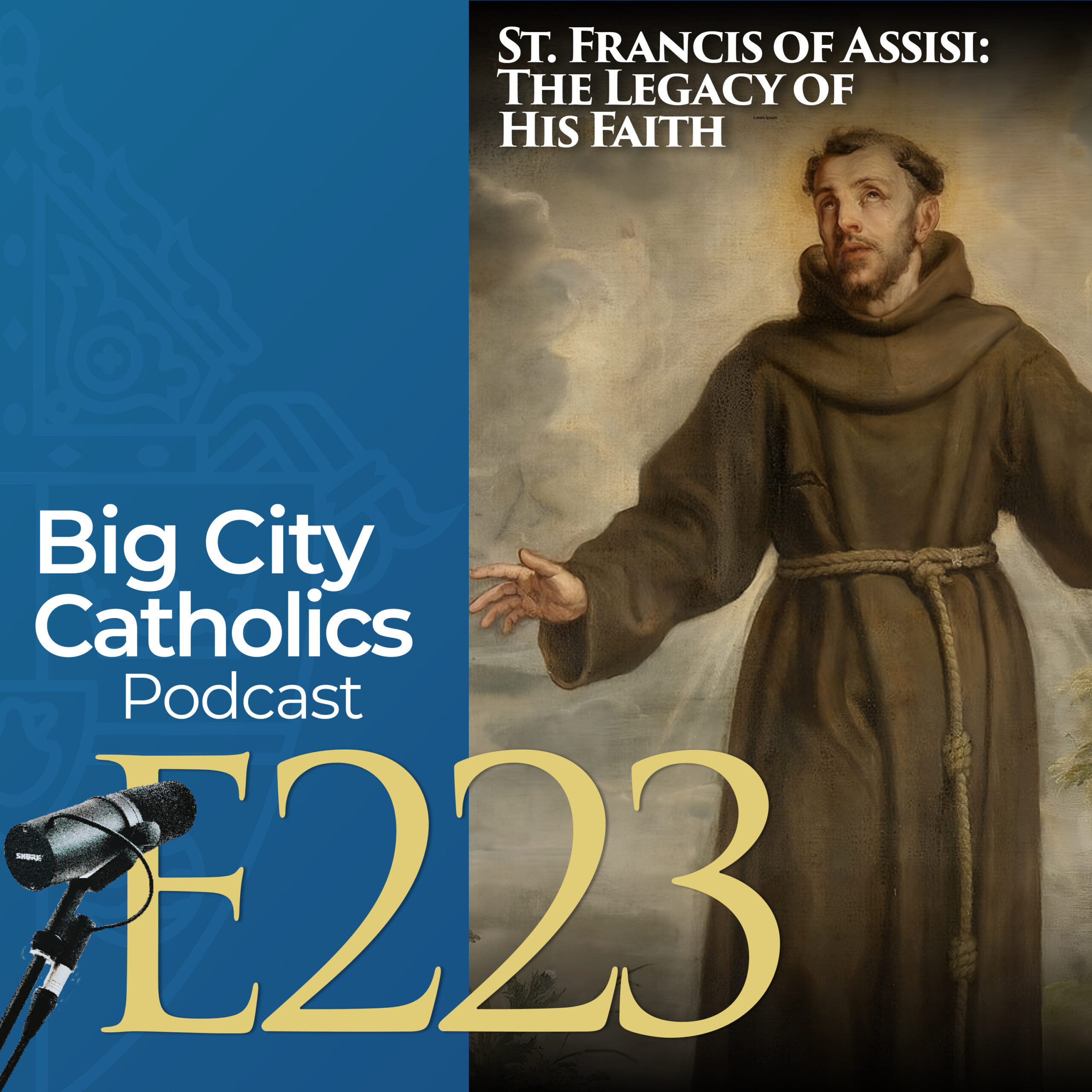
[00:00:10] Speaker B: Hello, and welcome to this week's edition of Big City Catholics. I'm your host, Bishop Robert Brennan, Bishop of Brooklyn, serving in Brooklyn and Queens. This is a very special episode of the podcast as we are on the threshold of the weekend marking the 800th anniversary of the death of St. Francis. Pope Le gave us this as a jubilee year and a year to celebrate St. Francis in a special way. But as we celebrate on Sunday the feast of St. Francis and commemorate his death on the evening of the third, this is a particularly good time to think about, particularly the end of St. Francis's life and to remember his impact. So this week, I'm joined by my own friend and classmate, Father Joseph Miller, who is serving in St. Gertrude's and. And St. Mary, star of the Sea in Far Rockaway. Also chaplain at Christ the King High School and doing various kinds of apostolic works here in the Diocese of Brooklyn. And Brother Damien Noviello, who is the Superior General for the Franciscan Brothers of Brooklyn. And they've really, in a special way, brought that Franciscan charism to the Diocese of Brooklyn and the Diocese of Rock Placenta, particularly to me as well. So we begin this week. I say welcome, first of all, Brother Damien.
[00:01:41] Speaker A: Thank you, Bishop. Thanks.
[00:01:43] Speaker B: Thank you for joining us. And welcome, Father Joe.
[00:01:46] Speaker C: Thank you, Bishop.
[00:01:46] Speaker B: Father Joe, would you please lead us in prayer? We both have an attachment to that prayer of St. Francis before the crucifix, right.
[00:01:54] Speaker C: And actually have the cross of San Damian, the crucifix of San Damiano, right over my desk.
So let us begin. In the name of the Father, Son, the Holy Spirit. Amen. Most high, glorious God, enlighten the darkness of my heart and give me true faith, certain hope, and perfect charity, sense and knowledge, Lord, that it may carry out your true and holy command.
Amen.
[00:02:21] Speaker A: Amen.
[00:02:22] Speaker B: Name of the Father, of the Son, of the Holy Spirit. Amen. You know, brother, we all know that the prayer of St. Francis, make me a channel of your peace. And it's a beautiful, beautiful prayer. I learned this visiting the church of Santa Kiera where that crucifix of San Damiano hangs. And that one always strikes me in a very particular way. I really enjoy praying that prayer.
[00:02:44] Speaker A: It's very special to me also because I think in the life of Francis, his praying that prayer, especially the part that says, enlighten the darkness of my heart, it really sets up a relationship with Christ that I'm not trying to fool you. I'm showing you exactly who I am.
And I want you to transform me into what you want me to be. And it's just. It's such a beautiful prayer. And in front of that crucifix that.
That's one of my favorite places in Assisi is in the chapel of the San Damiano Cross. Because the. The image on the cross is not a tortured Christ.
It's a very serene, non judgmental face of Christ looking on us with love. And that was the relationship Francis had with Christ was one of total love.
[00:03:38] Speaker B: Absolutely, absolutely. How did you come to know St. Francis in your life and what led you then to want to be a Franciscan brother?
[00:03:48] Speaker A: I read Cousin zakis biography of St. Francis, which is a very loose telling of the story, but it was very passionate and very vibrant. And I guess as a teenager I was passionate and vibrant also. And it really. It resonated with me, the whole thing. It was not a reverent biography. It was very earthy, if you want to use that term, and just was something that made me want to pursue it more. And then I met the Franciscan brothers, who were also very down to earth. One of the things about charism is relationships, you know, with people in and out of the church. So it was something that was very appealing to a teenager at that time.
[00:04:40] Speaker B: That's great. Father Joe, you were a student at St. Francis Prep. I think that's where it all began for you.
[00:04:46] Speaker C: I was sharing with Brother Damien before I said my freshman year, which was over 50 years ago. My father was excited I was going to have brothers in high school. But freshman year I had six different nuns from five different religious communities, so I had no brothers as teachers, although there were many brothers at St. Francis Prep at the time. And one of them, Brother DeSales, I met my freshman year. He was a librarian for many years at Prep, and he and I developed a wonderful friendship up until his death.
And was finally sophomore year where I had three brothers.
And one of the greatest teachers I ever had was Brother David, who is now the principal at St. Anthony's oh, yes. What you see with Brother David as principal is the Brother David we had as a teacher. The ironic thing is my sophomore year was 50 years ago, and at that point the world was celebrating the 750th anniversary of the death of St. Francis.
And Brother David made sure we knew that in our European cultural studies classes. And brother brought us to Assisi. He brought us to Italy, and he taught us to say the opening prayers in Italian, and it was wonderful.
And I had two other brothers. Brother Jeffrey was a Spanish teacher, and he shared with us a slideshow of him doing work in El Salvador. And he would refer to himself sometimes in the third person. He said, brother doesn't just speak Spanish, but brother has ministered in Spanish. And that was like an aha moment for me. And at that point, also, Brother Peter was the vocation director with the brothers. And Peter Dawson and I had filled out a little form very quietly, and they traced it down to my presence at St. Francis Prep. And Brother Peter and Bill Boslet came and sought me out. And they said, is this happened to be you? And my.
Yes. And I talked to him a little bit. I mean, a sophomore in high school, I was amazed with their detective skills. But Brother Jeffrey knew about this, and he's like, how did your meeting go with Brother Peter? I'm like, oh.
And I just always found the brothers at St. Francis to be tremendously supportive, just in the fact of discerning what to do in life. But again, too young to make a decision. But as I went to Queens College, those conversations with the brothers kept up. So along with Monsignor Jim Cooney in high school at St. Francis and the Franciscan Brothers, I just always felt this positive.
This positive guidance from them all.
[00:07:18] Speaker B: For me, the connection was with my dad. I didn't meet the brothers until I was older. And in a sense, it was partly through you, Father Joe. When I started teaching summer school while we were in the seminary, and I really got to know the brothers at that point, My dad was taught by the brothers both at St. Bridget's in Ridgewood. They call it Bushwick now, but it's always Ridgewood in my family. And then at St. Francis Prep, when, at that point it was in Williamsburg. He always had a great reverence for the brothers. I think he hoped we would have had a chance to go. At that time, St. Anthony's High School was in Smithtown. It was all boys.
It was, I guess, a little bit of a stretch to get there. Years later, when St. Anthony's moved to South Huntington, my youngest brother went there. And then I myself got involved in the school. And to this day, such a great thing to have the relationship with the Franciscan brothers. And the brothers do a great job of that Franciscan spirituality, connecting. It's like you just said, Brother Damien, that openness and letting Christ transform us like St. Francis did.
[00:08:19] Speaker A: One of the things that is one of the stories of Francis, apocryphal story, I'm sure, about the. The novice following him around and trying to imitate him and do everything exactly like he does it, and Francis turns around and says to him, no, he says, you have to love Jesus the way you love Jesus. That's what I'm doing. I'm loving Jesus the way I love Jesus. And someone has said to me, if you look at the Franciscan brothers, you don't realize how different everybody is yet. They're all doing the same kind of work, from people who are very serious to people who are just so joyful and. And, you know, loving.
And that's the charism of Francis.
[00:09:00] Speaker B: Yeah. And I think one of your gifts. It's a small community, but, you know, talk about being different from one another. You complement one another well. You know, like, each one has the certain gifts and the talents, and it all pulls together rather nicely.
So this weekend is a special weekend. This weekend we mark that 800th anniversary. We remember St. Francis's death. The first thing that comes to mind to me, and we spoke about it a little bit, is the cross, his relationship with the cross. You know, you mentioned the cross of San Damiano, and that's how he received his call. But you also see these great images. I was in St. Michael, St. Malachy the other day and came across a window and a statue. So, like the window, you see Francis reaching up to the crucified Christ. And the statue's kind of in a similar way, but almost as if he's reaching to take him down. You often see images of Francis at the foot of the cross.
[00:09:55] Speaker A: Well, it. It goes with the love of Christ. You know, there's. There's love comes with suffering.
And the whole idea of the. Of St. Francis and the stigmata, that wanting to imitate and love Christ so much, even to. To have the passion of Christ. That's really what we celebrate on October 4th and October 3rd. The whole idea of the. The transit is the idea of Francis passing over into his new life to the point of telling the brothers to lie him on the floor because he wants to be close to Mother Earth.
Because everything in nature was sanctified through Jesus coming to earth through the incarnation.
And that made everything holy. And Francis wanted to be a part of that.
So it was just beautiful.
[00:10:46] Speaker C: One of the beautiful things leading up to the death was the addition of the ode to Sister. Death was literally, according to something like, literally could have been days before Francis himself died. And again, he basically lost his vision. He lost use of most of his body, but his mind was still going. He was still able to talk. So this is all dictated. And that beautiful, beautiful image of praise be to you through our sister bodily death, through whom no living being can Escape and how many times back in the parish now and visiting the sick, visiting the dying. And even with hospice, that fear of death. And I've been able to use some of my Franciscan knowledge and spirituality information in visiting the sick and preaching at funerals that, you know, we as human beings have this fear of death. And just.
I'm not going to take all your fears away by these words of St. Francis, but you just kind of piece in a little bit that there is another way of looking at this. And sometimes in Greek people, you know, what do you know about St. Francis? And they can list off all the popular things, but once you get into some of this Franciscan spirituality and Sister Bodily death. And it's just like. And people in hospice that have been listening and praying and being counseled by social workers understand this. And it's such a beautiful image.
[00:12:14] Speaker B: It's very, very powerful. And even the beginning of that canticle of creation was at a very painful time in his life. Right. It wasn't that we have images of Francis jumping around in the field doing this canticle of creation, but the canticle was during a very difficult, painful time. Am I correct in that?
[00:12:35] Speaker A: Yes. Yeah.
[00:12:36] Speaker B: And that, I think, tells us something too, that it takes a special set of eyes, a special kind of faith to see the beauty of God's creation in your toughest moments. It's not always in the pleasant dreams that we experience God, but it's in those difficult moments that we can, with faith, sense the presence of God. And I would say it's heroic of Francis and to embrace it and to celebrate it.
[00:13:05] Speaker A: The story of perfect joy, where he talks about going to the. The friary and I'm not recognizing him and telling him to stay in the snow and going through all of these bad experiences and saying that perfect joy is when you suffer all those things and suffer them for Christ, because it's a realization that anything good comes from God and not from you.
And so we have to accept all of that, including the suffering. And if we accept it willingly, that is. That is joy, you know, so it's a whole rounded experience, from the good things to the bad things. It's all part of the life experience that God gives us.
[00:13:51] Speaker B: And we get some pretty explicit details about his death, about who was there, and about that whole image of him wanting to be close to the ground.
[00:14:00] Speaker A: And Lady Jacob, he waits for his friend Lady Jacoba to come with the almond cookies.
[00:14:06] Speaker B: Exactly.
[00:14:08] Speaker A: Oh, it's interesting that Claire, who was his first disciple, wasn't allowed to Be there because she was in the cloister. But this noble woman from Rome was.
[00:14:18] Speaker C: When you read the account, was it Thomas of Celano and his first testament gives a somewhat of an accurate who was there? And he kind of tells you who was there. And Brother Bill Short of the Guadalupe Province, now one of the fems, who's become a Franciscan self taught Franciscan historian and scholar, and he describes that scene so beautifully. And then he takes you through some artwork and you see who's there. And you know, again, Francis is blind. Francis can't see. He's like, who's there? Come closer to me. Come to the. Come to the right side. Come to this side. And then you start to see the artwork. And there they are, those original brothers. And then somebody else recreates it, and there's more people there.
And then the stories are coming out that there's more people, that suddenly there's a bishop there, then suddenly there's someone that looks like the sultan is there. And the story gets bigger and bigger. And then they asked Thomas Charlotte to redo it, and who was there. And they admitted that Lady Jacoba was there because it could have been scandalous. There was a woman at the foot of St. Francis as he passed from this life with the cookies.
And then Brother Bill says one of the reasons that happened, it came back in the. In the second story from Chelano was because her son was like, wait a minute. My mother was there? And you're ignoring her. Where's her proper place in history?
[00:15:38] Speaker A: That's.
[00:15:38] Speaker C: And I think she. Is she buried down there in the crypt, too?
[00:15:43] Speaker A: She is. She's exactly opposite him as you come down the stairs, which there's. All of the first brothers are around him. She is across from him, and Claire is across town. She's nowhere near him.
[00:15:57] Speaker B: It's very interesting. Poor Francis. When even his death was his celebrity. You might say people have started to become attached and fascinated by the life of Francis. And at first he was up in Assisi and being treated almost like a celebrity. Everybody wanted to check in. But they brought him back down to San Damiano, correct?
[00:16:18] Speaker A: Yeah. But then they had to bring him back again because they were afraid that someone would steal the body.
[00:16:24] Speaker B: Yeah.
[00:16:24] Speaker A: In the Middle Ages, if you had a saint's body, that was an economic boom for your town. In fact, they lost the body. They buried it in the basilica, when they built the basilica, but at one point they didn't know where it was. It was only, I believe, in the 1700s that they rediscovered it.
[00:16:42] Speaker C: Oh, Wow.
[00:16:43] Speaker B: I didn't realize it was that long. I had heard that story, but I didn't realize it was that long. Yeah. Yes, that I did. You know, between the having the body and then, you know, getting the relics. Right. As soon as he died, they had to guard it. But somehow or another, Francis seems to have risen all above it. When the Franciscans speak of his death, they speak of his transitus, his journey, if you will, to heaven. And there's actually a liturgical celebration of that is.
[00:17:13] Speaker A: Yes. They do it on the night, the Eve on October 3rd, and it's a whole big procession and readings. It's almost like a holy week, a triduum.
[00:17:23] Speaker B: Right.
[00:17:24] Speaker A: It recounts everything leading up to his death and all of those events. It's a very beautiful ceremony. Most Franciscan churches would have something. On the third.
[00:17:35] Speaker B: I'm going to be at not a Franciscan church, but one entitled For Saint Francis. Saint Francis Saint Place on Nostrand Avenue. And Father Vasilotti has asked if we could do the transitus.
Now I'll be doing the vigil Mass on the third, and he wants to do the transits. I've never experienced it before. I've heard a lot about it, but I never experienced it. Father Joe, you actually experienced it in Assisi at the Church of the Ponciucalo.
[00:18:00] Speaker A: Right.
[00:18:00] Speaker C: It was two years ago that the bishop and Father Joe Giobino led a group of priests from Brooklyn on a retreat in Assisi. And we were there literally during the. The beginning of October.
And our first stop from landing at the airport in Rome was in Grecio with the bishop. Celebrated Mass horse. And having read about this and used it at Christmas homilies, now, that beautiful, beautiful image that Francis created and to be there at that altar, it was. It was overwhelming. It was like, wow. And just standing there.
And then the next morning, we had Mass at the tomb of St. Francis. And Father Giovino said to me, oh, by the way, would you mind celebrating Mass this morning for our retreat group? I'm like, isn't that the Mass at the tomb of St. Francis? And he said, yes. The bishop asked you to do it? I said, oh, well, tell the bishop. Of course, the vowel obedience takes many forms. And then I said, who's going to preach? He goes, oh, the bishop would like you to preach also. I said, oh, isn't this nice now?
And I was keeping a journal.
And this is only morning two of our trip.
And the one thing that always took me to St. Francis was following in the footsteps of Jesus.
He didn't want to follow St. Augustine's rule, didn't want to follow St. Benedict's rule, didn't want to follow the Cistercians. He wanted the Gospels, period, end of story. He wanted to live as Jesus lived.
And when we went to Greccio, I was like, look at this. We're following in the footsteps of St. Francis, Francis following in the footsteps of Jesus. So in a twisted math way, I said, this week we are following in the footsteps of Jesus by imitating Francis. And for me, that just brought that whole week. I mean, celebrating Mass at The tomb of St. Francis was unbelievable.
Spending the Transitus at the Port Siunka and the morning of St. Francis, October 4, we conselebrated the 6am Mass in Italian with the OFM conventional community.
And they could not have been more welcoming, literally, with the bishop and I and our friend Father Sebastian Tatisio. And it was just such a great time to be in Assisi. And Brother Damon, you mentioned before, and in all this, we had a side trip. Oh, to see the San Damiano cross.
And you put that in the middle of this retreat and you just sat there. I'm not used to sitting. My ADD kicks in. He said, but I'm staring at this cross of San Damiano and the silence is broken by the little poor clan yelling everybody to shh, be quiet.
I said to our tour leader, I'm like, why? Why are there no photos? They said, then you can't buy the postcards.
But it was just to be in Assisi at the time of the Transitus and The death of St. Francis was so overwhelming for someone that's just trying to still learn more about Francis and incorporate his spirituality into my life. It was just. It was a tremendous, tremendous timing and everything that we went through.
[00:21:21] Speaker A: You know, you talk about all those different experiences, starting with Greccio, how Francis was so enamored with the fact that God comes and becomes human and comes to live among us.
So the playfulness of Jesus as a baby to. To the opposite end, the painfulness of Jesus dying on the cross. And you see in Francis's life how he. He sings and he dances, he goes to a cave and cries. He really wanted to experience Jesus in all ways, in the humanity of Jesus.
And he was able to do that.
[00:22:02] Speaker B: Absolutely. And God chose to become poor in that whole thing with Francis, even his conversion. One of the things that fascinates me as you get to know Francis more and more, is I always thought of his conversion as being this aha moment in the church. The Cross speaks to him. You know, he goes, rebuilds the church, Cross speaks again, and, you know, his life is transformed. But it seems it was a much longer conversion. You know, that, first of all, he had already been curious, and he did a lot of, kind of a fundamental reading of the Bible. He'd open the page and point to a passage, you know, go sell everything you have. And then he'd go and do it. And at one point, I love. You know, I thought his father just was getting mad that he was living simply. But, you know, the story that he went in, his father was a merchant, a trader. He went, he sold all the goods, and then he sold the horse, and then he gave the money all to the poor, which is a beautiful story, except it wasn't his to give. It wasn't his money to give. And basically the bishop told him that, right, you know, that's not yours. You know, the father threw him in, and there was that ecclesiastical trial. The bishop took him in.
But, you know, also said that Francis continued to need that ongoing conversion, that ongoing transformation.
[00:23:24] Speaker A: All of those external things that he did were part of his learning process. But. But I think he's stuck until he confronts the leper.
Yes, that's the thing. And it's. It's. For me, it's so symbolic because this guy is in the middle of the road, and Francis can't get to God until he gets past that leper. Whether the leper is a real person in front of him, whether it's his own sinfulness, whatever it is, he has to embrace the sinfulness. And, and, and no, he had a real repulsion.
[00:24:02] Speaker B: Right. For the real repulsion. It wasn't just that uncomfortable. Yeah.
[00:24:07] Speaker A: And once he does that, then he's on the. On the road, then he's on the road.
[00:24:12] Speaker C: I preached on that a couple of weeks ago, that whole idea where Francis, just as Brother said, you know, and I said, we saw the city of Assisi, we saw the gates there, and the lepers outside the gates, not allowed to enter. And Francis at one point would kind of like, you know, well, they're here, here's. Here's some of the money, whatever we're using. And it wasn't enough. And it says, Pope Francis used to remind us, you know, approach the person, press the money in their hand, introduce yourself, tell them who you are, make a relationship. And his brother said before, that's what Francis was all about in Franciscans of the world are relationships. And that the image that he gave, you know, it's. It's Become sweetness. To me, that which I hated has become sweetness.
[00:24:56] Speaker A: Yes.
[00:24:57] Speaker C: And I said, and we have to confront that in our own lives.
What is. What is the thing that we hate about ourselves, about society? Confronted and turn it into a sweetness. And I said, and here we go. We're like, Francis, we're converting ourselves. You know, it's. It's part of that change that we have to keep on doing that as bishop. As you said, it's not our thing with Francis, but it was continual. And that was his. Francis's promise. You know, I'm going to keep on doing this by following Jesus. And what a challenge that is.
[00:25:26] Speaker A: Well, that's why that prayer you began with is so important. It's continually enlighten the darkness of my heart, because as much as I try, it's. It comes back. It's still there. You know, I. We always need the salvation.
[00:25:42] Speaker C: Brother Bill Short used to call this the if then prayer. He said he starts it off beautifully, praises God. Francis always began by praising God. Then it's like, okay, God, if you do this, then I'll do this. If you enlighten my heart, if you give me true faith, then I will carry out your holy and true command.
And you know, these mad people love stuff like that. The if then statements.
[00:26:07] Speaker B: Yes, we do.
[00:26:09] Speaker C: And so that's why you said, brother, you know, I look at the cross here. I have one in the campus ministry room at Christ the King. I have one all over the place. I just. And it's just a reminder. And I look at myself, I go, the if then, pray God, if you do this, Lord, then I will do this. And it's. What a great reminder. And again with Francis, spot on.
[00:26:29] Speaker B: Well, here in the diocese of Brooklyn, we are blessed with great Franciscan spirituality. We have all of you, the brothers who are deeply embedded into our history, into our schools, and into different ministries and the care for the poor.
[00:26:47] Speaker A: We have almost 170 years.
[00:26:49] Speaker B: 170 years of the Franciscan brothers here. Wow. And with that, the major institutions, of course, are the St. Francis Prep, St. Anthony's High School out in Huntington, and St. Francis College.
And yet we also have other Franciscan orders, the Conventuals, the Third Order. We have. I was educated by the Franciscan Sisters of Allegheny, but we have Franciscan sisters from other countries, from provinces I can't name off my fingertips here. But we have some great examples of religious Franciscans. And then there were many lay people who have taken on that Franciscan spirituality and made commitments to Third Order promises, Correct?
[00:27:30] Speaker A: Yes.
[00:27:30] Speaker B: The spirituality of Saint Francis of Assisi is rich. And this year gives us another opportunity to reflect on it and to renew it. People know this in Brooklyn. Anyhow, we have the option, and it's probably more than an option. It's basically a request that we'll be celebrating on the feast of St. Francis on October 4th. That as the solemnity this year, rather than celebrate the 27th Sunday in ordinary time, we'll celebrate the feast of St. Francis. And I think different parishes are doing all kinds of things to renew that Franciscan spirituality. Let's hope that's a great impetus for the church, that rediscovery of the deeper Franciscan spirituality. I mean, the things the prayer of St. Francis, beautiful prayer, you know, the images of St. Francis that we see.
But hopefully this jubilee year can invite us deeper into the realities that Francis taught us and wants us to continue. Thank you both for joining me for this discussion. You know, the saints keep inspiring us. Last week we had the beatification of blessed Fulton Sheen, and now we're moving on to St. Francis. Saints are speaking to us. They're calling us. Yeah, they reach out to us. Thank you for joining us on this week's edition of Big City Catholics. Thank you for brother. Thank you, Father Joe. And we'll ask God to bless us. The Lord be with you and with your spirit. May the Lord bless you and keep you. May his face shine upon you and be gracious to you. May he look upon you with kindness and grant you his peace. And may the blessing of Almighty God, the Father and the Son and the Holy Spirit descend upon you and remain with you forever and ever. Amen.
[00:29:14] Speaker C: Sam.