Episode Transcript
[00:00:00] Speaker A: Foreign.
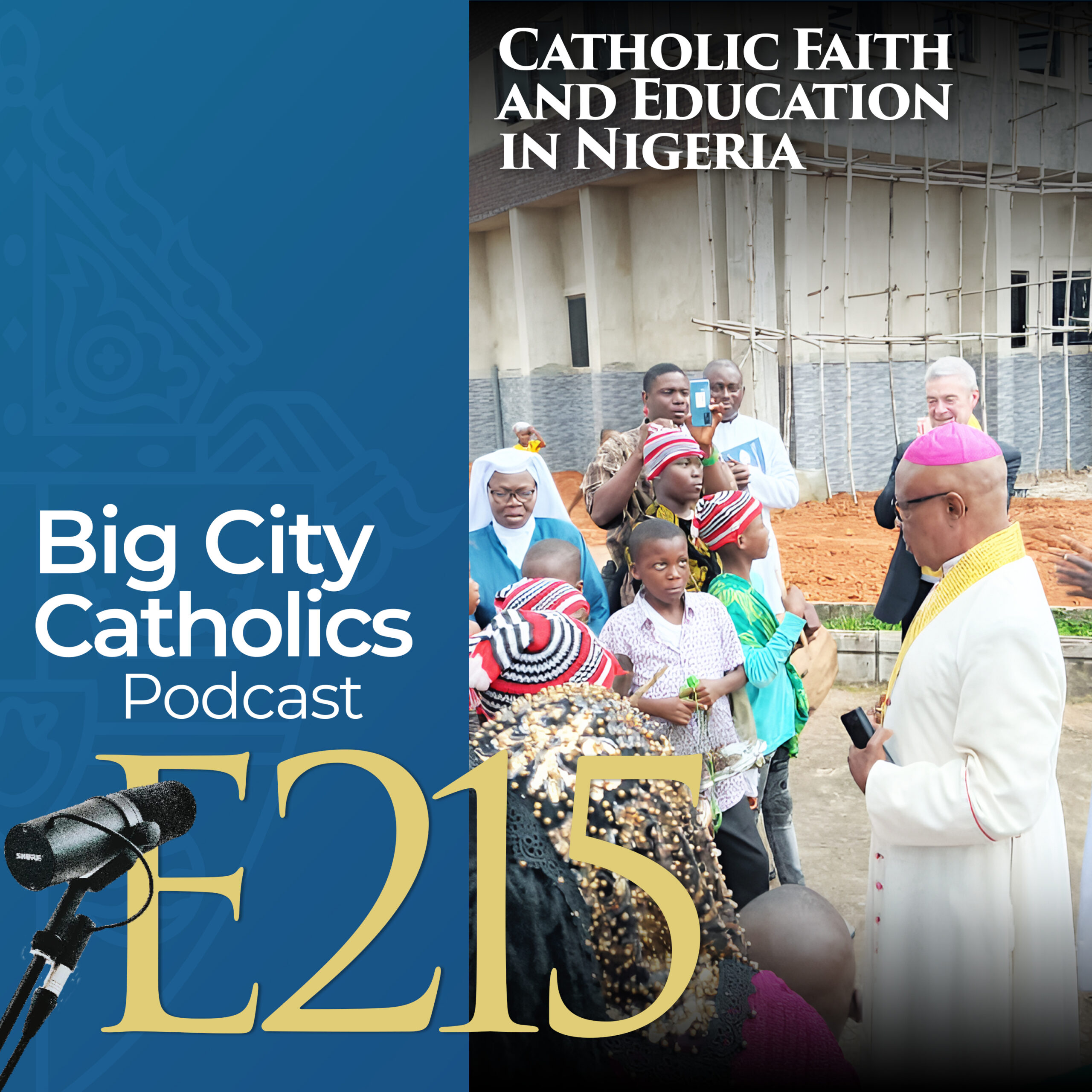
[00:00:10] Speaker B: Welcome to this week's edition of Big City Catholics. I'm your host, Bishop Robert Brennan, Bishop of Brooklyn, serving in Brooklyn and Queens. And this week I am joined by Father Cosmas, who is one of the priests at the parish of Christ the King, St. Mary Magdalene in. In Queens. Father Cosmos is also the director of the Nigerian Apostolate here in Brooklyn and Queens. Very important group bringing together both the Nigerian community of priests and of the faithful in praise of God and in apostolic works. I had the chance to visit, along with Father Cosmas, his home diocese of Honicha in Nigeria. And we'll have a chance to. To talk about that visit and some of the work that the Church is doing right there in Nigeria. We begin with prayer. In the name of the Father and of the Son and of the Holy Spirit. Amen. Lord God, you call us to be one church, Holy, Catholic, apostolic. To proclaim your works in every corner of the earth, to share our gifts, send out talents, to bring the good news of the Gospel to all, all of those we pray. Lord, increase our unity, strengthen our communion amongst one another. Help us to recognize in our diversity the universality of the Church and make us one in faith, hope and love through Jesus Christ our Lord. Amen. In the name of the Father and of the Son and of the Holy Spirit. Amen.
Welcome, Father Cosmas.
[00:01:44] Speaker A: Yeah, thank you, Bishop. Thank you so much for inviting me.
[00:01:47] Speaker B: I'm glad you did. In fact, you're making a great sacrifice here. And this is the wonder of computer technology.
We're actually speaking across the continent. You're still in Nigeria, in Lagos, getting ready to travel tomorrow back to the United States. And I'm back in Brooklyn. And here we are having our conversation. Father Cosmos, you invited me on behalf of Bishop Valerian Okeke to visit N Nigeria, particularly to visit the Archdiocese of Onitra, a place that I visited 24 years ago with Bishop Murphy. And what a great occasion it was to go back 24 years later and to see the work of the Church. Thank you for that invitation.
[00:02:31] Speaker A: Thank you, Bishop. I'm so appreciative of your coming, you know, making out the time to make this pastoral visit. It was a huge thing for us in our nature as diocese, A huge deal for the Bishop Valerian, and for the colleagues there to see you participate in our activities, your donation and everything we did. So we appreciate your visit. Thank you, Bishop.
[00:02:57] Speaker B: Thank you. You treated me so, so very well and I'm grateful for that. It really was beautiful. The Archbishop was a very gracious host. But you. You kind of really helped make it happen. It was one of those things that I said I'd be open to doing.
And you persevered to actually set a date and to get the whole visit coordinated. And, boy, was it ever coordinated. So thank you for that. Archbishop Valerian celebrated while I was there, his 45th anniversary as a priest, but he'll be celebrating very early next year, 25 years as a bishop. When I went with Bishop Murphy, he was the coadjutor to the archbishop.
In other words, like an auxiliary bishop, but ready to take over. And in these 24 years, he did a great, great deal of work within the church. What an impressive visit. Well, you and I, we went to one of. To two of the schools, right?
[00:03:53] Speaker A: Yes. We went to ckc. We went to the seminary, the ckc, Christ the King College.
[00:03:59] Speaker B: Christ the King, Yes. Both of those are really kind of like boarding schools. The students there live most of the year, and that gives them a certain structure and a certain stability, Correct?
[00:04:12] Speaker A: Yes. Yes. Because the. The kids come in from the age of 10, 11, or 12, and then they get the formation that they needed to grow until they get to the age of 18, and that preps them for college. And those of them in the seminary, that also prepares them to head into the apostolic work and then senior seminary for philosophy and theology and then becoming priests. Yeah. So it's a total and wholesome formation for them.
[00:04:42] Speaker B: That would be for the prep, seminary and the school, too, also prepares them for. For all kinds of possibilities. Archbishop Valerian and I agree with this, is very committed to education as the key to development.
[00:04:56] Speaker A: Yes. And I think looking at Nigerian society, the only thing that can salvage that country is knowledge, because the government enjoys people not having the best of knowledge, and so they could not be questioned. So now building up youths who are knowledgeable, who are sound, who could question the system, who could change things, is a huge tool for the church, for the community, and for the system overall, for the growth of. Of the. Of the country, Nigeria, and for the building of the best church that could be welcoming to every other person and for the society. So injecting a lot of energy on the young ones and then bringing them up in the word of God and then understanding the society and then nurturing them to become the best men or women that they can be you, is a huge asset for Nigerian improvement. Yes.
[00:05:55] Speaker B: Oh, so impressive. And it's in everything. The development in sport, there's development in music, there's development in making presentations and speaking articulately.
Wow, that was so, so impressive.
[00:06:07] Speaker A: Yes. Even the kids. I was, yeah. Like, the knowledge they get there is very holistic. Like, we saw the saxophone, those kids playing my piano and all that. So it's not just the academic knowledge is also artistry, the art part of it, the music part of it. And I was also thrilled that the young man who made some presentations to you when we were in Christ the King, very, very articulate, I was sure at that age, could make such beautiful presentation, you know. So I think that's part of the training that Bishop Valerian was trying to imbibe on the. On the society and in the system in Nigeria. Yes.
[00:06:49] Speaker B: We'll talk a little bit about the history later on in the podcast, but of. But just maybe it's worth mentioning that sense of history in the field of education. So the missionaries developed schools when they brought Catholic Christianity to Nigeria. But after the Biafra was. The government expelled the missionaries and seized all the schools, Correct?
[00:07:12] Speaker A: Yes. After the war, the government felt that the missionaries helped the church and the Ebos to sustain the war for three years.
So the government had to kick out the missionaries and took over the schools as. Which was the avenue through which the missionaries were able to put across the Christianity and also imbibing knowledge on the people. Yeah. So the government sees the top. So that he makes sure that the good side of the training and then the means to which the people improved their lives and built up their faith and resilience was destroyed. Yes. That's what the government did after the war. Yes.
[00:07:51] Speaker B: And then, as I understand it, two things happened in recent years, and I'm sure this is part of the work of the Church, of the bishops committing themselves to education.
First, it was a move, maybe, well, let's restart the whole thing. But then at one point, the government returned the schools to the church. Correct?
[00:08:09] Speaker A: Yes. Ever to be, you know, for a more holistic history, I was privileged before I left for United States, I was privy to be the director of schools.
Exactly.
[00:08:22] Speaker B: That's where I was going. Exactly. So you were the director of schools like a superintendent?
[00:08:27] Speaker A: Yes, they are like the superintendent. So within that period was when we had a governor who was a Catholic, so. So we had to go through the political chains with lots of writings. And of course, it was also not good for some people because they were feeling that at the point, the Catholics had more schools that were seized by the government.
So. But we had to pressure the governor of the time to hand over these schools for improvement.
He started, but couldn't finish. Then the next governor, governor, who we are also privileged to be a Catholic, made it happen.
So handing over those schools to the Church brought this great improvement that we saw. Because when I was there, that the schools were still under the government.
Those schools were poorly maintained. The buildings were nothing to write home about. There was no computer there. Some. Some of the kids study in a building that had no roofs on. There were no digital system.
Nothing was really working until we were privy to have this good Catholic governor who was also. And then, as a matter of fact, that governor also went to ckc.
So it was the training he got from CKC that also made him understood the impact of Catholic education.
So that was why he was able to hand over these schools. And that's where we are today, having the best improvement that we ever have now.
[00:10:03] Speaker B: And that put a lot of responsibility on your plate, because now you had to show that the church could do it better. And in fact, you did. And you were succeeded by my friend Father Pascal, who served with me in Long Beach.
So.
So that work continues to grow, and it's so, so impressive. But, you know, Bishop Valerian doesn't stop there. First of all, he's committed to education among his clergy. So he's constantly sending priests to study in different fields, education being one of them. So that he's really investing in the schools, not just in the buildings, but in developing priests and in developing a faculty so that you can provide that strong education.
[00:10:44] Speaker A: Yet I think he understood the importance of human resource that I give to him. He understands the need for priests to be fully developed and well equipped to work in the parishes and to be able to walk anywhere they find themselves. And so within the our state and in our region, Onitsha Archdiocese has the greatest number of priests who have doctorate degree. And what does, what does that do? That is what is helping him now. Because all the priests who are managing those schools that we got back from the government are all doctorate degree holders. So they have a lot of knowledge that they could impact. And then the universities he's building, he also have reasonable number of priests who studied doctorate in philosophy, doctorate in religion, doctorate in education, doctorate in different areas of science. And that becomes cost effective for him because if he was employing external professors to teach in those schools, you know, he was blending them external professors and then using his priests too, because if he has all external professors, then it will be too expensive to maintain such a college. And the impact will be on the families because it will now force the students to pay higher tuition fee so that the Professors, external professors, will be well paid for.
[00:12:18] Speaker B: Along those lines. Two of his other projects had to do with university apostolates. So you took me, you and Father Francis, one of the priests from the diocese, took me to the residence by the state university. He calls it youth village, where a thousand students are living. He built a regular student housing all surrounded. It's like a little community with a beautiful church.
[00:12:43] Speaker A: Yes. One of his thoughts when he started that youth village was before then, the students were living in the whole village neighborhood. So they were not having the holistic training, they were just going to classes and then living wherever they find themselves.
And so that led to a lot of misbehaviors from the students.
So he thought about it that if we continue to build up kids in this form, they were not having the best of tomorrow for the state, for the church and for the world. So he decided to do this youth village.
And then the concept of this youth village was that these kids, if you must, it's. You must not be a Catholic. All he cared about was, you're a human being. And if you're a human being, you're eligible to live there, even though it was a Catholic facility. But you can be a Muslim, you can be a Hinduist, you can be whatever you are, but he looks at you as a human being first, then having living in that environment that is polished, that is good, that is decent, that has morals, that you have all the facilities. In his mind, he thinks that if he's able to build this number of kids and they grow up and eventually become politicians or become governors or become presidents, they will have been grown and nurtured in a very solid environment that is different, that will also help them to build a better community for the upcoming generation.
So this concept was done, a very powerful tool because he was, he was looking at tomorrow. He was not even looking at the G of today. He was looking at the gain of tomorrow for the nation.
And so he did church there, he did games area, he constructed. And he also had buses that could take them from there to the college and back. So they had whatever they need within that beautiful compound. Their hostels were beautiful, well constructed, so that if one of them eventually becomes a governor, he can also think of building a better hostel for other students within the university than allowing students to loiter all over the place, not having some kind of control, which eventually affects the tomorrow of those kids. And also the system that we operate in.
[00:15:06] Speaker B: Powerful, powerful. And then not only the residents and working with the students, which provides a safe Environment that's very attractive, as you say, for all people, but it's a part of building up the whole of the person. You're also seeing a university underway. So the university is already working, but in different buildings in different places. The archbishop took us to Shanahan University.
It's under construction. He hopes to be in session in October on the new grounds. But building a brand new Catholic university, that's a major undertaking.
[00:15:41] Speaker A: That was huge. I know. You know, he's a very brave bishop. I know sometimes he starts some of these things even without enough fund. But in him we see a man with a lot of faith trusting God, you know, and making a journey that sometimes is not very clear to him. But he still believes that he will still get to the promised land.
So that concept of that university, now just a little history of that location, that location is more or less a business area. People living in our nature don't normally go to school.
So because people are more, you know, after elementary school, then they go into trading and they learn how to trade under somebody where they live for like seven years, and the person will give them some money to start up their own business. So that's how that area was developed. But in his mind, he felt also that if he cites a university there, some of them will also decide to go to school and then improve in their businesses too, because when they go to college, then they will have a wider concept of how to do business or how to live a better life or how to have alternative to whatever they are doing. And so he initiated that and signed excited that university and building such gigantic. We saw a lot of concepts, the posters, the big church, the big hall, the. The, you know, a lot of concepts that he is injecting into that academic environment.
It. With a lot of boldness, you know, which. With a lot of boldness and looking at that concept, he had a youth field village. So for him, the kids who are there who have done their first year are still scattered within the town. So he want to bring all of them within the compound of the school so that they will be able to have a holistic training, you know, instead of having, you know, you're staying there, you're not, you know, the training is giving you all it takes, your spiritual formation, your academic formation, your social formation, the psychological formation. So that's why he is making every personal effort to erect livable place for them so that he can get all of them who are living outside into the school compound so that he can be able to achieve his particular mission. Within that university compound.
[00:18:12] Speaker B: Very impressive. And just to mention, we also saw a hospital. There's a medical school associated with it, all kinds of ongoing educational work. So as I mentioned before, Father Cosmos, I was there 24 years ago. We joke a little bit because the archbishop before him, Bishop Orifuna, took us to the seminary, which was under construction at the time. And you and my friend Father Pascal were students there. We didn't really get to see anyone, but we were there at the university at the same time, never knowing how paths would cross at the seminary.
But in that whole complex is really just a Catholic world. The seminary, the hospital, the medical school. It's just amazing to see how in the 24 years, so much has built up, and not just in terms of brick and mortar, but in terms of formation. So we pray for that work to continue.
You know, let's talk a little bit about the Catholic Church in Nigeria. One of the things I've always sensed, and I really sense it when I was there, was a great, great reverence, great appreciation for the Irish missionaries. We passed one of the. The girls schools. I don't know if it was you or Father Francis, pointed and said, that's what the missionaries. That's what the Irish did for us.
[00:19:34] Speaker A: Yeah, the Queen of Rosary College.
[00:19:36] Speaker B: Yes. And I just thought, wow, that's a great appreciation. Tell me about the name of Shanahan.
[00:19:43] Speaker A: Okay. Again, the missionaries. The Onit Archdiocese has huge reverence for the missionaries, and then more or less the Irish missionaries. I just want to, you know, pinpoint that the Irish missionaries, they brought good news for us.
They saved us before the missionaries. In original Igbo culture, twins are looked at as evil because they don't understand how somebody can become two in one.
So they found it to be evil. So it was when the missionaries brought the good news, the education, their ideas, that the whole concept of some of the old cultural practices that were taken out and people started living a more descent understanding. So that's why on nature. And not only that, the missionaries also sacrifice a lot.
So many of them died because of mosquito bites, because when they came, there were no tents, there were no insecticides and all that. So, so many of them died. So their resilience is what kept on each archdiocese and church in Nigeria alive. So now Bishop Shanahan was also one of the earliest bishop we had, who fought strongly, who built most of those schools, ckc, your ROC for girls, CKC for boys. Then he. He built another school, Mata Mabinist, and also he established a lot of elementary schools. In every building that the church had had within our nature and its environment.
So with the level of education they gave to us, they brought in all it takes. They brought in their Irish teachers. And so what they did for us remained right inside us. And so we acknowledge them always. And we.
We appreciate them always. And so that's why when that university was being built, then at the shop said that we had a father of education in Igbo society. And that father of education is Shanahan, Bishop Shanahan, who gave us education.
So. And so he said then that since he brought education in our nature, that the first university to be built in on nature should have his name, to remember his contributions, his resilience, and all the beautiful things he did for us. So that's. That's what brought about the name Shanahan University.
[00:22:30] Speaker B: And that's a great story about that missionary gift. And one of your early priests was Nigeria's first beatified person, Our first blessed, Blessed Supran Tanzi. And it was great to visit the cathedral where his relics are and also the parish. I offered Mass. I celebrated Mass in the parish where he was serving, which was the home parish of several bishops from the country of Nigeria. Through Bishop Murphy, I kind of got to know the story of Blessed Cyprian Tansi. But it was one of great privilege to be so close to him.
[00:23:07] Speaker A: Father Tansi came from a town called Aguleri, and it's now a new diocese because, yeah, he just carved a diocese for their people. But then when Tasso was there, Aguileri and everyone was of Onitsha Archdiocese. So now. So Tansi was born in the village where Valerian was born. And Father Tansi was also baptized in the place where Valerian. Valerian was born, which is.
And privileged for us.
Even one of Father Tansi's students, who was also baptized in the same church of Father Tanzania, was Cardinal Arenze very
[00:23:49] Speaker B: important person in the life of the church. Yes, yes.
[00:23:52] Speaker A: The father of the church of Igbo land till today, because he was the first.
The first black Onitsha as the assistant bishop.
And so every other person followed from him.
And so Father Tansi is so revered. And so when eventually he's a. He was he from Monitsha? He eventually went into monastery in London.
So when he died, because of the good life he lived, so we were able to get his relics back to Onitsha. And he was intent in the cathedral where people go to pray so that every person will have access to him. And he has performed a lot of Miracles for us and for every person who sought for God's healing and help through him. And so we revere him as a huge gift to Onit. And as a matter of fact, he is the only saint we have in Nigeria as of today. And so we. We revere him so much. And through his. Through him, our prayers have been answered.
[00:24:59] Speaker B: That's great, great inspiration, great inspiration to parish priests, the importance, the effect of a parish priest. And really, we're grateful to Nigeria for so many of our priests and for a rich cultural community here. We have the apostolate. You coordinate the work of the apostolate. One of the key things is the flight to Egypt Mass, which you celebrate in February. I've had the chance a few times to be there with you for that. Tell us a little bit about the apostolate and about the flight to Egypt.
[00:25:30] Speaker A: Okay. Nigerian apostolate was a beautiful thing that the D of Brooklyn formed, which was beautiful. And it's been very helpful to different cultural backgrounds, you know, and for us, the Igbos and Nigerians, we are very social people.
We don't live our lives in isolation. We are not individualistic. And we, you know, where the other person, you know, everybody likes to come together to celebrate life and also to celebrate God. And so Nigerian apostolates in. We have three parishes that the Duchess of Brooklyn, as of today, granted us. St. Paul's in Cannesy and then St. Fortunata in Brooklyn and St. Clement Pope in. In Queens. And every Sunday, Nigerians gather in these churches to celebrate their Mass with their priests in their language, in the way they understand it. We dance, we clap, we. We enjoy liturgy, you know, we enjoy the Mass. We celebrate Mass. We celebrate it, you know, and not so an aftermath. Then another thing we do well is because we are very social people. We love living with each other. So we kind of gather together to have some social outing to check on each other, to advise each other, to create ideas for one another, especially those who are new in America, to guide them on how they can succeed and steps they can take and other helps that they need. And so in the process, you know, with one deacon, we had Deacon Uzi, you know, who kind of mooted the idea of flight to Egypt. And so when I became the coordinator, I imbibed it with all my heart because I found it as a huge tool that explains who we are in America. And then the concept of flight to Egypt is imitating Jesus, who left Israel to Egypt in. In search of safety when Herod wanted to kill him.
So the parents took him from Israel and ran to Egypt for safety. And so he found safety in the land of Egypt. And so we felt, okay, that Jesus flying to Egypt for safety, that so many of us also feel flew from Nigeria to America for safety. And which is a huge celebration for us. And so we use it to remind ourselves that we all left our homeland to come to America in search of safety, in search of goodness for our families, for our friends, and also to be able to help our brothers and sisters in Nigeria. And so we celebrate that culture in appreciation of the country of America who accepted us, irrespective of who we are. And we also celebrate that in acknowledgment of the Diocese of Brooklyn, who also allowed us to be who we are, who gave us the privilege to celebrate Mass in our own language and who gave us churches to, you know, be part and parcel of it and feel the Catholicism in us. So that was what that flight to Egypt represents in appreciation of America, in appreciation of the D of Brooklyn, and also to celebrate ourselves as sojourners in the land of America. And it's a very important feast for us, and we do that once every year. And Bishop, we thank you always for always accepting to join us. Your presence, I know, makes it very exciting for us. And I. I know I told you that before the day you. You know, we got. I don't remember the bishop's name. You were not able to come for the Mass.
[00:29:29] Speaker B: Bishop Sis came with.
[00:29:31] Speaker A: Yes, yes. So. But they were so excited that even when you finished what you went for, that you still kept. So they refer to is as the day we had to.
[00:29:42] Speaker B: I was able to be there for the social. That's right, yes.
[00:29:44] Speaker A: They felt so privileged to have two bishops for their celebration. So they appreciate, you know, your. Your presence and your pastoral still, you know, for us, you know. Thank you, thank you.
[00:29:56] Speaker B: And thank you for your good work, for the work of the apostate. I'm so grateful for the priests from Nigeria who do serve here, some of them while they're studying, some of them fully engaged in pastoral ministry in parishes and hospitals. In so many ways, we thank God for the gifts of the Nigerian people who bring that level of faith and enthusiasm to our land here in Brooklyn and Queens. And we pray for the church in Nigeria. We pray for the church throughout the whole country of Nigeria, especially where there is some persecution. We know that in the eastern. The Igbo country, it's a little more tranquil because of the.
It's a largely Christian area, but we pray. We ask the Lord to help as we continue to build on that work of education and formation. And finally, Father Cosmas, I thank you sincerely for a wonderful, wonderful visit. I thank you, Archbishop Valerian, Father Francis and all the people who made it such a pleasant and educational for me experience. Thank you so much.
[00:31:01] Speaker A: Thank you, Bishop. Thank you for coming and hopefully one day we'll go again, but thank you for this visit. Thank you so much. We appreciated your presence. Thank you.
[00:31:11] Speaker B: Good. And we'll ask God's blessing. The Lord be with you and with your spirit.
May the Lord bless you and keep you. May his face shine upon you and be gracious to you. May he look upon you with kindness and grant you his peace. And may the blessing of Almighty God, the Father, the Son and the Holy Spirit descend upon all of you. Remain with you forever and ever. Amen.
[00:31:30] Speaker A: Amen.
[00:31:31] Speaker B: Amen. Thank you once again, everyone, for joining us for this week's edition of Big City Catholics. Please join us again next week for a new edition. God bless you. Have a wonderful week.