Episode Transcript
[00:00:00] Speaker A: Foreign.
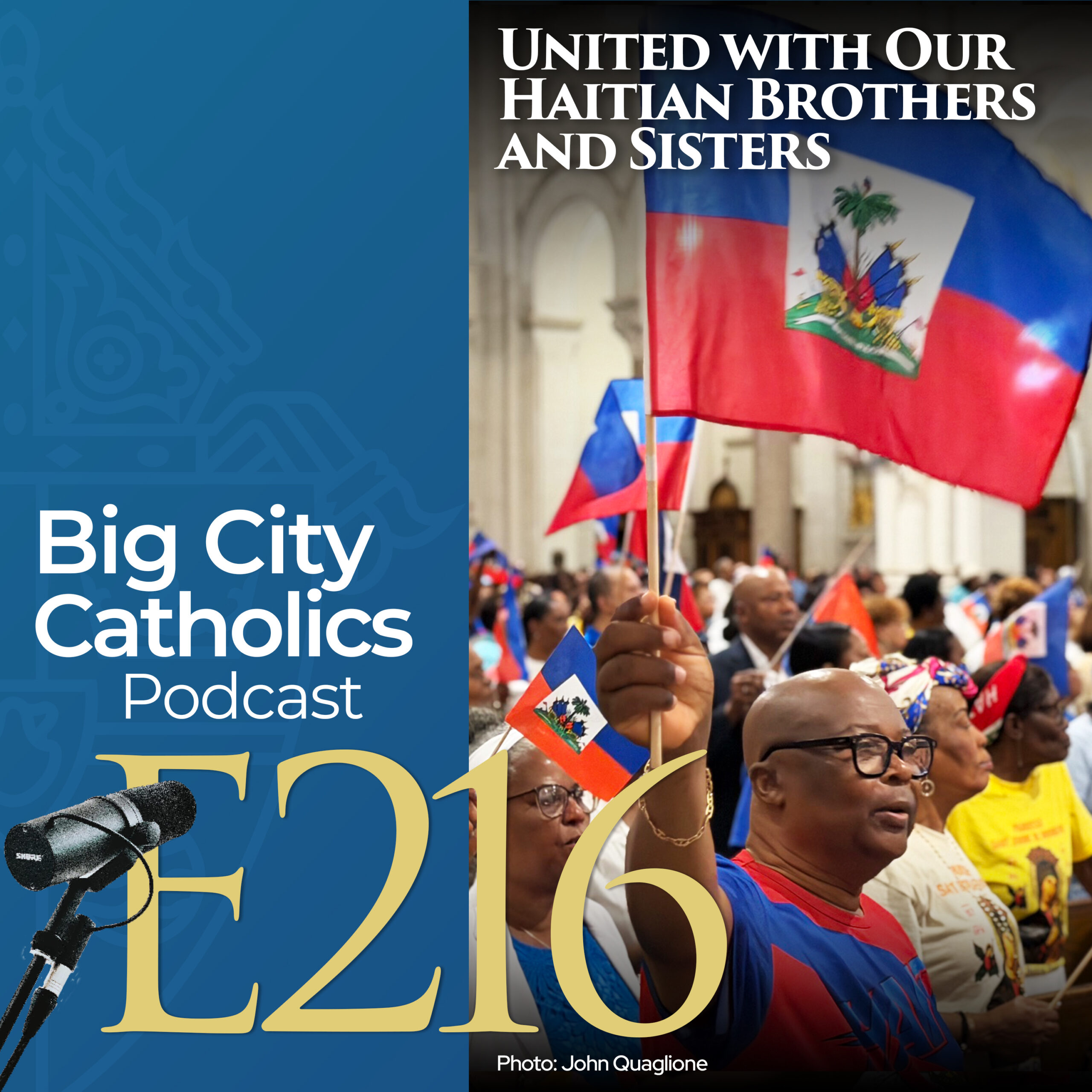
[00:00:10] Speaker B: Hello, and welcome to this week's edition of Big City Catholics. I'm your host, Bishop Robert Brennan, Bishop of Brooklyn, serving in Brooklyn and Queens. And I'm joined this week by Father Hilaire Belizer, coordinator for the Haitian Apostolate and pastor of St. Jerome's in Brooklyn. We're going to talk a little bit about some of the difficult situations in Haiti and situations here that affect the Haitian people. But we'll talk about, really, people of great resilience and of great hope. Why don't we begin this episode by asking God's help for all of those in need all around the world, in the name of the Father and of the Son and of the Holy Spirit, Amen. Oh, God, who being both good and almighty, provide for all creatures, give us, we pray, an effective love for our brothers and sisters who suffer hunger and famine, violence and war, natural disasters and all kinds of suffering, so that famine may be banished and that they may have the strength to serve you with free and untroubled hearts, our Lord Jesus Christ, your Son, who lives and reigns with you in the unity of the Holy Spirit, God, forever and ever.
[00:01:32] Speaker A: Amen. Amen.
[00:01:33] Speaker B: In the Father and of the Son and of the Holy Spirit. Amen.
[00:01:37] Speaker A: Amen.
[00:01:38] Speaker B: Hello, Father Hilaire. How are you these days in the summer?
[00:01:42] Speaker A: I'm doing okay with all that's happening, by God's grace.
[00:01:46] Speaker B: Yes, A bit concerned about the situation. And it's so good that we have this chance to talk and really to bring people up to date about what's happening in the world in our country and right here in our own diocese. You know, we're recording midweek and we heard earlier in the week of the terrible, terrible earthquake in Colombia.
And like with our Haitian community, we have many people who are here from Colombia, many people who right now are worried about family and friends trying to make contact.
And certainly we're praying for all of those in Colombia itself, those who are involved in rescue and help. So we join our prayers to the people of Colombia in a very special way. Earthquake is not a reality that's a stranger to people of Haiti either, is it?
[00:02:39] Speaker A: As you know, Haiti had been very much devastated by a lot of natural disasters, and earthquake is one of them. As you know, the last one was the one in 2010 that was the seventh point of earthquake that destroyed almost the entire capital for the port of France. You know, we lost so many lives, and that's what causes many people to seek refuge here in the United States.
[00:03:01] Speaker B: After that earthquake, so many lives were Lost. And you know too, Haiti is on a small island, Hispaniola, out there in the Atlantic and right in the path of many hurricanes too. Right.
[00:03:13] Speaker A: And with the infrastructures, anything that happened in Haiti basically destroy Haiti so easily because of this infrastructure. So yeah, where it is located, it's really. We are. Haiti is victimized of all those natural disasters. It's not really easy or that easy for us, you know, having that natural disasters and also other kind of disasters are caused by human sinfulness. We know the politics and all of those things, so.
[00:03:43] Speaker B: Exactly.
[00:03:44] Speaker A: That put us in a very, very bad situation.
[00:03:47] Speaker B: Yes. And we're going to talk about some of that. You know, I thank you for the work you do as coordinator for the Haitian Apostolate. It's an active apostolate here in Brooklyn and Queens. Right. We have Haitian presence Creole masses in a number of our parishes in Brooklyn and Queens. We have a strong Haitian population. We also have a very strong devotional life. And in the midst of all of these difficulties, these natural disasters, the incidents of violence and politics, there's a great devotion to our Blessed Mother. And one of the most touching celebrations that's personal to me is Our Lady Perpetual Help. I have a personal devotion to Our Lady Perpetual Help. And so we usually have a very big mass in June. June 27th, right?
[00:04:29] Speaker A: Yes. That's. As you know, Haiti is basically is dedicated to the Blessed Mother under the title of Albia Perpetual Health. In. In light of the relationship that Haiti had with the Blessed Mother. When Haiti was affected by this epidemic and at that point doctors couldn't do anything. It was a procession with the icon of the Blessed Mother that were done that week of. Before the feast. And according to the story, before the procession entered the cathedral, the archbishop at that time raised the icon and blessed the crowd with. With the icon. And then a big output of rain and that was washed away, you know, and. And it was from that time the whole. The entire country of the bishop with the president at that time, dedicated the country to the Blessed Mother. And that's how that relationship started with the Blessed Mother. But Haitian have been devotions for the Blessed Mother. Every celebration of the Blessed Mother, under whatever title is big for the Haitian, whether this Montcamm or Assumption that is coming up.
It's a big celebration for us.
[00:05:38] Speaker B: True. And January 1st, Mary mother of God.
[00:05:43] Speaker A: Yes. Every opportunity to come together to pray is very much needed.
[00:05:48] Speaker B: Very true. And you brought us together to pray recently. We'll talk about the. What's going on here. But in order to set the Context. Let's talk about what's going on in Haiti itself. You mentioned that there are many who have come to the US after the earthquake because everything was just absolutely destroyed. What's going on now? What's the situation like in Haiti these days?
[00:06:14] Speaker A: Right now it is the political unrest, you know, since the. The death of the president. As you know, they never had an election. There was no president. No. Now we only have a prime minister who is not really in control. Right now the country is being controlled by the gangs Port au Prince. You cannot go to Port au Prince. There's no airline going to Port au Prince. So it's the violence, the kidnapping, all those things continue.
The place is insecure. Cannot go. It is. If you go to the website or the US Website, you will see that they say this is the.
A dangerous place to go. So that's the situation of Haiti right now. It is insecure. There is no fright going there. If you have a chance to leave that insecure place, you don't want to go back there with that.
[00:07:03] Speaker B: Many people have sought in the past and recently this tps, which means temporary protective status. Correct?
[00:07:12] Speaker A: Right, right.
[00:07:13] Speaker B: And basically it's granted at times to people from a certain country or to a certain group of people within a country who might be persecuted or something like that. And a good number of Asian people came in after the earthquakes, after the hurricanes, but more likely in recent years, it was to flee from the violence. You've told me stories about people who just left everything. They just had to leave running and leave everything behind.
[00:07:43] Speaker A: A lot of professionals had to flee as well because of insecurity. And as you just mentioned, yes. After the. After such natural disaster, that TPS has always granted, that's how Haiti was able to benefit from that. And. But so the whole idea of the GPS is of course it's temporary and everybody knows that it's not forever. But of course, when the situation gets better, people need to go back. But the reality here we're dealing with here is that the situation never get any better in Haiti. It gets worse and worse. So after the earthquake, now we have all the violence, you know, the insecurity, it gets us. That's why you have. Not only you have those people who came after the Afrika, many people came, even another group of people came up with to free their security. That's why you have different categories of people here. People receive the TPS after they've pregnant. Some receive it after when they came fleeing the insecurity. Then you have another group of people who came here with I think the approval program by the Biden administration when it was granted to people, if you have families here who can apply for you. And a lot of people came under this program.
And of course it was also, it was limited. It was, I think it was a two years contract to come for two years, something like that. And after you have to go back. So that is the situation. But of course with regard to the state of Haiti, the way it is, the condition under these conditions, people are afraid to go back.
That's why they do not want to go back.
[00:09:19] Speaker B: And in some ways, would it be fair to say that perhaps somebody who has been living in America for some time would be particularly marked as a target for violence or kidnapping or something along those lines that somebody who has appears to have some money or some ties back in the U.S. oh definitely, definitely.
[00:09:43] Speaker A: Once you go there you are talking, the more they recognize you as someone who's been of course the diaspora, right away you are target they will go because they know you have money. Even if you don't have money, you have people who can really get the money, you know, to. And that's what's been happening. Many Haitian, many nation, they don't even go, they don't go on the after people, they, they kidnap anyone and they know those people going to have to reach out to some families in the US to kind of get them. That's why a lot of families get destroyed with the kidnapping because they spend everything they have. They have to. Sometimes they have to go buy money or sell their properties and sell everything they have to save their loved ones. So that's again another big issue that we've been dealing with.
[00:10:31] Speaker B: Given all of that. Let's, let's talk about the reality of the temporary protective status here in the United States and about the removal of that temporary protective status. You mentioned some of the expansion of it in the last administration.
One could argue the merits of those expansions or even I'll use the term misuse of tps that may have occurred at certain times in history. But by and large the people themselves who came, they came in good faith. This is not people sneaking across the border.
This is a sense of people coming in in a legitimate way. We talk about legal and so they've had the so called legal status but now it's just being removed. And so they in a sense abiding by the laws, contributing to society. People came, they got jobs, they not only providing for their families but contributing to the good of the country.
A lot of The Haitian people are in professions that are helping other people.
[00:11:39] Speaker A: The healthcare industry. All this depends on the work of the Haitians that are small businesses. And all these. Right. Dependent on, you know, many places are being closed right now because of that. Because.
[00:11:52] Speaker B: And so now, all of a sudden, the new policy removes that protective status for people who've been abiding by the law all the way through. This is not because of some abuse or overreach on their part, like they overstayed something. It's just that now something's lifted, and so they're vulnerable. And it's a time of great vulnerability and confusion, fear, real worries for families. But this has been coming. I think, if I recall, it was first set to be removed in February. And I know bishops in general, and I, I myself, we've done what we could to advocate for humane reasons, just to say, you know, I, I, my own advocacy was, what can we do to help Haiti? But what can we do to. Instead of trying to just say, rip it off and say, get rid of tpf, to say, what can we do to help change the situation so that people can go home? It was said to go in February. There was some court challenges. It worked its way all the way up. And in June, the Supreme Court argued that the president has the authority to do that.
You know, honestly, Father Hilaire, I don't quarrel with that. That's one of the problems when you legislate on both sides of the aisle by executive order. Of course, an executive order can be lifted by another president. So it was not done in a way that was safe and secure for people.
But the reality is, and I think what we're really asking of the administration, what we keep trying to stress, is a humane approach to this. I still maintain let's do what we can to help Haiti, but let's also recognize that this is not something so easily done to return whole groups of people en masse into a country that's already in tremendous turmoil.
[00:13:47] Speaker A: Right. I think, Bishop, when you made that statement at the Mass of Aritot, I think that was so powerful. And that stayed with me when used as the question, what can we do to help Haiti?
I think this is 1 million of those questions to answer. And if we can only focus on that, that can resolve most of the problems we're dealing with here. The church. I think the church has been doing this. I think the church has been doing that. I'm talking about, of course, the bishops, and we need to do with that more, which it is the advocacy to Continue not to. Yes, of course, the decision is made, but I don't think we should stop fighting. We need to keep on fighting.
Reaching out to congressmen to see how they can worry may put a bill out there to extend the, the CPS foundation while they trying to see how they can help Haiti get stable, civilized, how they can help, you know, with security in Haiti. I think that that should be first, the advocacy that is needed right now to reach out to those in power to see because how they can help Haiti by that. This is what needed in Haiti. Haiti needs security and peace.
If that is established, many people would choose on their own to go back home because you have a lot of people, a lot professional, they're not living a good life here. You know, the way things here.
[00:15:14] Speaker B: These are people who might have professional licenses but aren't licensed here. So they're doing different kinds of work than what they're capable of doing. And you know, by the way, sending everybody back has a ripple effect here in the United States because one area I, I happen to meet a lot of people from Haiti in the healthcare field as nurses, as aides and all of that. If people can't legally work anymore, we're going to start losing great talent pool. But again, we also look for the humanity here, even if this is the ultimate goal, to say, let's try to do this with a view toward the dignity of the person, with a view toward the stability of families and in such a way that again, that we help Haiti. One of the other thing I mentioned in that letter to the Haitian people on the feast of Our Lady Perpetual Help is a cry really to both parties, all those in elected office and all those who serve in office to say, please stop using immigrant people as pawns and to score political points.
My experience is that neither party gets this one right. You're playing people's lives here. It's not right. I really urge, I beg our elected officials, all the politicians and really all people of goodwill to find a way to say, let's stop using people as pawns. Look at them as brothers and sisters, perhaps brothers and sisters from other countries, but brothers and sisters, all of us, brothers and sisters. Especially now when we look at the Haitian population, largely largely Catholic, you know, brothers and sisters in Christ, and say, how do we see each other as brother and sister and effectively will what is good for them, for their families, try to do this with respect for human dignity and maybe with some kind of law and order. Don't push now all of a sudden, putting a whole Group of people now into the shadows, afraid to come out. That's when things go wr wrong in a society when you have people living in the shadows. Society itself has the effect of crime and other problems because people are living in fear and in hiding.
[00:17:16] Speaker A: That's the reality here she in Little Haiti. It's so quiet around here. If you go to travel and you will see that. Just before this meeting I had a couple who came to see me of course who is in this situation with GPS and they've been afraid. They didn't want to come out. Finally they gathered the courage. They came out. They even drove me around here. It's very quiet and the bosses are empty because people are so much afraid because they see what's happening on flatlands. They see the way they. It's almost like they. That remind them of kidnapping. It's like the same thing. They came, they. They. They talking but they grabbed people and push them on the whatever on the van or whatever they had and they run away with them just like that. That created a lot of fear. People just do not want to come out. And this couple who came to see me, this is a couple they came with I think in 2016 until they've been updated. It's a couple. One of them. One of them is a pharmacist. The other one is a. Who used to be a doctor Haitian but they doctor in the becoming public and with the. They came here with then they have three children who were born here. Now their problem is that those children are Americans but now they have nothing with the NWTPs. So they're afraid if anything happened to them what's going to happen to the children. And I've been physically advising them how to prepare themselves what to do to kind of stop taking just in case we haven't what can happen. We. We hope for the best but if anything happen you need to be prepared regardless. You have to find a guardian somebody who trust somebody and things like that. They don't. And they tell me how they do not have any relative here anyone they can friend. They're asking me to. To help them out in. In that sense and so it's a lot. And they both lose their job because they were. They were doing well. This is a couple they were doing well. But now everything ends on so now they doing they basically now they're using all their saving now but they're not sure what can happen for next month. I had to take them downstairs to the full pantry to get whatever they need because it's it's really, really a very sad situation to see. Right now they're asking me if I have any connection to Canada. How they can. Because they so afraid regard of losing their children because they don't want anything to happen to them. And you know they tell me how they go. They have to go out together because in case they would take picked up, they would pick up both of them together because they don't want to get separated and. But it's a whole mess. It is a whole mess out there. These are the things that we're dealing with right now. You know, and that's an example. People, they just stop working.
So how do they provide for themselves?
[00:20:07] Speaker B: And you're doing a great job trying to help people meet them where they have need, feed the hungry, care for the poor. That's we are and what we do and what else can the church do? I mean we do what we can to advocate also.
So we try to provide basic human needs. We do what we can to advocate. I'll come back to the Mass in a minute but when we were together for the Mass we had the mans for healing. You had somebody from the lawyers guild, the Haitian Guild of Lawyers to speak to people because there are practical things and, and really you talked, she spoke a little bit about fraud and things like that. So what are some of the advice the experts are giving people?
[00:20:48] Speaker A: Some of the advice they they offering is again to get ready. It's. They prepare a whole.
It's like a plan like plan for a preparedness plan, you know, for people to know what to do if for some reason you are deploy your detainer, get deported. You know how you should be, should be able to get access to your money, things like that, how to protect your children in that case, like for example, you are picked up, you are deported, you know who should be taken. You have to get somebody, somebody you trust to do that and to kind of like put the. Have this, this child know, have this person's number and put the number, give the number to the school, to the doctors. So just in case you are unable to go and pick up the child, they have somebody they know who is on file who can pick up the child can things like that.
A lot of practical things they were suggesting they were advising them to do at this point. Do not trust anyone who can come, who come and promise, who wants to promise you they're going to get you.
That's not really gonna happen.
Any lawyer who comment that they're gonna do that for you. Now this is do not go and spend money on that. That's why we have those. I reach out to those Haitian American lawyers to kind of like consider probable to work in that sense, to be there for people, to advise them, to do, to tell them exactly what they can do, what they cannot do for them, so that they. There's no people who don't get exploited in that sense. But I think in terms of the church itself, I think we as a diocese, I think we also need to.
We need to look at the immediate need for those brothers of ours who are in this situation where they just lose their job, they lose their livelihood. And we have to be well organized in that sense to respond to those needs, those immediate needs. These are the things that we need to look at this idea for the advocacy should continue. We need to continue to advocate, to see if they can be a change. We never know. And of course, of course, you know, I should say one of the things of course we do as church is what we did last time, the mass we had. It was such a great source of comfort and for the diocese to come together and show solidarity, to show support. That's why coming together to pray, to ask God to read on our behalf to.
That's very much needed. You know, that's.
[00:23:18] Speaker B: Yeah, that's so, so important and well said. Prayer isn't just like the. What do you do when there's nothing else to do? You just kind of offer, say, a pie as well, you know, pray. No, pray is really. We're throwing ourselves into the hand of God. We were talking earlier about Our Lady Perpetual Help, and I love that image. I grew up in the parish of Our Lady Perpetual Help, so I've always had a devotion there. But that image of Mary holding child Jesus. But as Jesus, you see the signs of the Passion and his crucifixion in the background on the icon and you see how he, the baby Jesus, is in his mother's arms with his sandal hanging off his foot, almost as if he would see something scary and jump into his mother's arms.
And I often use that as the image for what we're doing when we pray. And especially in a situation like this, when it is scary, when it is frightening, we jump into the arms of Mother Mary.
[00:24:15] Speaker A: This is beyond us, beyond our control. But we know God is always in control. And this is what this one thing we can do is to put everything in God's hands. We do not know what can happen, what's going to be like. But there is one thing we can do. Is to pray and let God be God. We have no control over what's happening. Whatever we can do to kind of like see how we can reach out to those, those are brothers and sisters in a very concrete ways. We need to do that so that they can really feel they. Not on their own.
[00:24:47] Speaker B: Absolutely, absolutely. If I could. As we draw near to the close, I make two observations. One, when we did have that mass at the end of July, you brought us together and you called it a mass of healing.
And I think that was the right tone, that we were seeking God's healing during this time of great concern, of pain and sorrow and confusion.
Yeah. But the second thing, if I can, about an observation about the Haitian people, when we come together to pray, it's always a joyful, hope filled celebration.
[00:25:26] Speaker A: Yes.
[00:25:26] Speaker B: You know, the music that was sung, they were songs of tremendous hope and giving glory to God. Those kinds of moments are really an inspiration to me to see that in difficult moments, sometimes the faith is even stronger than ever. And that was so evident among the Haitian people. You just. And I've seen it before, I've seen it after earthquakes, I've seen it after hurricanes. This is not only resilience, but there's. There's a hope that's grounded in the gospel. I'm just so touched by that, that Haitian faith. I remember going to a church where there was a fire, and one of the songs that day was I Will Sing of the Goodness of God.
[00:26:09] Speaker A: Yes, that's. That's what I was gonna say. Right. How those songs, you know, they really express that people make those. Those words their own to kind of like reach out to God. And so it becomes very. It's right. It's a. It's almost like a heart to heart conversation with God. That's the power of that, you know, and that's why you're gonna see that. Yes, we may be suffering women, but, you know, we know our God is their suffering with us. We are not alone. There's the deep sense of faith that. But because of the hope that, you know, people have, because I think they know regardless their God, their God is with them. God will never abandon them. God is, you know, will always be there for them. That deep sense of trust in God, that's what helped them carry on, help them go through, you know, trial that they had to go through, but because they know that their God is with them.
[00:27:01] Speaker B: Yes, indeed. Father Hilaire, thank you for joining us this week. Thanks for explaining this whole situation. I think for a lot of us, it can get all very confusing. And you explained such great clarity. And I hope this conversation was a help to many people and will spur our prayers and whatever efforts we can do to help one another. You know, we were talking about the devotion to the Blessed Mother, and for all of you out there, the podcast released on Friday, Friday the 14th, 14th of August, Saturday is the Feast of the Assumption. It is holy day, but it's. The obligation is lifted because of some of the confusion with Mass times and being able to fulfill the needs. So the obligation is not there. But certainly we're encouraged to celebrate the Feast of Our Lady's Assumption. Beautiful feast. Mary, body and soul, you know, body and soul taken up into heaven. Mary, who bore the sufferings of the world, who witnessed her son being crucified, whose heart was pierced, she experienced the pain and the suffering that we're going through. We can relate to her, just like we can relate to Jesus, who himself became human. But. But she was lifted, body and soul, into heaven. She triumphed over those sufferings. And so she's someone we can look to as a sign of hope and inspiration along the way.
And many communities, you said, for example, the Haitian community, great love for Mary.
It's not a holy day of obligation this year. It's not an obligation, but people will be praying, they'll be out for minutes because of love, for love of the Blessed Mother. And I know that's so true in so many of our own communities and our parishes. So, everybody, happy Feast of the Assumption. I love the Feast of the Assumption. But you know what? The one downer is, Father Hilaire, Feast of the Assumption, always reminds me that the summer's almost over.
I always remember my days going back to school when we went to Mass on the Assumption. I was like, oh, boy, this is it. This is. School's right around the corner. Get ready. Get ready for the get ready.
[00:29:05] Speaker A: That's right. But, Bishop, thank you so much. Thank you so much, Bishop. Thank you, too, for the love. You always show the concern. You always show how you, the Haitian community knows that. And they're very much. They're always good. They are so grateful for that. So just to come to call me, to have that, to have that sit down, to go to talk about the situation is. I know it comes from your heart because you're really concerned for your people here in the Asian community here in the diocese. So I want to thank you for that. And again, I know you have a lot in your place. That's why we pray for you a lot of as you know, the faith of the Kishu community. Yeah, the assumption can be said, but not just because we don't celebrate those pieces as a day of obligation. We celebrate as a day of rejoicing. So that's why, regardless that you lift the obligation, we still celebrate with joy. So of course you will be remembered that at the feast day we're going to have a procession as usual, and. And we won't be defeated, right?
[00:30:04] Speaker B: We won't. We won't give it to her to spare.
[00:30:06] Speaker A: Good for you. That's right. That's.
[00:30:09] Speaker B: Thanks for joining us all this week. Let's ask God's blessing. The Lord be with you and with your spirit. May the Lord bless you and keep you. May his face shine upon you and be gracious to you. May he'll be upon you with kindness and grant you his peace. And may the blessing of Almighty God, the Father and the Son and the Holy Spirit descend upon you and remain with you forever and ever. Amen.