Episode Transcript
[00:00:00] Speaker A: Foreign.
[00:00:10] Speaker B: Hello and welcome to this week's episode of Big City Catholics. I'm your host, Bishop Robert Brennan, Bishop of Brooklyn servant in Brooklyn and Queens. Today we're joined by Father Carlos Agudelo, the pastor of St. Leo's parish in Corona. Very, very busy place. He was going to talk with us. He was in col last week when the earthquake took place. We're going to talk about the earthquake and really how we have connections to that event. Father Carlos, welcome.
[00:00:43] Speaker A: Oh, thank you. Thank you, Bishop, for having me and for inviting me to this podcast. And it's also opportunity to extend my greetings to the community of Brooklyn and Queens who have welcomed me and into St Leo's Church, a place that I love so much.
[00:01:01] Speaker B: It's a beautiful parish, isn't it? So busy. It's that section of Corona, Elmhurst, Jackson Heights. We're just bursting at the seams.
[00:01:10] Speaker A: Absolutely. I think is the biggest population in the diocese, like. Yes, population in the diocese.
[00:01:18] Speaker B: It's certainly a very concentrated population. A lot of people crowded in and a lot of people. But it's also a very Catholic mascot population.
[00:01:28] Speaker A: Yes, people.
[00:01:29] Speaker B: It's people who are going to mass in great numbers up there and they have been for years.
[00:01:34] Speaker A: Right. As Pope Francis used to say, we are kind of in emergency room all the time here.
[00:01:40] Speaker B: That's right. Indeed.
[00:01:42] Speaker A: Indeed.
[00:01:43] Speaker B: And speaking of that, why don't we begin as we always do, with prayer? In the name of the Father and of the Son and of the Holy Spirit. Amen.
I'm going to use the prayer associated with Our lady of the Rosary of Chinki Kiera, patroness of Columbia, O incomparable lady of the Rosary of Chikinkhera, Mother of God, Queen of angels, advocate of sinners, refuge and comfort of the afflicted and the troubled. Holy Virgin, full of power and goodness, look down on us favorably so that we were helped by you in all the needs in which we find ourselves. Remember, O most clement lady of the Rosary, that it was never heard that someone who resorted to you, invoked your most holy name and ployed your singular protection was abandoned by you.
Encouraged with this confidence, we turn to you. We take you today and forever for our Mother, our protector, comfort and guide, hope and light at the hour of death.
Free us from everything that can offend you and your most holy son, Jesus.
Protect us from all dangers of soul and body. Direct us in all spiritual and temporal affairs. Deliver us from the temptations of the devil so that walking on the path of virtue, we may one day see you and Love you in eternal glory forever and ever. Amen. In the name of the Father and of the Son and of the Holy Spirit, Amen.
So again, welcome, Father Carlos. We pray that prayer. Lady of the Rosary of Cinque and Kira, patroness of Colombia.
When I was pastor in Long beach, out in Nassau county, we had significant Colombian population there. And so I learned a lot about Our lady of the Rosary of Cinque Queira, the great devotion that people have to her. And how appropriate at this time. You were in Colombia last week, you had led a pilgrimage?
[00:03:44] Speaker A: Yes. Yes, Bishop. So we decided like two years ago, preparing a pilgrimage to Colombia. And finally we were able to put everything together. And we went to visit basically three cities in Colombia. We went to Bogota and every city we were visiting as well, religious places. So in Bogota, we visit the Virginal Monserrate, the most high mountain in Bogota. And there is a shrine right there. So we celebrated the Mass in Monserrate.
And also we visit the Vino Nino. It's a devotion very Colombian. It's in a Salesian convent in the south of the city. We celebrate the Mass as well there, visiting the museum. And finally we had the opportunity to celebrate the Mass of the Salt Cathedral in Sipakida. It's a cathedral that used to be a mine, and there was abandoned mine. And so the government decided to construct a beautiful chapel. And a huge church is under the earth, 300 meters under the earth.
[00:04:51] Speaker B: Wow.
[00:04:52] Speaker A: Yes. It's a beautiful experience going there. Then we went to the city of Medellin, visiting the the shrine of Santala Montoya and also visiting places of Virgin Mary outside of the city.
There was also another experience.
[00:05:10] Speaker B: Wow.
[00:05:11] Speaker A: And the tribe of Virgin Mary. And we finalized our pilgrimage in Cartagena, visiting the shrine of San Pedro Claver.
It was in Spanish priest who decided to give his entire life for the black people during those days were coming from Africa as slaves, and he decided to evangelize them, to baptize them, to create a mission, Jesuit, saints and photocopier. We celebrate the Mass right there where the rallies are. So it was a pilgrimage. Everything was doing very well. We finalized the pilgrimage on August 7, where people returned to New York. And I decided to stay in Medellin visiting my family and my friends.
[00:05:57] Speaker B: Right.
[00:05:58] Speaker A: That's when everything occurred. The earthquake was actually almost 10. It was very early in the morning, was 7:30am So I was completely resting, still taking time for vacation. So was it resting when I told my entire body my house was shaking, I wake up and I saw the wooden Beams moving around, right?
Yeah, it was very, very scary, to be honest. But it's also opportunity to pray, because in those moments, Bishop, you feel that you are so, so dependent on so vulnerable. Those moments, you feel vulnerable. And as I mentioned during the celebration on Tuesday in the UK with Colombians, I was mentioning the value of the beauty of faith. That's real faith. That's what I did praying. And I say, oh, my God, help me. Help me right now. If is this the moment? So I am here. Forgive my sins and help me to be better. That's what you are praying.
[00:07:01] Speaker B: So you knew it was an earthquake? You could tell?
[00:07:03] Speaker A: Yes. Yeah, it was very strong, Bishop.
It's actually the city of Medellin is closed to the epicenter of the earthquake, as the earthquake was in the state of chocolate. So Medellin is the capital of the state of Antioquia.
So it even didn't struck the city in terms of damage. And I was actually reading a body is, because of the city of Medellin is over a stone. So the ground of Medellin, the body of Medellin is a pure stone that was helping not to destroy the houses and buildings in that city, but the soil in the other cities is another. Another consistence, another material. So that's why they suffered more. But the reality in the entire country is so devastating because as we know now, we have, you know, almost 400 people who died, almost 4,000 people who are still in hospitals around the entire Nation. For 4,000 people, we have thousands of houses and buildings that completely destroy even the church, the diocese, several churches, cathedrals, convents. And with all of the charity work of the church, Bishop, all of us, we know, like the efforts of the church does for helping the community, it's through the community. And that's beautiful when you see the solidarity, you know, among the church. So those buildings suffered. There are sisters, brothers, religious communities, institutions that they now have in right now, like the nursing home or hospitals or places to. To keep, say, the children or families. So it's very difficult. The situation in the future, that was basically my experience there. And continue praying for. For my community, for my country, and being here united with them in this situation.
[00:09:03] Speaker B: Yes, yes. Well, thank God you were all right. Thank God the pilgrims were already home.
The strength of the earthquake was 7.4. 7.4.
[00:09:14] Speaker A: Pretty strong earth, right? Yeah.
[00:09:16] Speaker B: And you spoke about. It was about 90 seconds that changed the course of history.
[00:09:20] Speaker A: 90 seconds. Just 90 seconds and change entire history right now. Like people who has really, you know, been impacted with this.
[00:09:30] Speaker B: Indeed. Well, we certainly pray for those, especially those who have died and for those who are wounded. In the early days after the earthquake, I would imagine there was a great emphasis on trying to locate people, trying to rescue people. I guess now it's kind of moved to a rebuilding of sorts. It's early yet, but it's trying to help people to put their lives back together.
[00:09:55] Speaker A: Right, right. So as you mentioned, the first stage was basically focusing, saving the life of people who were under the winds and the debris, even though they are continuing doing the effort, if any miracle occurred by saving another life because of that happening and other events like in Venezuela, after a few days, they found people who were dropping the buildings, but somehow they were able to have connection to the source of water because some reason, and they keep them alive or for another day. So they are very careful still right now trying to remove the debris of the collapsing buildings. And now people are concentrating more in helping in helping them and trying to do as best as they can to restore. Now there's the other stage, restoring. Right. So that we had to unite so many efforts. And the church has been, with good initiatives, Priests, the same priest, bishop. Normally we see as a pastor, let's say here in the United States and mostly of the church, we see as a pastor being in my office waiting for my appointment to attend people counseling. We have the church right here that just cross the parking lot in the church there in us.
Very convenient for so many reasons. So our buildings are very convenient. This is not the case in some cases in Colombia, Greece. They say they have a house in one place that they had to travel, like they say, one hour, two. Two hours to another community.
Seen in another perspective. Priests working and serving the community.
You see right now they are celebrating Mass outside.
[00:11:43] Speaker B: Outside.
[00:11:44] Speaker A: Yeah. Because the church somehow will destroy you. So they are.
[00:11:48] Speaker B: Or unsteady. Can you count on the roof not collapsing or something? Because even though the movement of the earthquake may have stopped, the damage that may be done on the inside.
[00:12:00] Speaker A: Sure. So they are in weeks of collapsing and they're trying to maintain it. So. Yeah, for the sake of the people. So you see priests confessing outside, you know, celebrating the anointing of the sick. And because this is the only result, not just the collapsing of the buildings, but imagine it. We cannot collapse in faith.
[00:12:22] Speaker B: No, not beautifully said.
[00:12:24] Speaker A: Yeah.
[00:12:24] Speaker B: No, we cannot.
[00:12:25] Speaker A: They are people who actually suffer being packed to the earthquake. Very, very powerful. And they are sitting in tents outside.
You see the fields of the city, like hundreds of families, bishops, hundreds of families. In the main plazas of the city. It's not just a building.
It's what that house is, what the building represents. Yes, you see the house.
[00:12:53] Speaker B: A house is one thing, a home is another thing. A house represents a home.
[00:12:57] Speaker A: Absolutely. So you can say, oh, it's easy to construct. It's just this or those three walls and just collect money and rebuild it. It's not just that. It's as well, the meaning of sacrifice, like there are houses of building has been inherited for three generations.
And you see people outside of the buildings, outside of the plaza just remaining there, they don't want it to be. They say, no, this building is going to be a demolish.
It's not going to be a stand anymore. But they are resistant to get away from the place that they grow up.
There are attachments, the attachment connection.
I think this is the stage that we need to show spiritual care, pastoral care, being with the people. And what I'm doing here in my parish is trying to call people that I know that are from Colombia and I have the phone numbers, trying to find out if they are okay, if any family member suffered something. So so far we have two parishioners, they have family members who died in the aircraft. So yesterday was actually one of the parishioners who came, she was crying because she knew that person was rescued from the debris, but died in the hospital later.
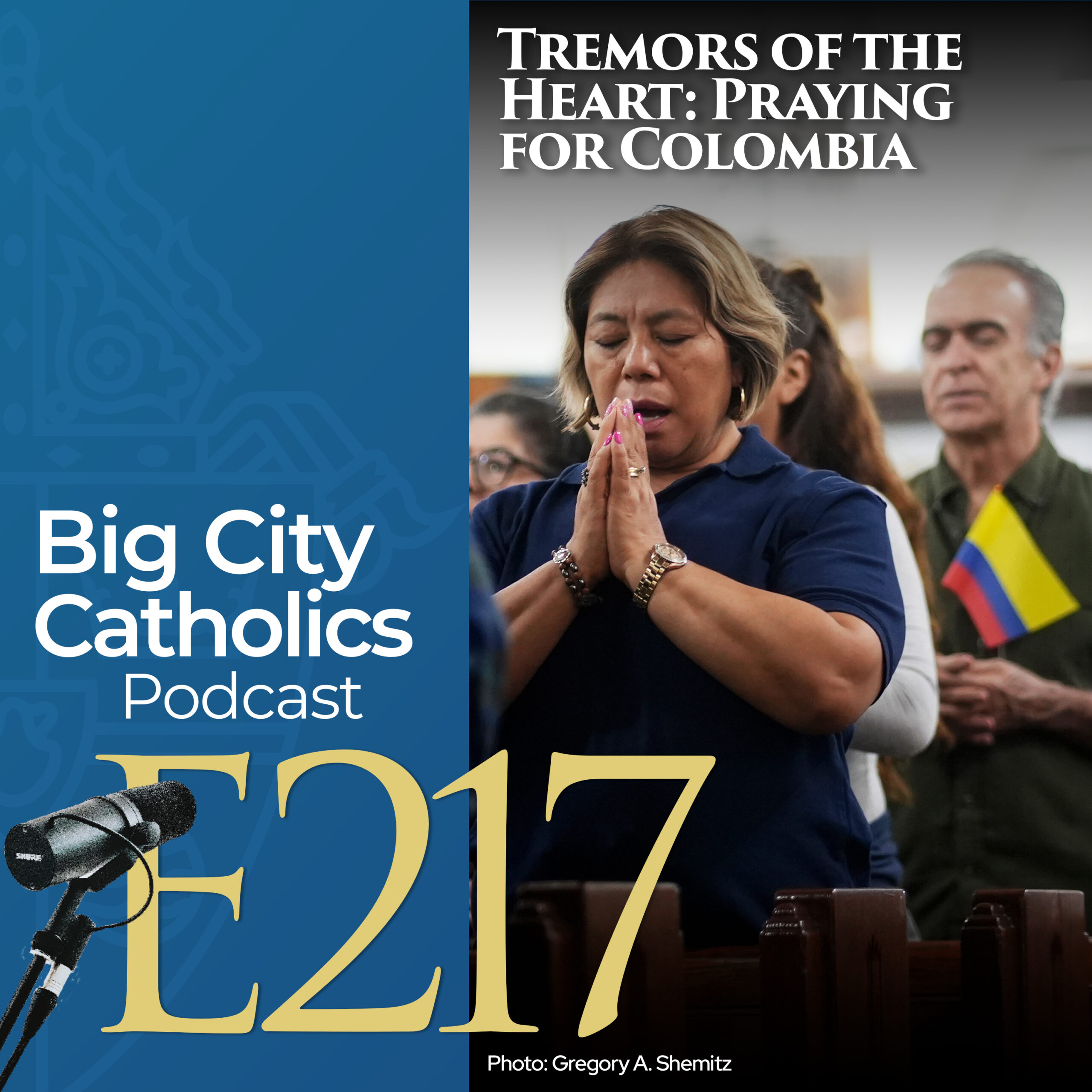
[00:14:21] Speaker B: I've said at the mass on Tuesday evening here in Brooklyn and Queens, we certainly didn't feel the tremors of the earth shaking, but we feel the tremors of the heart.
And we have a large Colombian community here in Brooklyn and Queens, particularly in Queens. And so there are lots of people with fit family members, and they themselves were affected. I'm so sorry to hear about families who lost members of their own family back there. And I'm sure there were a few days of worry because communication wasn't that easy right away.
[00:14:52] Speaker A: Actually, one of the priests who were here visiting, I mean, he were working in San Diego's and now he's in Colombia in the state of budget. We were able to talk with Pablo Diego, who used to be parochial here in San Leo's, and he was. I mean, all the communication for several.
We were able now to know how is he doing and how his family is doing. So it's little by little, that reconstruction.
The experts and the government said that the reconstruction will need like at least five years.
It's a long reconstruction that will demand efforts, united efforts for all of the institutions, government and foundations and.
And the church and Everybody has to be involved in this.
[00:15:43] Speaker B: You know, you mentioned before that sense of the Eucharist of communion. Communion and solidarity. At the Mass on Tuesday, you also spoke about the image of the body of Christ. We are united as the Body of Christ. And when one member of the body is hurting,
[00:16:03] Speaker A: bride was in Paul, remind us one member of the body. We are the Body of Christ.
And if one member suffer, all the body suffer. And if one member rejoices, all the body rejoices. And bishop, it happens in all of the nations. Like the division that can occur by, let's say for. By political affiliations or division, for different perspectives. Right. Even in religion. Right. Because you're a Catholic or you are in another denomination.
Those moments in this moment, that's when we need to be united.
[00:16:40] Speaker B: Yes.
[00:16:41] Speaker A: It doesn't matter if you are in another political affiliation, another group, even in another region, even you are not believer.
Right. So how we are brothers and sisters, how we are just the humanity right here, common humanity.
[00:16:58] Speaker B: We're all created by the one God and Father of us all.
[00:17:01] Speaker A: Yeah. There's the empathy for the one who is suffering.
The. I was mentioning as well. Those moments are kind of, you know, make us shape and. And in our own selfishness.
Then we are so self centered. First is I. Second is I. Third is I. Right. And then when you see what we can do, what we can do, and that's maybe God has given us.
If you have something, if God give you any talent, any gift, this how you're going to use it for others. It's not just saying that God is giving me this just for. For enjoy myself.
It cannot be that perspective in Christianity. It's like the gospel said when the gospel. You remember the story, you can. The one who own the field, gives so much harvest.
[00:17:54] Speaker B: Yes. The parable of the landowner who just kept putting the extra grain into the silo.
What good is that going to do you? That's actually one of the brighter moments in these darker times.
Usually when we have these calamities, these crises, these disasters, we see a lot of suffering and a lot of pain, but we also see a lot of courage and a lot of valor and people and faith, people stepping outside of themselves. So you saw that right there in Colombia. You saw firsthand the hard work of people stepping up to rescue and to help one another, to people who are themselves in need, trying to help people in basic needs. It's like what we saw here during Sandy, or what we saw here coming up on the 25th anniversary of the September 11th. Those moments are horrible, horrible moments. But we see some great examples of humanity. And you spoke about how you did get to see some of that, the beauty of that shared humanity.
[00:19:00] Speaker A: Absolutely. One of the stories touching my heart was actually in Venezuela, during the earthquake in Venezuela. And I was watching the news and the reporter had the opportunity to interview a rescue personnel, one of the rescue personnel. And he was crying and in. The reporter continued asking why he didn't want it to go into his personal life.
Right. But she insisted and he said, okay, okay. He was suffering from cancer. He was diagnosed with cancer and his family was asking him not to go because he was sick, he was in need of chemotherapy, all that stuff. And he said, no, I cannot see in this reality. I know that I'm going to die, but I need to spend my last days helping others. That story, I was in shock because when we are passing through any suffering, any sickness, the first person that came to our mind is our song. I need my recovery. That's it.
[00:20:02] Speaker B: Yeah.
[00:20:02] Speaker A: You see, people, even as these rescue personnel was thinking nice, he decided just to go and helping others and all the time, those kind of stories. Or let the mother in Colombia, she returned for her daughter and she saw the entire building collapsing and she just took her daughter and put it upside and she died.
So she sacrificed her life because of the love of her daughter.
And yeah, I was mentioning the story and the connecting with the homily, right. With the woman who was asking Jesus that her daughter would be healed, the one who was suffering, tormented by the demon. And she just basically she. She didn't have any fear to talk with Jesus, even though she was Canaanite and was considering for another and other reality, another cultural being rejected maybe by the disciples or some people. And she said, no, I am doing this because of my daughter. So you see, when you love, when we love, we are able to remove any stone, any obstacle, any border, and just do it.
[00:21:14] Speaker B: Just do it.
[00:21:14] Speaker A: Beautiful.
[00:21:15] Speaker B: That was Sunday's gospel. You spoke about those virtues of faith, hope and charity. An occurrence like this brings those virtues out of all of us.
[00:21:26] Speaker A: That's the only way to see and to act through faith.
Just does remaining in our rational fence. And we just kind of are complaining or trying to find and other answers or what happened to us or what is what is going on in the world and all of the mentalities and times of theories that is coming through our minds. Instead of saying, let me just believe it and let me find reconciliation with God is not just saying that God is going to need giving me A new opportunity. But I'm also changing my life.
Hope. In the promises of God, he said to us, I will be with you until the end of the earth. So that's one of the promises.
[00:22:11] Speaker B: Even in the suffering, I'll be with you.
[00:22:13] Speaker A: Yes, that's the promise. And charity, love is not just saying, I love you. As the gospel said, if you see somebody who is hungry, you cannot say, oh, go, and. And I will pray for you and eat well. No, let me just provide something for you. Right. What we can. Exactly.
[00:22:32] Speaker B: And for us, far away, those virtues of faith, hope and charity are awakened when we hear about something like this, whether it be the earthquake in Venezuela, the earthquake in Colombia. We're hearing now about earthquakes in Indonesia and Spain. There was recently a hurricane in Hawaii. It awakens in us a concern, that sense of solidarity, of faith, of hope and of charity. So we strive to respond in charity. And we took a collection for Venezuela, and we are going to be taking collections. And some have already begun to assist. And people are so very generous to helping Colombia to do what we can. Those responses, they come, people. There's something very human about that. We respond almost spontaneously. We want to do something to help. But what we did this week was also important. I think of Mother Teresa. I was talking about this with Desales Media. I think of Mother Teresa, known for her care for the poor and for the needy. But she would always tell her sisters and she would tell the people, but first we pray.
[00:23:38] Speaker A: First we pray.
[00:23:39] Speaker B: We're not just social workers are doing projects.
[00:23:42] Speaker A: Oh, yeah.
[00:23:43] Speaker B: We're people of God, and we're going. Our first thing is to commend the need and to commend our prayers to God. And so that mass was just absolutely beautiful. We were at Blessed Sacrament Church in Jackson Heights. Father Rick Beutha hosted us. You did a lot of the preparatory work right there from Columbia, calling to check on us here back at home. And it was just so beautifully put together. The parish opened their arms, their hearts, their doors to us. It's a beautiful celebration. And, wow, that's a big, great church. And it was just about full between
[00:24:21] Speaker A: this richness in our diocese.
You are a bishop of a very diverse, like several countries. Like, we have heard always that New York is the capital of the world.
[00:24:34] Speaker B: That's right. But diverse, but united in faith.
[00:24:37] Speaker A: Yes.
[00:24:37] Speaker B: So, of course, there were many, many from Colombia there praying for their hometown. But there were also a lot of other people from other countries.
[00:24:45] Speaker A: Yes.
[00:24:45] Speaker B: Who were gathered because we're united in the faith and we are concerned and we do want to pray for our brothers and sisters.
[00:24:53] Speaker A: What I have noticed since I move to New to New York, like back in 16 years ago when I, when I came from Colombia, that I used to be. I am from the and I used to be. I say that I used to be because New York changed and I used to be very local.
My mentality was very local. And people from Medellin are. I am from Medellin, so I can say that we are so proud of the city, Right?
But then after I came to New York, I learned something beautiful. The beauty of another part of Colombia that I didn't know.
Secondly, the beauty of faith and expressions and people from another countries that's changed my life forever.
My life changed forever. So my it was more universal, more universe, more international.
And I understood with the experience in Brooklyn, and I thanked God the way how he works. God works mysterious ways. And somehow I just landed here in Brooklyn.
[00:26:02] Speaker B: Well, I for one, I'm glad that you did.
[00:26:05] Speaker A: And then I say, thanks, God, I mean, and open my mind changed my this gift of serving the church, Universal Church. I want to say that I feel so blessed, so blessed being part of this Diocese of Brooklyn.
[00:26:18] Speaker B: As one who also came into the Diocese of Brooklyn, perhaps not from as far away as Medellin, but as one who came into the Diocese of Brooklyn, I too consider myself very, very blessed.
Father Carlos, thank you so much for joining us and thank you for leading us us in that prayerful reflection and gathering us together again, helping to bring us all together to pray. We continue to pray for all of those who are affected by the different situations in the world, natural disasters, earthquakes and storms, fires and all kinds of things. We still continue to pray, too, for those who are suffering war and in violence, for those in our own country suffering from uncertainty because of some of the immigration situations. We had a Mass a week or so ago for the Haitian community. We asked the Lord to accompany us in all things and to help us to walk with one another, showing that face of the Lord. And so I'll close by asking God's blessing.
[00:27:20] Speaker A: The Lord be with you and with your spirit.
[00:27:22] Speaker B: May the Lord bless you and keep you. May his face shine upon you and be gracious to you. May he look upon you with kindness and grant you his peace. And may the blessings of Almighty God, the Father and the Son and the Holy Spirit descend upon you and your families and remain with you forever and ever.
[00:27:37] Speaker A: Amen.
[00:27:38] Speaker B: Thank you, Father Carlos. Thank you all for listening to this week's episode of Big City. Catholics. Please join us again next week for a brand new episode. God bless you and have a wonderful week.
[00:27:56] Speaker A: Sam.