Episode Transcript
[00:00:00] Speaker A: Foreign.
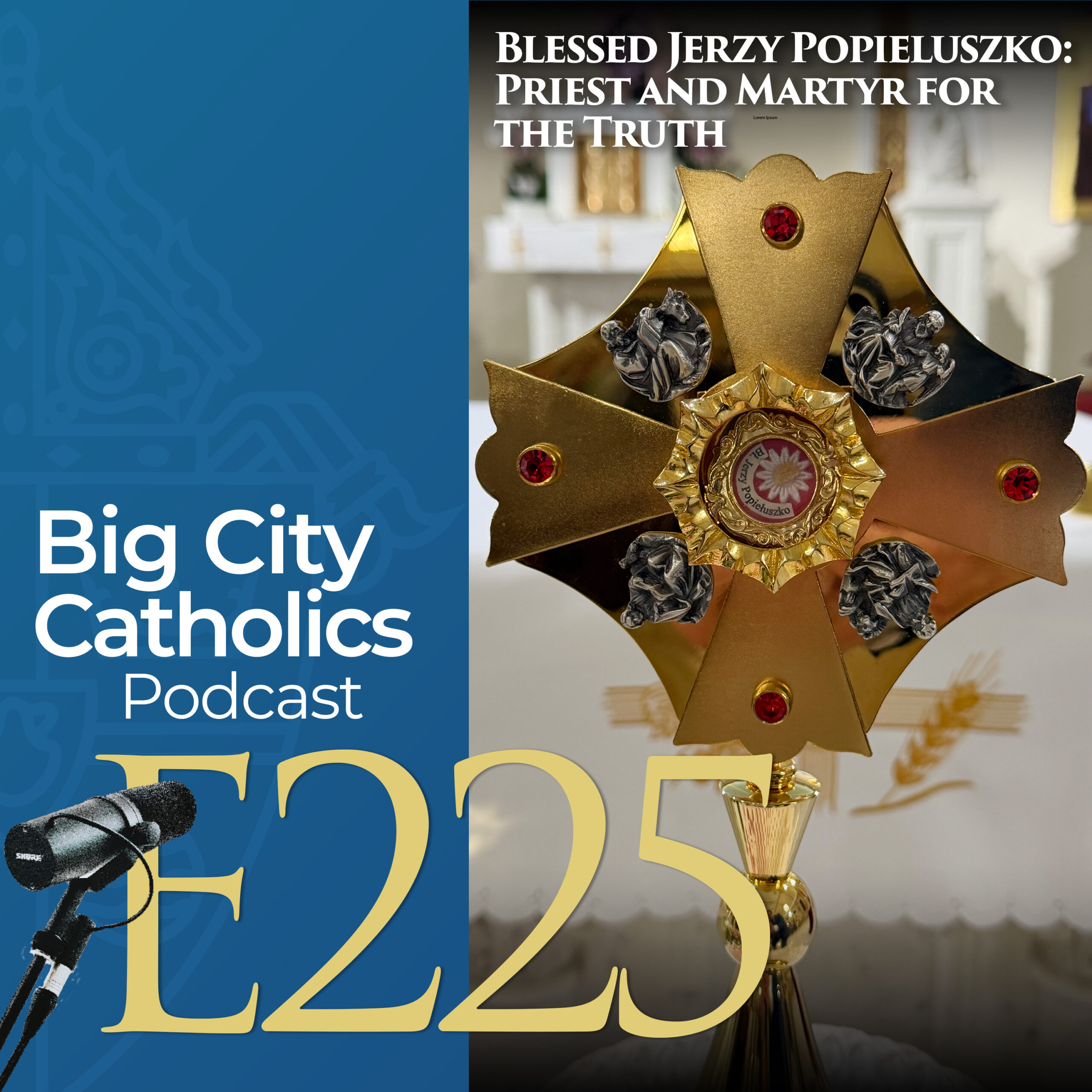
[00:00:10] Speaker B: Welcome to another episode of our diocesan podcast, Big City Catholics, with Bishop Robert Brennan, Bishop of Brooklyn, serving the people of Queens and Brooklyn. And I'm Father John Huang, priest secretary to Bishop Brennan. On Tuesday, October 13, Bishop Brennan celebrated Mass at 16, St. Francis de Chantal Church here in Brooklyn for the installation of a relic of Blessed Father Jereshi Popie Uszko, a Polish priest who gave his life for the faith and for the truth. There we had an opportunity to sit down with three members of the Polish community, Joanna, Kzavara and Damian, to talk about Fr. Popie Uszko's life, his witnesses, and what his story means to us today.
Before we begin, let us take a moment to pray in the name of the Father and the Son and the Holy Spirit. Heavenly Father, we thank you for the witness of Blessed Yoshi Popie Ushuko, who remained faithful to you even in the face of persecution and death. Help us learn from his courage to stand for truth and to overcome evil with good.
Bless our conversation today, and may it inspire all who listen to live their faith with greater courage, hope and love.
We ask this through Christ our Lord. Amen. In the name of the Father and the Son and the Holy Spirit. Amen. Bishop, it was such a nice celebration, wasn't it?
[00:01:41] Speaker C: Great. And we had a celebration of Mass and we received the relics and installed them. And then they always, on the 13th of the month, May through October, they commemorate in that parish the Fatima apparitions. And so October 13th being the final one that was incorporated into the day. And we prayed the rosary and a short procession around the church.
[00:02:06] Speaker B: Beautiful statue and a beautiful procession and
[00:02:10] Speaker C: great crowd of people. Yeah, right. Wasn't it really very, very impressive when we were there last time? It wasn't too long ago,
[00:02:17] Speaker B: it was Lenten season.
[00:02:20] Speaker C: That sounds about right. And we were there and we had Mass and enjoyed that very much, but had a wonderful lunch. Father Lucas ranked for lunch with a good number of parishioners who represented different aspects of the life of the parish. And a fair number of them were young and they were very talkative.
[00:02:41] Speaker D: Right.
[00:02:41] Speaker B: I personally, it was great opportunity to learn about the Polish community especially. I was very impressed with the Polish school. They really teach them not only faith, but the language, culture and everything.
[00:02:55] Speaker C: It all gets built in together.
And so these young adults went through that experience, and now they're living out their faith very admirable ways. So our conversation with Joanna Saveri and Damien was a conversation in preparation for that Mass where we talked about blessed Jersey Populuszko, my own devotion To Blessed Yerche is very strong. I've had that for a long time. I've always admired him as a priest and now as a martyr. It was interesting to hear the perspective of a woman who was a child in Poland when all of this was taking place. And then two young adults, his parents and grandparents, share their experiences. And we had a chance to talk about what does it mean for us today, for us living here in Brooklyn and in Queens, especially for young people of Polish descent. What does that example of blessed Jerusalem have in their lives? And what message does it teach all of us? It certainly teaches me lessons as a bishop, you know, the idea of accompanying, of standing with people in times of great suffering. So why don't we take a listen to that conversation?
[00:04:10] Speaker B: Yes.
[00:04:11] Speaker A: My name is Joanna Gavris Dijak, and I'm from Poland. I'm very.
[00:04:16] Speaker C: Where Poland are you from?
[00:04:18] Speaker A: It's a very small town. More like east, south of Poland, somewhere between Krakow and Lublin.
We can talk about big cities.
[00:04:27] Speaker C: Very good, very good. And you're in St. Francis de Chantal parish. And today we're going to be having a conversation about Blessed Jersey Pope Rusko, we're receiving his relics tonight. I'm very excited about this.
I have a great personal devotion to Blessed Jersey for many, many years. And I'll say this at Mass. I don't remember how I got to know Blessed Jersey, but somehow or another, I heard the story and I just delved into it. I read what I could. I saw two different films. I visited his tomb at the church of St. Stanislas Koska in Warsaw twice. I'm just so fascinated by his W.
But you would have been in Poland growing up, and in the time of Blessed Jersey, what was it like in the late 1970s and the early 1980s?
[00:05:17] Speaker A: That was my teenage time.
[00:05:19] Speaker C: Exactly.
[00:05:19] Speaker A: And not necessarily I was very aware of what was going on at first, because. But that also reflects the time of the fear. My parents did not introduce to us what the problem was. You know, they didn't tell us really what the common is because they didn't know what we're going to say in school. And maybe we will somehow, you know, tell people who don't want.
You shouldn't know what my parents are thinking.
So we all knew of what's going on from school.
And one day I came to my parents and I was. I was against them. And I said, mom, dad, you always said bad things about communists, about Russia.
Why are you so negative?
You know, I was like in seventh grade. I guess that's the seventh grader.
Okay. So my parents said me and they start to talk about freedom, about communists, about the war, about the church. They explained to me how my father works hard in three shifts and the money that's supposed to go back to the country are flowing to Russia somewhere are going against the Christian. How my mother lost her job because she was active in the church and because my siblings went to study in Catholic university.
And I was so shocked. Like my whole world, you know, of happiness was destroyed because my parents tried to provide. They work in many jobs. We had a small farm and we didn't feel the hardship.
[00:06:55] Speaker C: Right, but you didn't feel the freedom.
[00:06:57] Speaker A: Well, after my parents show me what's going on, we wait in the kilometers of lines and the stores are empty and the priests are in jail. And Prima of Poland was in jail. When my partner explained this to me, then my eyes opened. And then more and more facts like a friend of my brother tried to escape to Germany. There was shooting, they shoot the plane. So suddenly, like from a sweet childhood, I was opening my eyes into a grown up world. It was really shocking.
[00:07:37] Speaker C: Now have you heard it's very endemic. Have you heard stories about Poland in these days?
[00:07:43] Speaker D: Yeah, absolutely. So 1981 is very important for my family.
My grandmother, that's the, that's the year that she immigrated, right before Halloween. So actually right in this time, October is when she immigrated into the US and you know, when I was growing up, I noticed that, you know, kind of like, you know, Ms. Joanna, you know, I noticed that my grandmother or perhaps my parents sometimes were a little negative. And it was, would be a little frustrating because I'm, I'm here, you know, in America. I'm trying to go ahead and start building the foundation, the next blocks for my, my future generations, my kids. And it almost felt like I, we still had this kind of like pessimistic, negative kind of mindset. And it wasn't until I started getting older in high school, perhaps even past that in college, that I started understanding the, the history of Poland and understanding the reason why my grandmother escaped in 1981. She did anything she could in order to, you know, get out of Poland just so she could have a better life for not only herself, but for her family. After that, you know, once she actually did end up coming to the U.S. it took her roughly 19 years, you know, working for minimum wage job, $3 an hour in order to sponsor us and give us the opportunity at a better life. And you know, God bless her soul, she just passed away in June of this year. And it was. It's an incredible thing that we're having this conversation right now because it's almost feels like everything is aligned perfectly. You know, this past summer, I spent a lot of time in Warsaw because of a program called Polonia Camp, where the Polish government wants Polish people from overseas to come back to Poland, see how it is now versus how it was, you know, 40 years ago, you know, 30 years ago. And it's quite incredible because when I was there, I felt the energy of what it was like back then, but I also see the beautifulness of how it is right now. And it's quite incredible because, you know, as this relates to the blessed, you know, Father George Jerry Popiwuszko is, you know, it's a story of perseverance. It's the story of, you know, you rather be free physically rather than be constrained mentally. And that's one of those things where, for example, in my grandmother's case, she wanted to escape, you know, Communist Poland just so she could have a glimpse of freedom. And of course, it wasn't going to be easy, but then again, it's is the easy route, the best route. You know, that's the story that, you know, George Izzi Popuzko tells us now where, you know, if you don't stand for nothing, you'll fall for anything.
[00:10:00] Speaker C: That's right. That's so true. Damian, your recollections.
[00:10:04] Speaker E: Yeah. I would get stories just from my grandmother and my parents about just the hardships that they had to sort of endure during the time to sort of, like, give me a comparison as to what life is. Is like when I was a child versus what they had to really live through. And the stories that I would just hear from based on the questions that I would ask because I was just curious about their lives back then. And it was unexpecting to, like, hear these stories. And I kind of, kind of just dug deeper into that hole where I would find the truth of these heroes who, like, shaped our nation and kind of gave hope.
And there were plenty of stories in regards to Jerzy Popiuszko, who really gave a sense of, like, his story and where he kind of was in it.
[00:11:04] Speaker C: Yes. And played an important role in it. And that brings me back to you, Joanna. One key moment for me, not from Polish heritage, but one key moment in my life was the election of Pope St. John Paul II. And I remember his first visit to the United States in 1979. I was a teenager myself at that point.
And then of course, after that, then the emergence of Jerze Papunusko. Well, first let's talk about the Pope. So you remember going to see the poet?
[00:11:34] Speaker A: Yes, I remember seeing the poet, but still as a teenager, as a very young person. As much as you try to hear, you don't incorporate this in your life. You say you don't be afraid, but then you go on with a regular life and you're not brave enough.
You have to come to the hardship, you have to come to the oppression. You have to come to the answer. Like Father Piusko said, you have to be brave. If you're Christian, you cannot just say, I don't agree with evil. You have to stand so brave, you know? And the same John Paul ii and the same message coming from Papiusko. You have to take a stand, you pray for courage and you have to have the courage. And this not easy. That's not easy. That's why they are saint, not us. Yes, because like I'm working in a school and I'm listening to Papyrusko. Be brave, stand against oppression. Am I brave? I wish to be. I wish. I'm happy to hear. I'm happy that thanks to Father Wukar bringing his remains and you being here, I get to know him more. And it gives me the courage. The same as he gave the courage to do work, working class, being together, it gives the courage. The message is very present and is still current.
[00:13:00] Speaker C: His story is so inspiring, certainly for me as a priest, but for all of us, first of all, jump right in on the story. But he started off by ministering to the people in the factories. He went into the workplaces. Right.
[00:13:14] Speaker A: It was kind of. I heard the story, reading the story, that was accidental, that they need a priest, you know.
Right. And then. But you know what? If you hear him, you can feel the richness of his heart. And he said, a goodness doesn't need many workers because it's going to collect thousands and millions people. They're going to come from distance because the people want to hear the truth and want to hear the justice and they want to do the justice. So staying. And this incredible how God is choosing a priest who didn't have the best health, I hear.
And he didn't feel like a great spokesman, but using his heart and his courage to be suddenly as strong as a lion, you know, as strong as a soldier, as a brave, you know, the bravest soldier who would stand and not be afraid to give his life for the truth and love.
[00:14:11] Speaker C: And he did. He went right to the end.
Tell me what inspires each of you, Damian and Zaveri, about the life of Blessed Jerusay?
[00:14:20] Speaker E: Well, for me, the inspiration that I would get is his resilience and just fearlessness in opposition to the voices that tried to shut him down during his time. And there were a lot of incidents through the years, even in the past decade, where we kind of experienced that and we kind of have to remember what he has said and pretty much the message of the gospel. And he really just pushed that message as much as possible and they kind of like had to be incorporated into our lives.
[00:15:06] Speaker C: It's very insightful because basically what you're talking about is human dignity. He was that that message of the gospel is he called on everybody, called on the authorities, but he called on all of us to respect human dignity. The dignity of every person, the dignity of the worker, the dignity of the family, the dignity of faith of every human.
[00:15:24] Speaker A: It's very interesting that he was saying I'm not against anyone, I'm not against all these security guards of this communist peace. I'm not against anyone.
Because every person has this dignity, Every person has this goodness. And I'm thinking why he annoyed them so much, did not just kill him, but they kill him in such brutality, all these tortures.
I was thinking about it because they could just put him in a jail. But why such a burst of evil? Why such a. What annoyed them so much? And I was reading his comely. The less comely, you know, the less work is usually your, your representation, right? Like the artist, like he's less painting or writer, like less book. And there's so many of those unbelievable words like he said that, that the human dignity comes and the value that we have to fight because we are sons of God, because we are sons of God, we have the right to be free and right to speak the truth.
I think that was really annoying for evil because now the regime, any regime, here or there, then and now, don't want you to remember you are son of God, don't want you to have this dignity of a free, brave man, you know, just be scared.
[00:16:57] Speaker C: Dignity and rights is bestowed not by governments, right, but by God.
[00:17:02] Speaker A: And that's the powerful thing. It's scary how powerful is this?
So now he is going on the war with the evil himself.
And that's why the area is bursting. You know how to silent him. If they put him to jail, it will not silence him. And that's why people feel even with. I was a kid and I didn't maybe understand Fully his word on Jelpo. But you drone, you drawn, because there is something powerful, powerful gospel. The words of God, dignity, values, giving you courage. You have to be. You have no excuse, you know, not to fight for justice.
[00:17:45] Speaker D: Yeah.
[00:17:46] Speaker C: Tell me what inspires you?
[00:17:48] Speaker D: I gotta say, you know, when you. When you. At the beginning of the podcast, when you said, you know, what you've heard about Jesu Popiusko, and it's almost like you don't really recollect where you heard the name from or how it all started. And that's exactly kind of how I feel. It is for me, because that's a name that, as a Polish person, you know, you hear it a lot. You know, but it wasn't until I started digging a little deeper and doing a little bit of research where I actually got to know Jasper Pepe Wushka and know exactly what he. What he stands for. You know, earlier.
Earlier this week, I was listening to one of his, you know, homilies that he had.
Fortunately enough, they're on YouTube. And it was quite fascinating because a grown man was brought to tears just listening to his message. And it's interesting because, you know, during those times in Poland, it was difficult times, it was communist times, there was a lot of suppression and oppression. And it's quite fascinating because, you know, nowadays, maybe we don't have those kind of things, and at least, you know, not here in the usa, in New York, but we all have something that we're all faced with, you know, some kind of burden or something. We all have our cross, something that's a difficulty for us in life. And I get a lot of inspiration from listening to, you know, the Blessed Yeshua Popi Rushka, because it gives me that. The message of perseverance. It gives you that message of, with God, everything is possible, and that's exactly what he recognized. Whereas, you know, maybe, you know, I, as a man, I may be weak, but. But with God, I am strong. And that just comes to show you that one voice that is aligned with God's and God's message is more powerful than millions who are not. You know, how many people try to destroy him, how to try to destroy his message, but they perhaps destroyed his body physically, but his message, his spirit, his ideas still live on. And the present, you know, here with us today. It's an absolutely incredible thing.
[00:19:33] Speaker C: It really is. It really is. You know, I thought of when you were talking about with God, we had that line, that famous line from Philippians, I can do all, all things in him who Strengthens me.
[00:19:44] Speaker D: Right. That was a very interesting time for, you know, as Ms. Joanna said, for, for. For the young people.
[00:19:48] Speaker C: Yes.
[00:19:49] Speaker D: Where it almost feels like, you know, there's a lot of people that are scared to go to church or, or professor faith.
And it's interesting because it's almost like you still have that yearning in your heart. You still have that yearning inside of you telling you that there's something that is off and you will never feel that success or satisfaction unless you bring God into your life. And you could always build a life with God or without God, but one is a lot more satisfactory. It's a lot more fun, it's a lot more joyful, and you feel the love that you're able to make an impact not only on yourself, but also on the world and society and humanity. And it's quite incredible, you know, just this message that we have over here where with God everything is possible.
[00:20:26] Speaker C: And from what I could see, he would get very tired, he would get worn out, he would get discouraged, but then he would get up again.
He knew that he was nourished by the sacraments. He had that life of prayer. He would get up again and just do what had to be done and face that. And yeah, we all have our crosses. We all have these little crosses, but, you know, in his case, his little cross has led him to a big cross.
[00:20:50] Speaker D: Now, Bishop Brown, I have a question for you.
[00:20:52] Speaker C: Okay.
[00:20:52] Speaker D: Based on the.
[00:20:54] Speaker C: You're going to replace me in this podcast, I think Severian, I had some time before he questioned. He's a good interviewer. Go ahead.
[00:21:02] Speaker D: I just have to ask, you know, from a youthful perspective, you know, what can the youth, or what can the youth draw or what message can you share for the youth nowadays? Those who are perhaps, you know, pushed away from the church, or those who are looking for something but looking for love or looking for God in all the wrong places, what message could you share for them?
[00:21:20] Speaker C: Don't give up.
Use the John Paul. Be not afraid. You know, we hear a lot in the press right now about this return of young people to the church. Right. What is it that young people are looking for? I should be asking you that question. What are they looking for? I'll tell you what I think it is and then you can tell me if I'm on the right track. I think people are looking for something to hold on to. They're not looking for wishy washy answers. They're not looking for feel good kinds of messages. Certainly we want to feel good, but it's me, it comes from Asia. Would say it comes from the truth that Jesus is the ultimate answer to every human situation, to every human problem. And so I would say, be strong, trust in God.
Pray, pray. Say Lord, Lord, you know, I'm doing the best that I can. Lord, sometimes it's hard. Help me to know that you're with me in those things. Am I right on what people are looking for?
[00:22:22] Speaker D: I agree. As for what young people are looking for, I also believe it's a sense of community. I think it's also very important.
I recognize that when I'm around youngsters like Damian, you know, who were able to go ahead and have that community built together. It's a beautiful thing, because now it doesn't feel like. And it's kind of like what the Blessed Joshua Papiusko said, where the whole thing was about uniting people, bring it together, because together we're more powerful than one.
[00:22:47] Speaker C: He would talk about these masses, these monthly masses for the homeland, and he said, what do we do with these masses? He says, people come together and they pour out their grief, they pour out their prayers for those who are suffering, for those who are in prison, for those who lost family. They pour out their hopes and they pour out their hearts. But we do it together. There's that sense of unity. And you're right, because when you see that return to the church, you usually do see it in groups, right? Whether it be social media or something like that. The young people are bringing each other. That's a very important point. Very important.
[00:23:21] Speaker D: It's also a beautiful thing because now once you meet friends in church and you go to Mass together, it's almost like you don't want to not go to Mass just because, you know they're going. And it's a beautiful community kind of event where you don't want to, in a way, you know, turn your back on your brothers and sisters.
[00:23:34] Speaker C: Well, you know, I'm going to tell you something. I knew that I was coming here tonight, and I, like I said, I have this devotion to Blessed Jerzy Popoluszko and pardon my poor Polish, by the way, I'm doing the best I can.
I'm doing the best that I can.
But I also knew that when Father John and I were here a few months ago, I was just so edified by the conversation of the families and the young people and the young people. So I spoke to Father Lukasz and asked him we could get a conversation going about all of this. So I'm so glad that we had this Time together. Yes.
[00:24:15] Speaker A: This is one intriguing thing because he is talking about courage, right? About courage, about being brave. But he also talk about kind of sacrifice. He said, love has a price, and truth also have a price.
Truth has a price. And don't be afraid that you pay for the price, that you. For the chef, you pay nothing but the real grain of the finest wheat. You pay the price.
So now would you think, are we living in a comfortable country? Are we ready for sacrifice? Or people who live in poverty that time were more ready because they did not have maybe that much to lose. Are we ready for the sacrifice? Are we afraid to lose my job? You know, if I'm going to talk about God and something. Yeah, it's. It's the different.
Different regime.
[00:25:13] Speaker C: I think you're on to something. And yes, I. Those are some of his words that really captured me. He said, you know, in the history of the Church, in the history of Christianity, there are many examples showing to what extent you have to defend the truth. You have to defend it to the end.
[00:25:27] Speaker A: Right?
[00:25:28] Speaker C: Jesus Christ suffered and sacrificed for us. That is a good question. It's hard for us, I think, because we are somewhat.
[00:25:35] Speaker A: You don't want to die, we don't lose our job.
[00:25:37] Speaker C: Sacrifice it is.
You're onto something.
[00:25:42] Speaker A: How did he get such a. How did he. What do you think? How did he, a kind of regular, maybe even not the best health person, got such courage?
[00:25:54] Speaker C: I think he found himself in this situation and he just rose to the occasion. He just wrote, like, with the strength that comes from God. There's no other explanation for it. It's with the strength that comes from God. We were here together on Tuesday night, the 13th of October. And these days of the 13th are important days in the history of Fatima. And blessed Yosha had a great devotion too, to the Blessed Mother. And you see that in the masses. And at one I remember hearing him saying something commending to Mary. Mary, protect all of those who. This was after a number of people were killed. Protect all of them, watch over their families. And the other thing, this is a big thing for him. And he kept saying, protect us from desiring revenge.
[00:26:42] Speaker A: Revenge.
[00:26:44] Speaker C: Protect us from hatred and revenge. And forgive us our sins as we forgive those who trespass against us. He was big on that, that protect us, Lord, from revenge. But we're gathering and we're going to celebrate Blessed Jerusalem, popular, but we're also going to be honoring Our lady of Fatima. 13th of October marks the last of the apparitions. And we're going to have our procession. And as we kind of wrap up, I'm going to ask you, Saveri, you told me as I came in today, this is your favorite day of the year.
[00:27:16] Speaker D: It's my favorite day of the year, May 13th and every 13th for the next six months, maybe because it's the start of summer and perhaps, you know, the way it's also the end. But I also feel, you know, the 13th and Pope John Paul, St. Paul, John Paul II. For me, that's also like a very big day. You know, when I was going to my communion, I was fortunate enough to be able to have the rosary and the necklace blessed by Pope John Paul II at that time. So that's. That's a beautiful gift that I have now. But I always felt kind of drawn to him. And even, you know, when he got shot on the 13th of May, and how, you know, he was asking, you know, Mother Mary to come to his intercession, like, it's. It's a. It's a beautiful thing. And it's. For some reason, it's always drawn me. And it's. It's a beautiful, beautiful holiday.
[00:28:03] Speaker C: It is. And beautiful. We're going to have a beautiful procession. We're going to have some time in prayer. I could spend another hour with all three of you, but I think we're going to be heading over to Mass. I think there's a crowd of people waiting for us in church, so. So I think we'll just have to meet again sometime.
[00:28:19] Speaker D: We want to thank you for coming out here to Borough Park, Brooklyn, coming to our beautiful church, and we're glad to be able to host you over here. And this conversation also is incredible to not only share for the Polish community, the Polish people, but also for the Blessed Jopiusko.
[00:28:34] Speaker A: I just want to also thank you for bringing Father Popiuszko closer to us Polish people. You'll be surprised because we tend to put him in a draw that he's a martyr and he was against the communism. But that's not what you get the saint for.
[00:28:51] Speaker C: That's right.
[00:28:52] Speaker A: That's not. And you coming here and talking about.
[00:28:56] Speaker C: We all have to thank Father Lukas for that.
[00:28:59] Speaker A: The message of his message is so current, we can use it today. And his life is not waste because his message, it's very useful for our life right now.
[00:29:11] Speaker C: Well, God bless you all and thank you for your time tonight.
[00:29:13] Speaker A: Thank you.
[00:29:14] Speaker E: Thank you, Bishop.
[00:29:14] Speaker C: And as they say in church, let us pray.
So, Father John, I thank you because you really did all the engineering work on this but the insights that each of them brings to this is just fascinating. And then later on, when we had the chance to talk after the Mass and expand that conversation beyond just the three who were on the podcast, there really is a great sense of life and faith and devotion among these people.
[00:29:40] Speaker B: Right. So to be honest, I didn't know about the blessed Pope Iousko, and it was a great opportunity and a gift for me to learn about his life, his witness. Just hearing about his, all those circumstances in which he lived, it really makes his witness much more personal. It was very impressive that he wasn't trying to be a hero, but he was simply trying to be a fabled priest parish with his people when they needed him the most.
[00:30:11] Speaker C: Right? Yeah. He didn't sign up for solidarity for this movement or that movement. They needed a priest to come and say Mass, and the pastor sent him. And that just began an association. Then he listened to them and he walked with them during the course of the week. We had a conversation with some of our pastors at a pastor's meeting after that. And I see the same thing happening standing right here. The priests of this diocese, parish priests, and they want to accompany. They want to listen to the needs and the hopes and the concerns of their parishioners and pray with them and serve them. We have great priests here in Brooklyn and Queens, and it's for me, a great privilege to be associated with them and to work along with them.
[00:31:00] Speaker B: Yes.
[00:31:00] Speaker C: So please join us next week for another edition of Big City Catholic.
We'll be talking about Respect Life Month and some of the very important issues that are arising today. We always talk about the right to life and the sad reality of abortion, which is becoming all the more available, especially through the abortion pill and that being made available by mail order delivery. Dehumanizing effects just go on and on and on. It just. It's a big slide. We'll talk a little bit about capital punishment and some recent events that have been taking place in the country. We'll be talking about migrant dignity. And by the way, on the subject of migrant dignity, Father John, you and I will be tomorrow, the day after this podcast releases. So we'll be Saturday at St. Jerome's Parish for Mass and then beginning Stations of the Cross procession, an outdoor procession. Please join us 9:00' clock at St. Jerome's for Mass, 10:00' clock for the outdoor stations, and we'll be going from there to St Therese, to St Vincent Farrer as a gesture of prayer for dignity of migrants. So we look forward to that walk again. Accompanying, listening, providing a prayerful witness. We put all things into the hands of God.
[00:32:23] Speaker B: Looking forward to it.
[00:32:24] Speaker C: Why don't we ask the Lord to bless us?
[00:32:26] Speaker B: The Lord be with you and with your spirit.
[00:32:29] Speaker C: May the Lord bless you and keep you. May his face shine upon you and be gracious to you. May he look upon you with kindness and grant you his peace. And may Almighty God bless you. The Father and the Son and the Holy Spirit. Amen.